Walk the Scottish coast that changed science

 Getty Images
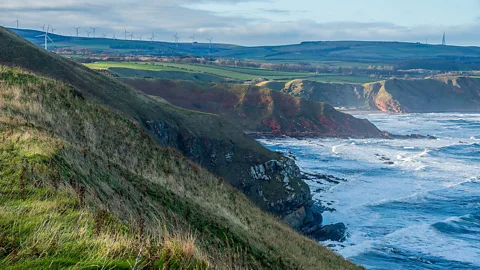
The one-mile coastal walk, launched to mark the 300th anniversary of James Hutton's birth, leads visitors across the Berwickshire cliffs to the outcrop where the Scottish geologist found the evidence that Earth was vastly older than anyone had imagined.
I am standing on the grassy cliffs above Siccar Point, a rocky outcrop on Scotland's east coast, looking out over the steel blue of the North Sea from the final viewpoint of the new Deep Time Trail. This gentle one-hour return walk leads to the site of one of the most important discoveries in scientific history – a place that transformed our understanding of Earth.
The route has been created to mark the 300th anniversary of the birth of James Hutton, the founding father of geology, who was born in nearby Edinburgh in 1726. Long before Hutton set eyes on Siccar Point in 1788, he developed his radical theory that the Earth's surface was formed by cycles of erosion and renewal. But it was this rock formation – known as Hutton's Unconformity – that provided the evidence he needed to convince the world.
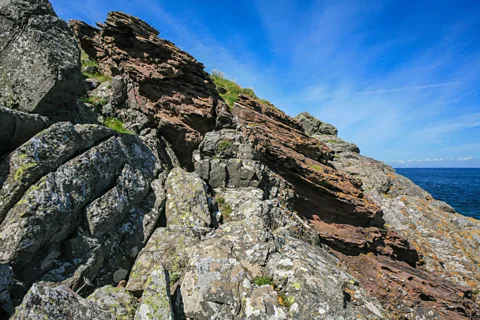
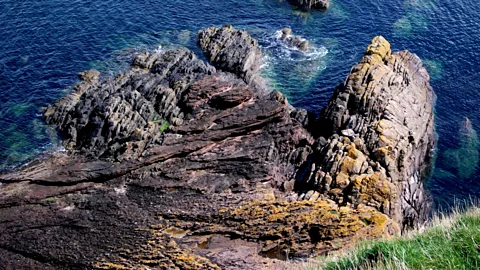
At Siccar Point, ancient rock standing upright are capped by much younger, horizontal layers of sandstone, revealing a vast gap in Earth's history that couldn't be explained by 18th-Century ideas. This immense span of geological time is now known as "deep time" – the concept at the heart of the new trail.
 Alamy
Alamy"Hutton discovered geological time," said Professor Mark Wilkinson, president of the Edinburgh Geological Society. By doing so, he laid a canvas for future scientific revelations. "You can't have evolution if you haven't got a lot of time. Hutton gave us that time."
Walking through deep time
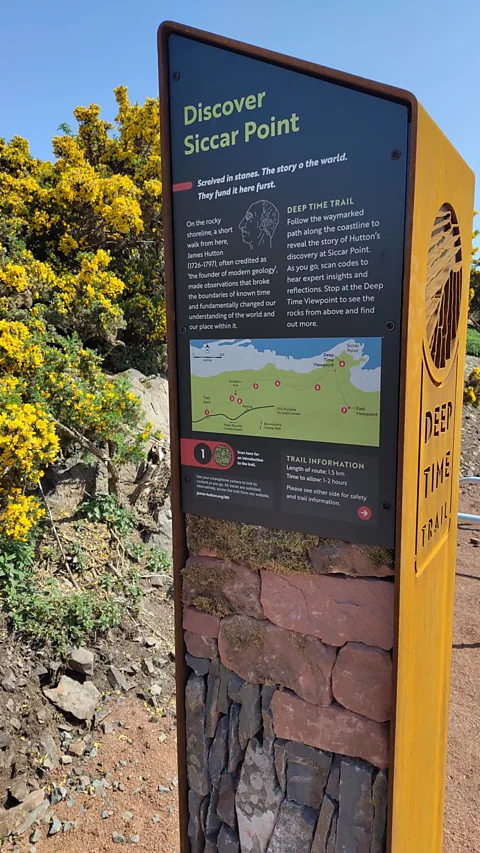
Starting near Pease Bay, the Deep Time Trail follows the cliffs past stones engraved with Hutton's writing and interpretation panels that link out to expert audio commentary. So, as you walk, the story of the Scotsman unfolds.
The first voice I hear on the audio narrations is Dr Elsa Panciroli, a scientist, author and former chair of the Scottish Geology Trust, welcoming me to the trail, and introducing Hutton and Siccar Point. "Geology can be challenging," she later tells me. "A lot of it takes place underground, on scales beyond our comprehension. So having a person to hook the story to, like Hutton, is really useful."
As I continue, I pass St Helen's Kirk, a red sandstone church that was already in ruins when Hutton visited 238 years ago. The kirk is surrounded by dykes (impressive stone walls) made of greywacke – a hard, dark-coloured variety of sandstone that also run up the coastline.
 Angus Miller
I make an exception to my usual no-phone rule while walking, as scanning the QR codes along the route unlocks a fascinating audio companion. As I stroll, I listen to stories about Hutton the polymath; farmer, chemist, naturalist. A figure of the Scottish Enlightenment, he established a social club with the economist Adam Smith and chemist Joseph Black, who discovered carbon dioxide. It was a time, the narration says, when "all sorts of new and intellectual ideas were being discussed" in Edinburgh.
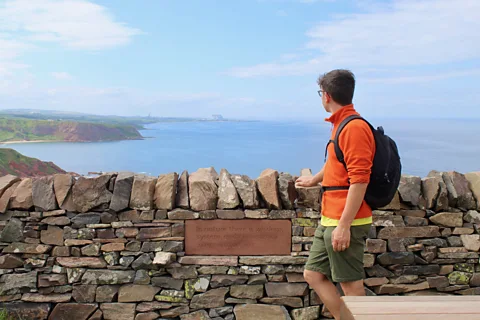
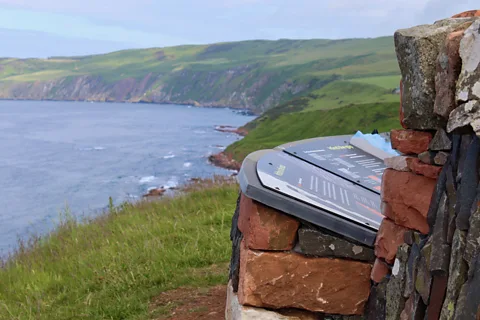
Walking on, a craggy dyke guides me to a bench with idyllic views. The scenery on Scotland's east coast is softer than that of the west, which is sculpted by the full force of the Atlantic. Looking along the coastline, rolling green hills and farmland descend to Borderland cliffs, which tip over and plummet to golden beaches and secluded coves. "In nature there is wisdom, system and consistency," reads a quote by Hutton, engraved in a brick and embedded in the wall.
Hutton took an observation-led approach to his research, something that was uncommon at the time. He turned his two nearby farms – between which the 51km James Hutton Cycle Trail now runs – into working laboratories and observed how soil washed away and renewed in gradual cycles.
He also travelled around Scotland gathering rock samples. On the Isle of Arran and in nearby Jedburgh, Hutton found other notable unconformities, but Siccar Point would be his prize example.
Hiking to Siccar Point
On the sunny June day of my visit, Siccar Point is backdropped by a blaze of sun-splashed blue, stretching into the horizon. Skylarks and swifts call over the lapping waves. Standing at the clifftop, I have the feeling of reaching a threshold: where water meets rock, and rock meets human comprehension. The stylish semicircular viewing point at the trail's end, which looks down on the rocks and explains how they changed the world, is built from the same stone and stacked to mirror the famous outcrop below.
 Stuart Kenny
When Hutton came here in 1788, he arrived by boat with friends Sir James Hall of Dunglass and John Playfair. It's easy to imagine them sailing along the coast, notebooks in hand, scanning the site. Hutton believed he'd find an unconformity here, washed clear by the sea, and was ecstatic with the result. After they docked, he explained the significance to his friends while scrambling around the rocks. Playfair later wrote that "the mind seemed to grow giddy by looking so far into the abyss of time".
When I look down from the viewpoint, it's clear that the famous outcrop is made from two types of rock. The dark greywacke stands almost vertical, sticking out of the ocean like defensive spears, while the red sandstone lies flat on top like a stack of pancakes.
More like this:
Hutton realised that for those darker rocks to have formed in horizontal layers, then tilted upwards, eroded away and buried beneath the younger sandstone, immense spans of time must have passed. So Earth, he concluded, couldn't possibly have been created in 4004BC, as was the Biblical view at the time. Rather, it must be unfathomably older.
In fact, we now know the greywacke rocks formed 435 million years ago on the floor of an ancient ocean. As tectonic plates slowly collided and that ocean disappeared, they were – as Hutton theorised – squeezed upwards into a mountain range. What remains are the eroded remnants of that range. The sandstone on top formed another 65 million years later when what is now Scotland sat south of the Equator.
 Stuart Kenny
The next interpretation board is in a quiet spot, looking out over boulder-strewn shorelines beyond Siccar Point that twist out of sight to the south. A QR code on the board links out to art about Siccar Point. "Sharp grey ribs rise up through horizontal bands of red sand," sings folk artist Karine Polwart. "A lost seabed lifted to the stars."
Bringing geology to everyone
One aim of The Deep Time Trail is to make Siccar Point more accessible to the public. Despite being an international pilgrimage site for geologists, it's still off most tourists' radars – even in Scotland.
"I went to high school in Eyemouth, which is literally just down the coast, but I didn't know about Siccar Point until I was at university," says Dr Katie Strang, geology curator at The Hunterian, University of Glasgow. "Hopefully this will lead to engagement with people who might not have thought about walking a geology trail. It's a beautiful part of the coast."
 Angus Miller
Looking out over Siccar Point, I feel a sense of immensity, standing on the stub of an ancient mountain range, on rocks hundreds of millions of years old. It's easy to understand why this landscape inspired one of science's greatest leaps. As Hutton concluded in his Theory of the Earth, there was "no vestige of a beginning, no prospect of an end".
--
If you liked this story, sign up for The Essential List newsletter – a handpicked selection of features, videos and can't-miss news, delivered to your inbox twice a week.
