Losing to win: The strangest game in football history

 Getty Images
Sometimes sporting rules can incentivise teams to behave in ways that appear to defy logic – by actively trying to lose.
It has been called the most extraordinary game of football ever played. Yet there was no global audience watching with baited breath, nor a championship title or coveted trophy on the line.
Indeed, before the two sides – Barbados and Grenada – stepped out onto the pitch, it appeared it would be a very ordinary match between two small nations to decide who would qualify to compete in the 1994 Caribbean Cup.
Barbados looked to be cruising to a 2-0 victory until the 83rd minute when Grenada pulled one back. Minutes later Barbados funnelled the ball to defender Terry Sealey, who passed it back and forth with his goalkeeper Horace Stout. Then Sealey intentionally blasted the ball into his own net to make the score 2-2.
Then things got even weirder. The Grenadians tried to do the same thing. They attempted to score in their own net only to find the Barbadians blocking the way. The Grenadians then went up the other end to try to score in the Barbadian's goal only to find their way blocked again.
They continued to try to score in both nets until the full-time whistle. In extra time the normal pattern of play seemed to resume, with the Barbadians eventually scoring the "golden goal" which ended the game and saw them win the match.
So what was going on? In an attempt to make the qualification stage of the cup more exciting, the organisers had decreed that there would be no draws. If a match finished tied, then it would go to extra time. A "golden goal" was introduced which, if scored, would immediately end the game. The golden goal would be worth two normal goals – a quirk expected to make little difference. Only it made all the difference.
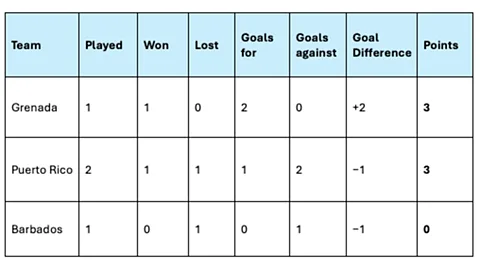
It was all to do with the previous matches in the qualifying group. Puerto Rico had beaten Barbados 1-0, but lost to Grenada 2-0. With only the top team going through to the cup proper, it meant Puerto Rico were effectively eliminated due to the goal difference.
Barbados, however, had a slim chance. If they could beat Grenada by two clear goals or more it would give them the points and the goal difference needed to overtake Grenada in the table.
 Kit Yates
At 2-0 in the 83rd minute they were sitting pretty, but when they conceded, the 2-1 scoreline would no longer be enough. Instead of trying to score in the remaining seven minutes, the Barbadians reasoned it would make more sense to take the game to extra time by scoring an own goal. This would give them 30 minutes to score the golden goal, which would be worth two. So they duly did.
When the Grenadians realised what their opposition were doing, they tried to score an own-goal themselves which would have seen them defeated, but not by a big enough margin to allow Barbados to overthrow them at the top of the group.
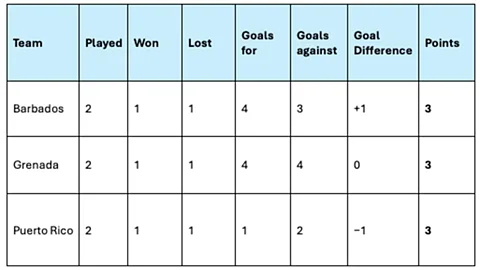
Scoring in the Barbadian net would also have given them the victory, which is what led to the Barbadians having to defend both goals. With Barbados netting the golden goal, they finished the match 4-2 winners. Their plus one goal difference, was enough to surpass Grenada's goal difference of 0 and leave Barbados top of the group.
 Kit Yates
This is a stunning example of a perverse incentive: a tweak in the rules which causes behaviour that is the opposite of what was originally intended. Perverse incentives are sometimes known as the "cobra effect". The name derives from a story which goes back to the era of the British Raj in India.
Bureaucrats in Delhi became concerned about the number of venomous cobras in the city. To resolve the problem, they placed a bounty on each cobra's head. Soon after, thousands of dead cobras began to pour in.
But rather than going out and catching cobras, some entrepreneurial individuals had set up lucrative cobra-breeding programmes to cash in. Once the British got wind of the ruse, they withdrew the bounty. With no viable income stream, the temporary serpent-breeders released the cobras in huge numbers.
In a sporting context, the cobra effect has reared its head on multiple occasions. At the 2012 Olympics, badminton players from China, South Korea and Indonesia deliberately attempted to lose matches to secure an easier draw in the knockout stages.
The England national football team had a similar incentive to lose their last group-stage game to Belgium in the 2018 World Cup, to ensure they were placed in the easier side of the knockout draw. England's manager made eight changes and his side duly lost the game, securing a route which led them all the way to playing the lowest-ranked team in the semi-finals (although there is no suggestion that England deliberately played poorly to lose the match).
More recently, a match at the World Cup 2026 between Austria and Algeria sparked conspiracy theories after it ended in a draw. The two teams entered the match knowing draw would give them a point each needed to send them both through to the next round, while a loss could knock them out. Both teams strongly denied deliberately playing for a 3-3 draw, but some fans voiced their scepticism after the match, even going as far as to describe the game as "scripted".
In American sports, teams with a worse record one season get earlier picks in the draft (the process by which teams select new players for the next season). As a result, there has often been an incentive for teams who aren't fighting to make it into the playoffs to "tank" by losing games late in the season.
More like this:
There is a branch of mathematics which potentially allows tournament organisers to avoid these perverse incentives. Game theory assumes that parties competing with one another are rational and act in their own self-interest, providing a framework for understanding how participants will act under a given incentive structure.
Indeed, in Major League Baseball, the National Basketball Association and the National Hockey League, a mathematical "anti-tanking" strategy is deployed to prevent teams from deliberately losing matches towards the end of the season.
Instead of the worst team getting the first pick in the draft, teams are entered into a lottery to determine who gets the first pick, dampening the incentive to finish bottom.
But it shows that, unless thought through carefully, rules can incentivise some strange behaviour, even from those you would expect to be rational.
--
If you liked this story, sign up for The Essential List newsletter – a handpicked selection of features, videos and can't-miss news, delivered to your inbox twice a week.
