Historic slipway dig at Buckler's Hard enters river

 Buckler's Hard Shipyard Trust and Maritime Archaeology Trust
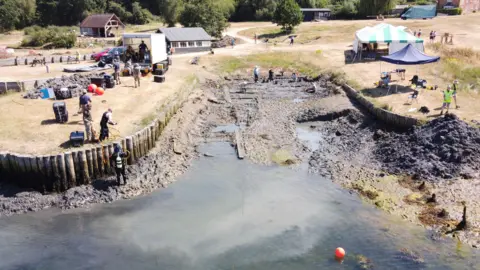
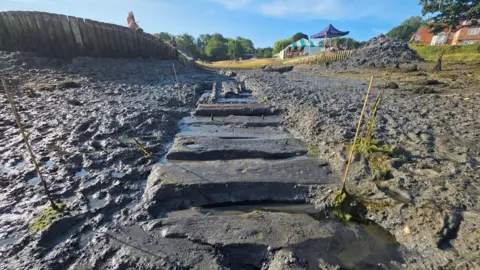
An excavation of a slipway from the 18th Century where ships for Lord Nelson's fleet were built is continuing after the structure was first revealed last year.
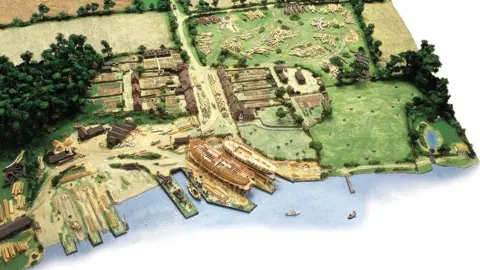
Buckler's Hard, the small hamlet in the New Forest where the slipway is located, was once home to one of the busiest private shipyards of the 1700s.
A team has been digging on the land and into the water, with divers working in the Beaulieu river at the lowest part of the slipway.
It is hoped the findings will help improve the understanding of shipbuilding techniques, infrastructure during the period, and the way the villagers lived.
 Beaulieu Enterprises Ltd
Last year, the slipway structure was revealed and the team is now hoping to find more in the lower intertidal area of slipway two.
They are also hoping to find locations of buildings and shipyard capstan positions on land.
Lauren Tidbury, from the Maritime Archaeology Trust, said: "I'm not sure I've ever actually been involved in a project before that involves all three elements of archaeology, so underwater, intertidal, on land, all at the same time.
"We've got to work with the tides, you know, and the times of the tides, and really maximize those low tides for intertidal work, and maximise the high tides for the diving work, and then also have a team of volunteers on land with the trenches here."
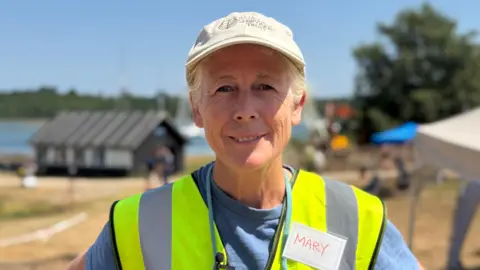
Mary Montagu-Scott, chair of the Buckler's Hard Shipyard Trust, said: "Last year, we did an archaeological dig on the upper half of the slipway, and we uncovered a full set of beams.
"These are the groundways that the ships were launched on.
"I'm very excited by the structures that we've found, mostly timber structures.
"We think [one structure] could predate the village of Buckler's Hard. This could be a 16th-Century building associated probably with a boatyard."
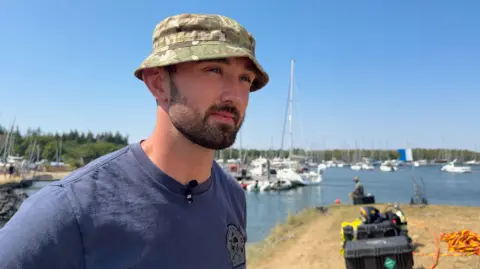
A team of army divers from Marchwood is helping with the dig, along with scuba divers.
Chris Brown, regimental Army diving supervisor for 17 Port Maritime Regiment, said: "My team are here to just assist with the dredging of the Buckler's Hard and seeing what we can discover.
"Whether that's exposing more of the timbers that are on the seabed, or discovering some of the lost artifacts from over those years.
"We're just going around basically sifting through mud until we find it all."
 Buckler's Hard Shipyard Trust and Maritime Archaeology Trust
The dig is being funded by the Buckler's Hard Shipyard Trust through donations and with help from the Beaulieu Estate.
A total of 55 wooden warships were built at Buckler's Hard for the Royal Navy in the 1700s, some of which were comparable in size to HMS Victory.
One of the most famous ships built at the site was HMS Agamemnon, which took part in the Battle of Trafalgar and was known as Lord Nelson's "favourite".
There are plans to place a replica of the vessel on the end of the slipway, as it would have looked under construction.
You can follow BBC Hampshire & Isle of Wight on Facebook, X, or Instagram.
