Nuclear site dig will change prehistory, says archaeologist

 Oxford Cotswold Archaeology
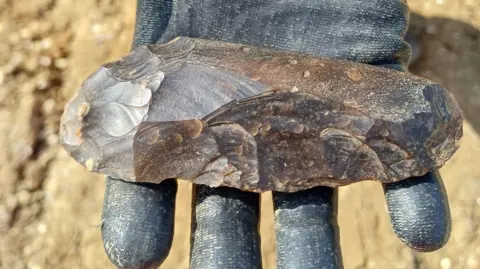
"This is the best site I've ever seen in my entire life - it's fantastic you see the huge ebb and flow of peoples from the Neolithic period onwards," says archaeologist Richard Mortimer.
He is working on a vast excavation ahead of the building of the Sizewell C nuclear power plant, near Leiston, Suffolk, where a "princely burial" was uncovered.
Mortimer said: "I believe what we're doing here will change the way we see prehistory particularly, but also to an extent the medieval."
The excavation stretches across 150 hectares (370 acres), with more than 200 archaeologists are working across 70 sites.
Suffolk's earliest farmers
 Oxford Cotswold Archaeology
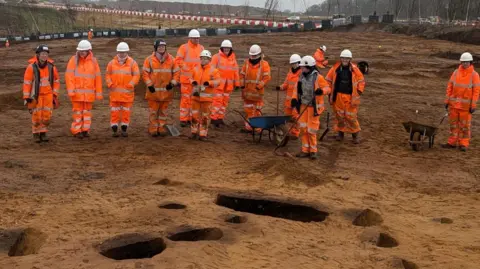
The vast majority of what archaeologists dig up are pits, depressions in the landscape dug out by ancient people and filled in with stuff, said Mortimer, who is a post-excavation project manager for Cotswold Archaeology.
While pits might not sound very exciting, they reveal where people, who left no other record except the things they left behind, were living and working.
At least 1,000 Neolithic (4000 to 2500BC) pits have been excavated so far and they have provided tantalising evidence of Suffolk's earliest farmers, just arrived from Europe.
These people would have moved around the landscape - coppicing wood for fires and buildings in one area and planting crops in another.
 Oxford Cotswold Archaeology
Mortimer said: "When they go there, they camp for two or three weeks and they put up tents.
"And the first thing you do when you're camping is dig a pit away from where you're living."
He believes these would have been the camp's toilets "because you're human and you're sensible and you don't want a latrine where you're living".
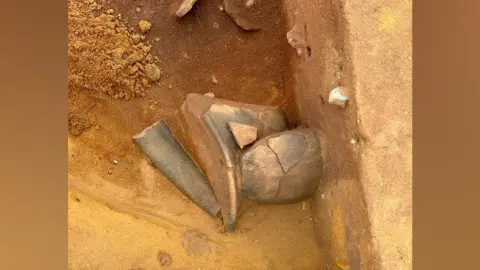
Nothing organic has survived in east Suffolk's acidic dry soil, but right beside the waste pits are pits with broken pottery and flints as well as hearth waste.
The evidence covers about 200 years - between (3700 and 3500BC) and then it disappears, suggesting farming techniques changed or the land became depleted.
Monks and huts
 Oxford Cotswold Archaeology
Another highly unusual find is an early Bronze Age hut (about 2000BC), which Mortimer described as "rarer than hen's teeth".
"I know of two others which are over in Bradley Fen, in north Cambridgeshire," he explained.
Similar to the Cambridgeshire example, its post holes were filled in with burned flints and pottery sherds after the hut burned down or was deliberately set fire to.
 Oxford Cotswold Archaeology
This landscape-scale excavation has given archaeologists the opportunity to excavate what was once medieval Leiston Abbey's farmland.
Mortimer said usually monastic excavations focus on the surviving buildings.
"Here, we are able to look at where their money comes from, where their people are, what their people are doing, what their lands are used for - and that's a new and exciting thing again," he said.
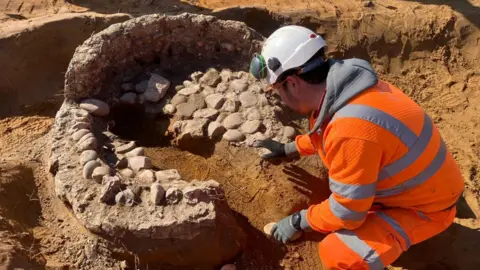
Hundreds of medieval ovens have been discovered, which Mortimer thinks were crop-drying ovens used for a cash crop such as flax to make linen and hemp to make products such as rope, rather than for wheat.
He said: "You don't need that much wheat to feed a few monks, but monks want money not just for fancy wine but to do good works."
 BBC/Rare TV
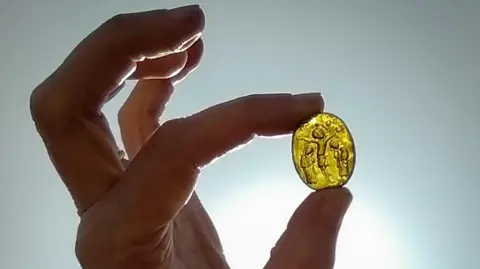
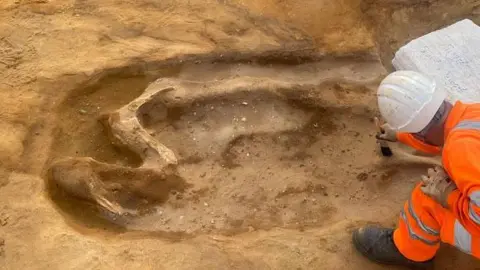
Previous stunning finds included an "extraordinary" hoard of 321 11th Century silver coins, as well as the Anglo-Saxon cemetery with its "princely" horse burial.
But Mortimer, said it is not the individual discoveries that he finds most exciting.
"It is the fact that you've got such a vast area of land which you've been able to dig in and open upon a huge scale in one location and you've seen everything that's in it - it's never happened before," he explained.
"I've been digging in East Anglia for 30 years - and 10 years elsewhere - and this is changing my view of everything I've ever done before in my life here, and that's fantastic."
Visitors will be able to find out more about the discoveries and the stories they tell at three free open days at the site running until Saturday.
Many of the excavations' archaeologists will be taking part in Sizewell C's Big Archaeology Showcase at the Sizewell Visitor Centre.
There will be artefacts, family activities and talks and virtual reality displays, one a tour with headsets and the second in a projection dome.
Do you have a story suggestion for Suffolk? Contact us below.
Follow Suffolk news on BBC Sounds, Facebook, Instagram and X.
