How weight lifting can help you stay healthier as you age

 Getty Images
All exercise helps you live longer, but strength training helps you live better – here's how you can get stronger.
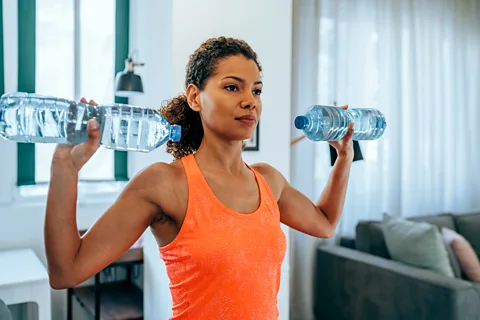
If you watched me carry my shopping into the house the other day, you'd have caught me behaving a little strangely. Clutching a two-litre bottle of water in each hand, I started doing squats.
It's part of my mission to introduce more strength training into my day-to-day life.
And there's good reason why I should. When it comes to staying fit, my circle of friends tend to focus on cardio. We count our steps, track our runs, cycle at the weekend. Some of us even enter the occasional half-marathon or triathlon.
But while aerobic exercise like this can keep you healthy and help you live longer, experts say that adding in strength training can ensure you live a better quality of life as you age.
"Strength is the neglected sibling at the health dinner table," Stuart Phillips, a researcher in muscle physiology at McMaster University, Canada, tells me.
I've therefore been looking into the benefits of resistance training and how best to add some into our lives.
The biggest gains
When it comes to strength training, also called resistance training, the biggest health gains come when you are just starting out compared to doing nothing at all, says Jess Gorzelitz, an epidemiologist at the University of Iowa. "The riskiest group are those who do nothing… That's a big message for people who are new to this."
Initially, you should aim for two sessions per week, lasting between 20 to 30 minutes each, says Phillips. He suggests doing any of the following with several repetitions in a set and repeating the set two to three times:
• Lower Body: Sit-to-stands, squats, step-ups, or lunges.
• Upper Body Push: Wall push-ups, standard press-ups, or chest presses.
• Upper Body Pull: Rowing movements using a resistance band or machine.
• Trunk/Core: Planks or loaded carries (which involves walking while holding weights).
As you train more you can look to increase the amount you do to get further benefits. If using your body weight feels too easy for certain exercises such as squats, you can consider adding some light weights.
Focus on big movements
You don't necessarily need to set foot in a gym or any special equipment to start resistance training. (BBC Sport explains how to work out at home without equipment.)
Gorzelitz, who is a powerlifter herself, says we can easily do bodyweight squats using a chair. A couch or bed can help us to practice sitting down and standing up in a controlled manner, whilst household items like cans of food or bottles of water can be used for bicep curls.
 Getty Images
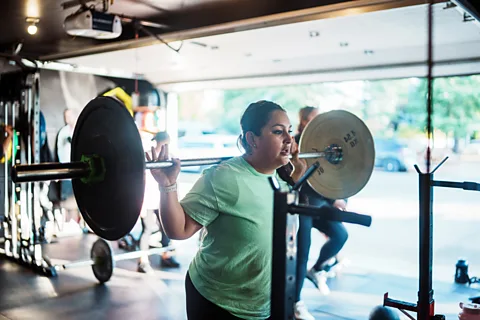
For those who do visit the gym, Gorzelitz recommends focusing on the following "big three" movements that target the entire body:
• Barbell back squats
• Bench presses
• Deadlifts
She also suggests trying shoulder presses as "your back can never be strong enough". Back strength is key for posture, preventing back pain and improving spine stability. (Watch the video below to find out why squats can also give your brain an unexpected boost.)
Challenges yourself
If your workout feels too easy, simply add more resistance, repetitions or additional sets, because over time as we build strength, our body will adapt to challenge. "That does not need to be dramatic. Small increments repeated over months are where the magic lives," says Phillips. When you start out, you may only be able to hold a plank for less than 15 seconds, for example, but you'll gradually be able to increase this as you get stronger.
The level should feel challenging but still manageable, adds Phillips. "You do not need to crawl out of the gym like a wounded animal. Progress gradually," he says. It's better to be consistent than try to do too much. If you do lose motivation, remember that as with all exercise advice, small bursts are better than none.
Regular muscle strengthening exercise will give you a better chance of living longer. It can also lower your risk of cardiovascular disease, cancer, diabetes and premature death, according to a large review of studies. It found that just 30-60 minutes per week of muscle strengthening activities was linked to a 10-17% reduction in all-cause mortality.
Health benefits increase when we do more according to another large recent study, which found that 90 minutes to two hours of resistance training per week reduces the risk of an early death by 13%. And those who do both resistance training and cardio have a 58% lower risk.
"A simple way to put it is this: aerobic fitness likely helps you live longer, but muscle strength helps you live better while you are here. Ideally, we want both," says Phillips.
Strength train at any age
We benefit whatever age we are, research shows. Gorzelitz has found that adults aged over 70 who took part in regular weight training had a lower risk of dying compared to those who did none. "In particular as we age, we can see improvements in functionality, physical function and muscle mass," says Gorzelitz.
More like this:
Building extra muscle gives you reserves for when you get older, says Phillips. "When illness, injury, surgery or ageing arrives, and they usually do, you want more in the tank. I think of resistance training as a pension contribution for your future self," he says.
There are mental health benefits too. Gorzelitz says that going to the gym provides her with a clarity and calm. "It's the release of getting to the gym and working out a lot of physical tension and anxiety."
The key, say both Gorzelitz and Phillips, is to find exercises that you can do easily and fit in with your day-to-day life.
As I already do plenty of cardio, I can now be found doing the plank and some squats before my morning coffee or between meetings. I aim to increase this gradually and know my future self will thank me.
*Melissa Hogenboom is a senior health correspondent at the BBC and author of Breadwinners and The Motherhood Complex. She is melissa_hogenboom on Instagram.
--
For trusted insights on health and wellbeing, sign up to theHealth Fix newsletter by senior health correspondent Melissa Hogenboom who also writes theLive Well For Longer andSix Steps to Calm courses.
