Satellite killers: What a war in space might look like

 Getty Images
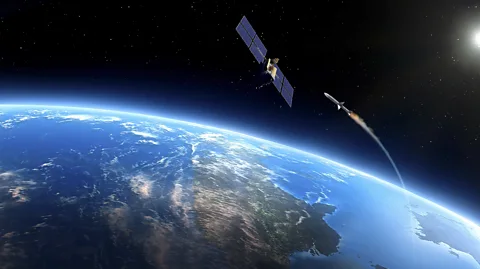
The satellites that orbit Earth have remained largely untouched in modern conflict. But in the 21st Century, space may no longer be a safe haven.
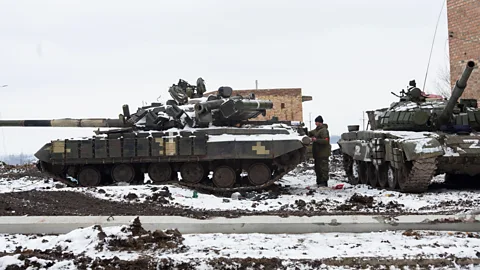
Around 03:00 on 24 February 2022, thousands of satellite modems across Ukraine and Central Europe went offline. A few hours later, Russia's invasion of Ukraine began.
"The first strike of the Russia-Ukraine war was not the tanks rolling into Ukraine, but a cyberattack against a commercial satellite system, which was later attributed to the Russian state," says Kari Bingen, director of the Aerospace Security Project at the Center for Strategic and International Studies in the US. "Why would they do that? They wanted to degrade the Ukrainian military and government's ability to communicate."
In modern warfare, the first shot may involve not a rifle or a missile, but a line of malicious code aimed at satellites in orbit on Earth.
During the Cold War, the US and Russia faced off against each other on land, in the air, under the sea and – also, largely unnoticed – in space. But now tensions are growing again in orbit, and this time, in the public eye. The stakes are high; a $626bn (£479bn) space economy could be at risk.
In early February, it was revealed that two Russian satellites have likely intercepted the communications of at least a dozen European ones since Russia's invasion of Ukraine in 2022. Such interceptions may have allowed Russian intelligence services to read the sensitive data they transmit, or hypothetically, even to take control of the satellites.
Over the last few years Earth-based telescopes and orbital cameras have spotted two Russian satellites, Luch-1 and Luch-2, making a number of suspicious manoeuvres in orbit. In particular, they have been seen making close approaches to Europe's most important, if elderly, geostationary satellites. These include Intelsat 39, which orbits high enough above the Earth that it appears to be stationary above a single point on the Earth's surface. Such a lofty perch makes them ideal platforms for communication, navigation and military purposes. And a prized potential target for a would-be adversary.
Western countries are having to make plans to thwart such attacks if conflict with another power like Russia takes place.
"When one satellite is coming really close to another in space, it's a game of who's going to do the first manoeuvre, and then how the other satellite reacts to that," says Norbert Pouzin, senior orbital analyst at Aldoria, a French satellite tracking company
This dance has been compared to dogfights – aerial battles between fighter planes. Except they take place in space.
 Getty Images
This recent behaviour seems to be an extension into space of Russia's hybrid warfare – conflict that involves non-military tactics, such as disrupting communications systems. Satellites are seen by Russia as the Achilles heel of the United States and its allies, as they have become so dependent on them. Disrupting them could cause massive damage to civilian and military infrastructure.
"This is not new behaviour by the Russians, whether it's in space or on Earth," says Juliana Suess, an expert in space warfare at the Royal United Services Institute. "We keep seeing this sort of testing of boundaries, whether it's drones entering Polish airspace or Russian satellites manoeuvring close to other communication satellites, whether they belong to Western governments or are commercial satellites. We've seen them do this for over 10 years."
From the Cold War onwards, counterspace weapons have been developed to destroy, disrupt or degrade satellites and space-based infrastructure to gain military advantage over an opponent. These range from cyber-weapons like the one used in this attack, through to jamming and spoofing a satellite's signals, to the more sci-fi-sounding weapons such as lasers, or electromagnetic pulses (EMP). These can be used to blind or destroy a satellite from the ground, air or even from another satellite that has manoeuvred close to its target.
Then there are kinetic weapons such as missiles launched from the ground or air, or dart-like objects fired from another spacecraft, which can also destroy a satellite.
"We are seeing cyber [attacks on satellites] on a routine basis; electronic warfare – jamming and spoofing – is prolific on the battlefield of Ukraine, and China has fielded an enormity of jammers in the region, embedded with their forces," says Bingen. "The Iranians have fielded jammers and frankly you can now buy a low-powered GPS jammer off eBay."
Some countries have tested actual physical weapons in space, such as missiles to disable a satellite in orbit. Bingen explains that the technology was incubated in the Cold War by the US and Soviet Union. Then China's missile test in 2007 changed the game, she says, when it launched a missile at a dead weather satellite, which created thousands of pieces of debris that were predicted to stay in orbit for seven decades.
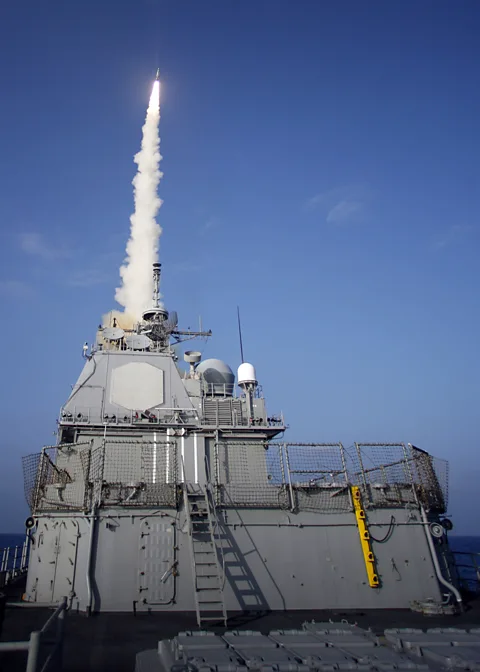
In 2008, the US publicly announced an operation called Operation Burnt Frost. "It used a missile defence interceptor launched off a ship to take down a malfunctioning American satellite," says Bingen, who explains this was done for safety reasons.
Other countries have joined this in-space arms race. India has demonstrated the same capability to use a missile defence interceptor to take down a satellite as the United States and China. "The Russians did it as recently as November 2021, three months before they invaded Ukraine. Was that signalling [for] us, or was it the military conducting tests?" adds Bingen.
 Getty Images
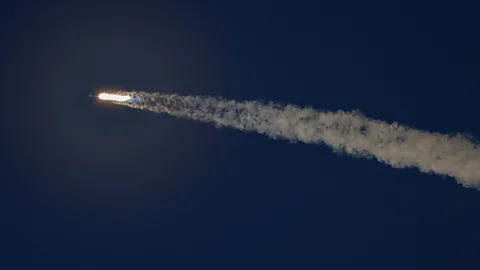
Pouzin explains that there is also speculation from US officials that Russia has test-fired some kind of co-orbital weapon. This isn't a satellite, but some kind of bullet launched from a satellite in space. But this has been denied by the Russians, he says.
Suess suspects there may be a darker reason for the testing of this technology. "They [the Russians and Chinese] know that we're watching these assets, and they know we can see them manoeuvre close to them," she says. "So they are showing off their capability to make sure we can't feel safe in any domain, and space is no different."
"The question is always, why are they doing it?" says Bingen. "Are they signalling [to] us? Are they testing technology, operational procedures and tactics? Or gathering intelligence on us for the day when they want to do this for real? We just don't know. We have to plan for the worst-case scenario."
Or at least, this was the question experts were asking. Then the Russians seemed to become serious, just before the Ukraine War.
Nukes in space
In 2022 Russia launched Cosmos 2553 into space weeks before the invasion of Ukraine. Two years later the United States announced that the satellite could be part of a Russian programme to develop a space-based nuclear weapon. This bomb could, it's believed, be used to destroy entire satellite networks, such as SpaceX's vast Starlink system, which has supported Ukraine's response to Russia's invasion. Russia has denied this.
The idea of nuclear weapons in space is not as far-fetched as it may sound. In 1962, the United States exploded a nuclear bomb in orbit to see if it would cause an electromagnetic pulse (EMP). These pulses can disable electronics, disrupt radio communications and create artificial radiation belts to neutralise satellites. The test, known as Starfish Prime, did cause an EMP – and one that was much larger than expected, causing several satellites to fail in the days and months after the explosion.
Further, smaller-scale American and Russian tests followed. Then, in 1964 the Partial Test Ban Treaty outlawed the testing of nuclear weapons in space.
"Looking at what we know and what's been discussed there is no current nuclear-armed satellite in orbit at the moment," says Suess. "They could certainly build one. I think any nuclear-capable state could."
But are the Russians really planning to build one? Even if they were, Suess argues, it is unlikely they will actually use it. Their ally, China, is growing as reliant on space technology as the US, she says. "It only makes sense for Russia as a last straw," Suess says.
The debris caused by such an explosion may even trigger the Kessler effect. Suess explains that you could end up inadvertently preventing access to space for months if not years due to the radiation.
 Getty Images
What might the future of counterspace weapons look like?
"We do know that the Chinese programme is advancing quite fast in the development and the testing of new technologies and new hardware in space," says Pouzin. He explains that, based on which projects are being funded by government agencies in the West, a great deal of money is going into developing small "guardian" satellites. These would serve as guardians of a highly valuable and vulnerable satellite or could be sent to inspect another satellite, he says.
More like this:
Japan, France, India and Germany have all "indicated" they plan to, or are already building, such "bodyguard" satellites.
"Any country that has a missile and has basic orbital positioning information, like Iran or North Korea, and knows that satellites follow predictable trajectories can launch a missile to intercept a satellite," says Bingen.
Whereas shooting down one – or even a handful – of satellites in a constellations such as Starlink would not disrupt the entire network.
A nuclear weapon may not be the only option available, however.One idea is to use 935 small, synchronised jammers carried by a fleet of drones, balloons or aircraft. Research from China suggests that these could form an electromagnetic barrier powerful enough to block Starlink from over an area roughly the size of Taiwan.
"The danger of a miscalculation by one of the space powers is only going to increase," says Suess. "If there is a satellite break-up, and there is a suspicious satellite not that far away, the question will inevitably be… was this an act of deliberate, malicious interference or an accident?"
--
If you liked this story, sign up for The Essential List newsletter – a handpicked selection of features, videos and can't-miss news, delivered to your inbox twice a week.
