I tested AI glasses in Paris. Here’s what they got wrong

 Getty Images
Wearable AI can help travellers navigate cities, translate menus and fundamentally transform travel. But a weekend in Paris showed me the trade-offs behind the convenience.
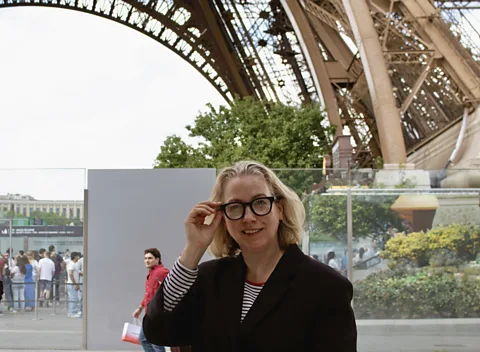
In Paris, I find myself standing beneath the Eiffel Tower having an argument with my glasses about how tall it is.
The first time I ask, the answer comes back as 330m. A few minutes later, I try again. This time, the glasses confidently tell me, through a tiny speaker near my ear, that it is 324m tall. This is not the kind of discussion I had expected to be having during weekend testing Ray-Ban Meta AI glasses as a travel companion.
This small discrepancy in height – the official Eiffel Tower website lists it as 1,083ft, or 330m – throws up some big questions for me. If I can't trust the glasses to tell me the correct answer to something easily verifiable, what can I trust them with?
Why wearable AI is becoming mainstream
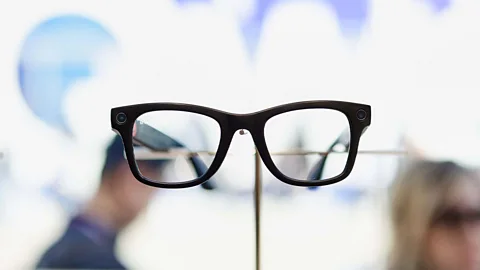
Launched in late 2023 by Meta and EssilorLuxottica, the parent company of Ray-Ban, the glasses are part of a fast-growing category of AI wearables that is moving from novelty to mainstream use. More than seven million Meta smart glasses were reportedly sold in 2025, and rival products from companies like Google and Samsung are now in development. Apple is also widely reported to be working on smart glasses of its own.
The promise for travellers is immediately appealing: live translation, help with directions, hands-free photography and quick answers about restaurants, landmarks, menus and whatever else happens to be in front of you. In theory, they combine the functions of a guidebook, translation app, smartphone and audio guide in a single wearable device.
As someone who spends too much time in new places navigating with Google Maps and staring at her phone, I am excited to see whether they make me feel a little less like an awkward lost tourist as I wander around Paris.
 Laura Hall
But I am also uneasy. Camera-equipped smart glasses have attracted growing criticism for the way they can be used to film and photograph people without their consent. I wonder whether this particular type of travel tech will help me connect more deeply with the city, or mark me out for all the wrong reasons.
A travel guide for your ears
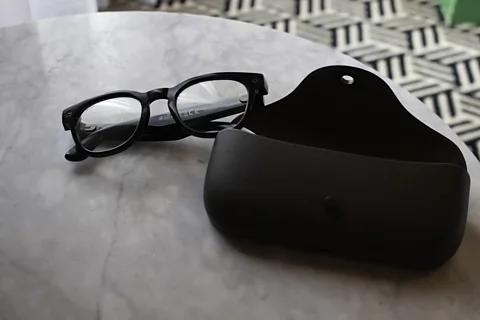
The Ray-Ban Meta AI glasses I packed for my weekend trip to Paris are chunky and black-framed. They look like a standard pair of glasses but I find speaking to thin air a little strange, so I hide my mouth behind my hand, as if I am about to cough, before asking a question.
Unlike augmented-reality headsets, the glasses do not project information across the lenses. Instead, they use cameras, microphones, speakers and voice AI to create a kind of audio-first layer between you and the world around you. Wearers can make phone calls, take photos, record videos, listen to music and podcasts, translate text and speech, ask questions about what they are seeing, set reminders and request recommendations.
I begin by asking the glasses to give me directions as I walk with my travel companion from the Gare du Nord through Le Marais and down to the Seine. They quickly send the route to the maps function on my phone and alert me to open it. I suppose it's technically what I asked for, but it means I have my head down, staring at my phone, instead of looking around and enjoying the city, which is not what I hoped for.
That said, the experience improves dramatically when realise I can set a route on Google Maps and follow voice directions through the glasses, using them as a headset rather than a navigation tool. That works surprisingly well, and it's better than wearing headphones because I can also hear everything around me.
 Laura Hall
At Place de la Concorde, I ask for a brief history of the square. The glasses tell me that Louis XVI and Marie Antoinette were executed here when it was called Place de la Révolution. So far, so good. Later, my travel companion asks me how long it took to build the Louvre. I tell her, via the power of the glasses, that it took more than 800 years.
This becomes one of the device's most useful functions, acting like travel guide for my ears, able to pull up information quickly and efficiently without forcing me to scroll through my phone or flick through a guidebook. Instead of looking like a lost tourist, I can keep walking while satisfying my curiosity.
I try out some other applications on the go. I ask it to convert currencies to give me a ballpark idea of prices, and it is successful. The translation function works well too, when I look at a French newspaper and ask for an English translation. Later in a café, the glasses provide both a verbal summary of the menu and a line-by-line translation. As someone who speaks French, I find myself nodding along.
Useful, but not always trustworthy
But at the Eiffel Tower, things start to unravel. Suddenly I'm questioning everything that has happened so far today.
The issue isn't the size of the mistake so much as the confidence with which it was delivered. When I ask where the information came from, the glasses respond vaguely: "I get my information from my training data, internet searches and other sources." This leaves me wondering how I am supposed to judge which answers are reliable. All sources seem to be treated as equally valid, whether they are accurate or not – a known AI issue in other areas. Still, it handles most of my basic travel-guide-style questions well, and when I later verify the answers, it is correct in all other cases. The technology is useful – provided I have time to check the information that matters.
 Laura Hall
Some features are less convincing. While I can take photos and videos from my point of view, I can't zoom or focus manually, and unless the glasses sit perfectly level on my face, the results can be slightly crooked. I far prefer the control and options available on a smartphone camera.
The object-recognition feature is similarly mixed. Sometimes it identifies what I am looking at accurately, while other times it just offers vague observations such as "you're looking at a view of a street, maybe in Paris, with tall buildings". Which is true, but not exactly revelatory.
The darker side of travel tech
And then there are the privacy issues. Wired has reported instances of Ray-Ban Meta AI glasses being used to record women without their knowledge or consent, earning the glasses the ugly nickname "pervert glasses". Swedish newspaper Svenska Dagbladet also reported that workers reviewing data from Meta smart glasses had seen intimate and sensitive footage, including people who appeared not to know they were being recorded.
More like this:
Meta's own privacy policies state that voice interactions can be stored and processed using machine learning and trained reviewers to improve its products. Its voice privacy notice also says transcripts and stored audio recordings may be kept for up to a year unless users delete them sooner.
Those concerns are serious. But as a traveller, my biggest reservation turns out to be something else. The longer I wear the glasses, the more I feel they undermine one of the things I value most about travel.
 Laura Hall
In years gone by, if I was lost, I might have asked a stranger for directions or relied on a hotel concierge for recommendations. I might have wandered aimlessly in the city and discovered something through serendipity.
With the glasses, I don't need to ask anyone anything, because the glasses handle it all.
The technology deals with directions, translation, information and recommendations. It reduces issues and increases convenience. But the glasses don't live up to the promise of helping me connect well to the world around me. If anything, they sometimes place another invisible layer between me and the city.
This feels like part of a wider issue in travel technology, where every innovation promises to make travel easier. Yet some of the most memorable moments on a trip happen precisely because things don't go according to plan.
It has me thinking about what I really want. Swapping accidental discoveries and human interaction for convenience feels like too much of a trade-off.
The verdict
I can see the appeal for trips where language, logistics or cultural context are more challenging – for example, an upcoming trip to Japan, where translation and basic travel-guide functions could genuinely improve the experience. But for future trips around Europe, where I already have some familiarity with the language and customs, I'm less convinced they would add enough value for me. They might also make sense for business travel, when time is limited and convenience matters. That said, I would still verify important information, and I remain uneasy about what Meta is doing with my data.
My advice is to stay conscious of how and why you're using them, and what you want to get out of your trip in the first place. As wearable AI becomes increasingly woven into daily life, travellers will need to think carefully about what they want technology to do for them. The glasses excel at making some elements of travel easier. The question is whether easier always means better.
--
If you liked this story, sign up for The Essential List newsletter – a handpicked selection of features, videos and can't-miss news, delivered to your inbox twice a week.
