'The moment I made eye contact with a whale'

 Marcia Riederer/ Ocean Photographer of the Year
In a series of striking photographs, Marcia Riederer captures the elegance and curiosity of the elusive dwarf minke whale.
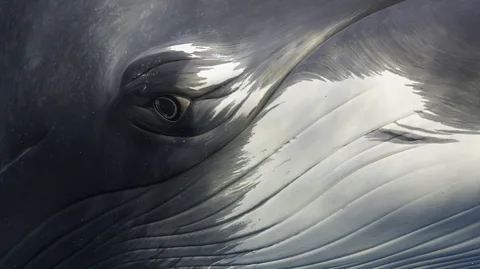
A whale the size of a large van stared directly at Marcia Riederer as it circled the rope she was holding onto in the water. "It felt like time slowed down… like it was looking into my soul," recalls Riederer. "Its eyeball was the size of my head and it was really looking at me."
Riederer, a Brazilian photographer, had a life-changing experience in June 2023 when she made eye contact with a dwarf minke whale in Australia's Great Barrier Reef.
"I had goosebumps. It was an intense and just amazing feeling," she says, adding that she cried during the encounter. "I felt like I'd been chosen because it came straight to me."
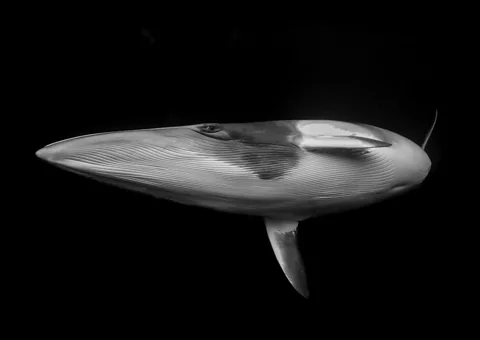
Riederer captured this powerful encounter on camera. With its fine details and smooth lines, her black-and-white image more closely resembles a drawing or watercolour painting than a photograph.
For her eye-catching photo, Riederer was named best fine art photographer at the prestigious Ocean Photographer of the Year awards in London in September 2025.
At the awards ceremony, judge and deep ocean photographer Laurent Ballesta said the word that immediately came to mind when he saw Riederer's photograph was "harmony".
"The author of The Little Prince, Antoine de Saint-Exupéry, said that 'a work of art is perfect not when there is nothing else to add, but it is perfect when there is nothing to remove'. And this is so true of this image," Ballesta said when presenting Riederer with her award. "There is a kind of gentleness. When I see it, I would just like to sink with it."
 Marcia Riederer/ Ocean Photographer of the Year
The Great Barrier Reef is the only place in the world where dwarf minke whales are known to congregate predictably each year, during June and July. Alastair Birtles, a professor of marine biology at James Cook University in Australia, has spent more than three decades studying these whales and says we still know very little about their behaviour and migration patterns.
"Nobody knew they were in the Great Barrier Reef until the 1980s," he says. Birtles thinks the whales gather along the outer edge of the reef each year to learn to court and mate.
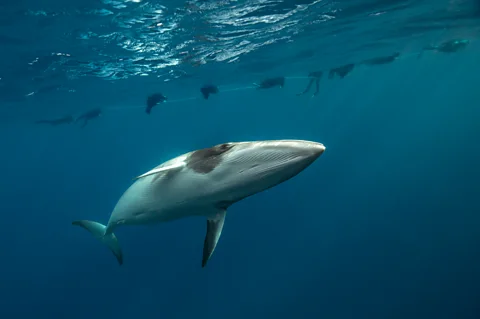
"We see mixed groups of mature males and females and they and the many adolescent animals are doing belly presentations to each other," he says. This is when a moving whale turns on its side and presents its white belly to another whale – and sometimes to a person or object such as a dinghy.
Belly presentations are a courtship behaviour but they also allow the whales to utilise their binocular vision and get a better view of their surroundings. When interacting with humans, Birtles believes the whales move in this way because "they're wanting to get a really good look at you".
It was something Riederer sensed herself. "They are so curious; they want to look at us just like we are looking at them," says Riederer. "They come and they really stop to look at you."
Riederer spent several days in the water with a total of 40 inquisitive whales. "There were eight whales at the same time and they just kept circling us. One came so close – it was at arm's length," she says.
Despite the proximity, she did not reach out. In Australia, it is illegal to touch a dwarf minke whale as this could harm both swimmers and the whale. A startled whale could injure a swimmer or itself by, for example, becoming entangled in equipment. Touching the whales could also lead to disease transmission, from human to whale and vice versa.
During Riederer's trip, "the whales came to us which made it even more special," she says.
These ocean giants glide through the water with incredible precision. "They never touched anyone and were very aware of what was going on in their surroundings," Riederer says. "They are very gracious in the way they move. It was definitely not intimidating."
The encounters with dwarf minke whales are "the most intense animal-human interactions that you can possibly think of, because they are so curious about us," says Birtles. "They just keep coming back and having another look – and they come so close and stay so long.
"It is a life-changing, very powerful experience. People would burst into tears when they were trying to tell me what it felt like, to have had a five-hour encounter with an animal like that," he says.
 Marcia Riederer/ Ocean Photographer of the Year
Growing up to around 8m (26ft), the dwarf minke whale is the second smallest whale in the world. They have a distinctive sound, which has been dubbed the "Star Wars vocalisation" and likened to the iconic "da-da-da-da-dang" whooshing sound of a lightsaber.
They are an incredibly elusive species and there are currently no accurate population estimates. "We have no idea of their total abundance… we know so little about them," says Birtles. The whales went unnoticed in the Great Barrier Reef until the 1980s and two decades later, it remained a mystery where they headed next.
In 2013, Birtles and other scientists at James Cook University started tagging some of the whales. One whale called Spot was recorded migrating over 7,000km (4,350 miles), down the Australian East Coast, round Tasmania and then down to sub-Antarctica.
"They do the same journey that the humpbacks do, even though the humpbacks weigh 40 tonnes and are 17m (56ft) long. Minkes are tiny (7-8m and weigh 4-5 tonnes) and yet they do the same migration," says Birtles. They feed on krill and lanternfish in the Southern Ocean.
Changing currents and temperatures are a major threat to this whale species, says Birtles. "The dwarf minke whales are likely to be much closer to their biological limits of their energy reserves because they're a small whale doing a huge migration."
 Marcia Riederer/ Ocean Photographer of the Year
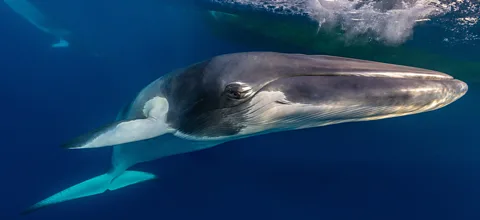
Birtles describes Riederer's photos as "technically wonderful".
"You can see the sharp snout which gives the whale its name (Balaenoptera acutorostrata which means sharp-snouted whale), the eye quite clearly staring at you, its dark throat patches and the lovely contrasting patterns of black and white and grey," he says. "It is like a watercolour painting. It's like somebody has done delicate brush strokes."
More like this:
Photographers such as Riederer play a vital role in helping scientists carry out their research, Birtles adds. "I'm only one person in the water, and I will not see all of the whales and I may not get good enough shots to identify them."
"We could not do this research without the help of the dive industry, and the photographers on board," he says.
Riederer hopes that her photos will inspire people to feel more connected to nature. "When you look in his eye, you see he's a creature just like us," she says. "These whales also feel afraid, curious and hungry. They have places to go, they do their best to look after their offspring. I think we should give them all the respect and opportunities that we wish for ourselves."
--
For essential climate news and hopeful developments to your inbox, sign up to the Future Earth newsletter, while The Essential List delivers a handpicked selection of features and insights twice a week.
