Lost shipyard has bones around the world

 Viola Trust
What links Father Ted, James Bond and an abandoned port in remote South Georgia?
The answer, surprisingly, is a shipyard found nine miles inland in the market town of Beverley, East Yorkshire.
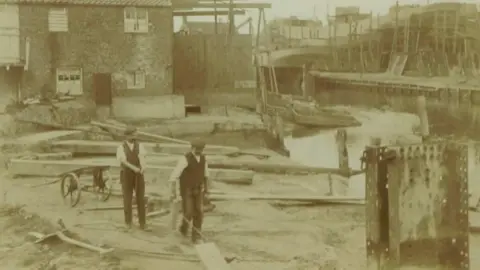
Today, it is a quiet mooring beside an industrial estate. But on the eve of World War One, the Grovehill Shipyard, on the banks of the River Hull, was a powerhouse of the British trawler-building industry.
Among the ships built there were the MV Plassey, the wreck seen in the opening credits of the TV comedy Father Ted, and the Thorina, a trawler shown being blown up at the beginning of the Bond film For Your Eyes Only.
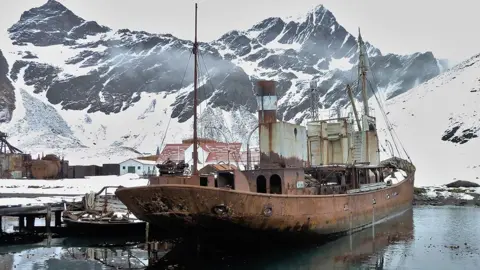
Perhaps better-known today is the Viola, an Edwardian steam trawler now beached in South Georgia, almost 8,000 miles (12,500km) from home.
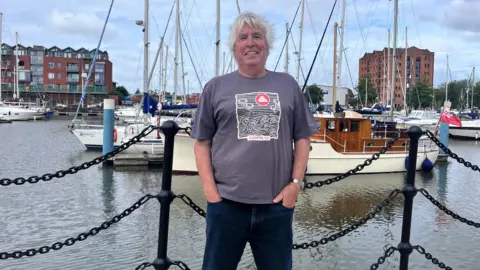
"People come up to me and say, I read about this trawler, which it said was built at Beverley, but that must be wrong, it's miles inland?" says Dr Robb Robinson, a maritime historian.
"And I'd say, no, they were built there.
"And then I'd tell a tale about them being floated down the river. It's just something quite different, really."
The shipyard of Cook, Welton and Gemmell was established in Hull in the 1880s, but moved to Beverley in the early 1900s.
As war broke out, the shipyard soon began playing a part by building minesweepers, anti-submarine patrol boats and tugs.
One trawler that started life here was the Viola. It was built for fishing in the North Sea, but became an unsung hero of the Great War.
The Viola was requisitioned by the Admiralty to become one of the first vessels to use depth charges.
"It was floated down the river Hull, and fitted with its engines," says Robinson. "And it sails off to war.
"During the course of the war, it was involved in the sinking, almost certainly, of a couple of U-boats."
The Viola was later used as a whaling ship and scientific support vessel in the southern Atlantic Ocean.
It survives to this day, though you would have to travel a long way to see it. The vessel is beached in the abandoned port of Grytviken in South Georgia.
In 1982 it was one of the vessels targeted by Argentine scrap metal merchants in the landing that sparked the Falklands War.
 Robb Robinson
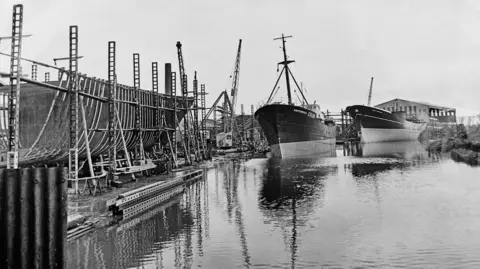
The Viola is one of hundreds of steam trawlers built in that period from about 1902 until the end of the First World War.
Over the years, attempts have been made to bring the Viola home.
A trust was set up to raise the £3.5m required to restore the ship and return it to Hull, only for the plan to be cancelled due to rising costs.
Instead a "Virtual Viola" has been created by the Glasgow School of Art.
 Mirrorpix via Getty Images
Cook, Welton and Gemmell closed in 1963, but its legacy lives on.
Among its most famous ships were the Royal Research Ship William Scoresby, which helped to research El Nino – the natural weather pattern that forms in the Pacific Ocean and can drive extreme weather around much of the globe.
During World War Two, the ship was pressed into service for Operation Tabarin, which, according to Robinson, was something of a "cloak and dagger" operation in the South Atlantic aimed at preventing Argentinian claims to sovereignty of various islands within the Falkland Islands Dependencies.
Robinson adds: "We'll go around the world and you'll find the sort of bones or the wreckage of Cook, Welton and Gemmell trawlers that survived."
CORRECTION (4 August 2026): A previous version of this article stated that the Virtual Viola would be housed in the Hull Maritime Museum. This is incorrect. In actual fact, the Viola Trust said it would gift the Virtual Viola to the wider Hull Maritime project, which is delivering the refurbishment and preservation of six historic maritime sites and two historic ships.
Listen to highlights fromHull and East Yorkshire on BBC Sounds, watch the latest episode of Look North.
Download the BBC News app from the App Storefor iPhone and iPad orGoogle Play for Android devices
