What next after glass centre shuts its doors?

 BBC
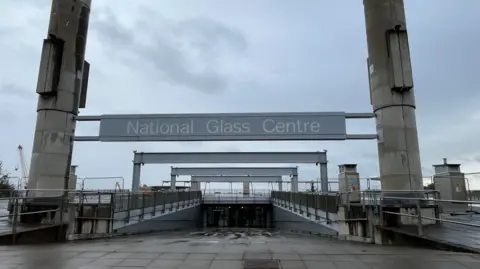
BBCThe National Glass Centre (NGC) closed its doors for the last time on Friday, less than 30 years since it first welcomed visitors. But is this really the end of the road for the facility?
"We push on, we fight on," says Carolyn Basing, a glass artist and chairman of the campaign group, Save the National Glass Centre.
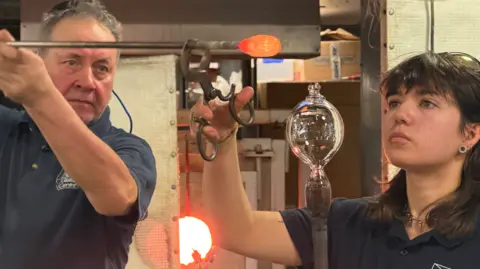
The site, which opened in 1998, housed workshops and hot glass furnaces and was also a tourist attraction.
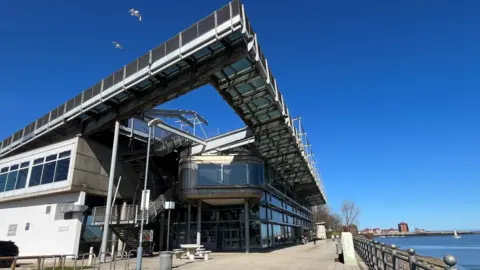
The focus for campaigners is now on protecting the building from demolition and getting a listing application in place.
The city council has also confirmed the grounds for an Article 4 Direction are being assessed. If invoked, it would require site custodian the University of Sunderland to submit a full planning application to knock down the building.
Basing says the building is "frozen in time" on the outside - at least for now - but is still at risk.
What is happening with the Article 4 Direction?
Sunderland City Council passed a motion calling for demolition plans to be stopped back in March.
A spokesperson for the local authority said the measure "must be based on robust evidence" and confirmed preliminary assessment work was under way.
However, they did not provide a timeline for an outcome.
Basing says at the moment, the university can demolish the building "with a minimum amount of planning restrictions".
"All we are hoping for is that it gets put in front of a full planning process where there's a slightly more democratic process going on and also the public will be given the option to be able to comment on it fully," she says.
The university says it continues to follow "all planning rules and guidelines".
What else is being done to protect the building?
Alongside the listing bid and the Article 4 assessment work, the campaign group has asked the local planning authority to consider issuing a building preservation notice.
It would effectively remove permitted development rights for a period of up to six months while a decision is made on the listing application.
The council says it has also received an application to list the building as an Asset of Community Value.
Meanwhile, the university has applied to Historic England to get a Certificate of Immunity (COI).
A COI is valid for five years, during which time a building could not be listed or protected from demolition through a building preservation notice.
In April, the university requested what is known as a "screening opinion" regarding the proposed demolition.
It helps applicants find out if a full environmental impact assessment (EIA) is needed before making a planning application.
However, Historic England has said determination of the screening opinion should be delayed until there is a decision on the COI.
What about glass artists?
A planning application for the centre's proposed replacement Glassworks was submitted in July, with the facility expected to open in a former warehouse in 2028.
Last year, campaigners warned of a "glass-making gap" in the city between the NGC closing and Glassworks opening.
Sunderland Culture, which will be running the new site, said there would be an alternative provision in the interim period, subject to funding.
CEO Nick Malyan says support being offered includes annual grants and a residency scheme to give artists access to facilities.
There are also plans for a "pop-up space", which will provide a regular public programme for engagement and learning, but the plans are unconfirmed.
 BBC/Jim Scott
"From our perspective, we're doing everything within our control," Malyan says.
"We're focused on ensuring we've got provision for makers.
"But the key thing is we want to make sure those people know they can continue to be part of a community, that they can continue to access facilities and continue to see a future for themselves in Sunderland."
Where will equipment and collections go?
The university says specialist equipment inside the NGC will be gifted for free to Sunderland Culture, whether to put in Glassworks or an interim facility.
A spokesperson says it is working "closely" with the council to enable "the safe transfer and formal accession of the collection of glass-work and ceramics currently held by the university".
"This would unite the contemporary glass works currently held at the NGC with the city's historic glass and ceramics collection," they say.
It has already been confirmed the Northern Gallery for Contemporary Art (NGCA), which was housed in the NGC, will relocate to the Culture House in the city centre.
