Code of conduct complaint for council leader over libraries plan

 BBC
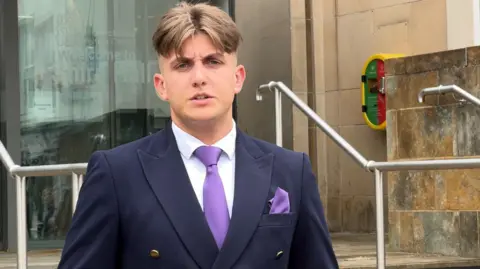
BBCReform UK's Warwickshire County Council leader George Finch is to face another code of conduct complaint, this time from Warwickshire Pride, after he said books containing "contested gender ideology" should not be promoted in libraries in the county.
Later referencing material featuring transgender issues, he said libraries should "not seek to embolden political ideologies", which he said were "highly charged and polarising", saying they should not be "taught to children as pure fact".
Finch said a new policy would be developed after receiving "a number" of complaints from residents regarding some children's books.
Following his statement on Monday, Warwickshire Pride said it had submitted a formal code of conduct complaint against Finch.
The BBC has contacted Finch to ask which titles of books he was referring to.
Warwickshire Pride said his comments "further marginalised" members of the LGBT+ community.
"The suggestion that books or resources acknowledging LGBTQ+ people somehow undermine neutrality is both misleading and dangerous," it added.
Reform councillor Mike Bannister confirmed there was "no indication whatsoever" that staff had promoted specific literature and promised that the new policy would be "fully discussed" with the libraries team.
In an interview with BBC CWR, Finch said he was not referring to books about "people's sexuality", but rather those featuring transgender issues.
However, he refused to be drawn on which titles he was concerned by.
"Kids should be taught how to be good people, not if they want to be a boy or a girl - that's completely irrelevant," he said.
The Warwickshire Pride complaint comes after an independent investigation found Finch breached the code of conduct after he made public comments that could have jeopardised a child rape case.
He has the right to challenge that verdict, with the process understood to be ongoing.
Other complaints about his portrayal of political rival councillor Jan Matecki as a burglar on social media are understood to remain under investigation as well.
 Google
Reform are not the only party to question children's exposure to the idea of gender identity.
Two months before the last general election, the then Tory government proposed to stop schools in England from teaching pupils about gender identity, although secondary-school children would learn about protected characteristics, such as sexual orientation and gender reassignment.
Earlier this month, library staff in Essex, run by Reform, were told not to promote events such as Pride and Black History Month.
Staff there were instructed to not highlight events unrelated to day-to-day activities, but the authority said it would not be removing books from shelves.
On Wednesday, Finch echoed the stance of his fellow Reform councillors in Essex, saying that books about "Black Lives Matters shouldn't have their own stand" within libraries.
In a statement, the council leader said his administration would begin work on a "comprehensive policy" that would give parents "peace of mind that their children are not being told to believe one set of political ideas over any other".
He added it would apply not only to libraries but to all council‑owned public spaces.
Finch wrote: "Warwickshire County Council's libraries should be politically neutral, family-friendly, and not seek to embolden political ideologies."
He added material involving sex, gender, identity or other social or medical issues should be presented "in an age‑appropriate and responsible way".
He said any policy would be developed "thoughtfully and lawfully", adding the council "should inform and serve residents, not campaign at them".
In a statement, Warwickshire County Council said it could not comment at this stage, describing it as a political matter.
'Political censorship'
A statement from Warwickshire Pride questioned why the identities of the LGBT+ community were being treated as "a political ideology rather than the lived reality of thousands of people across Warwickshire".
It said: "The suggestion that books or resources acknowledging LGBTQ+ people somehow undermine neutrality is both misleading and dangerous.
"Public bodies should not seek to limit access to information simply because it relates to a minority group or because some people find it uncomfortable.
"Libraries should be places of learning, exploration, and understanding, not tools for political censorship."
The group said its code of conduct complaint was linked to allegations of this being a "wider pattern of rhetoric" from Finch, calling on him to withdraw Monday's statement but also seeking an opportunity to meet with him.
The statement said: "We urge Warwickshire County Council to stand firmly on the side of inclusion, equality, evidence-based policy, and the rights of all residents to access information freely and without discrimination."
The local Liberal Democrat group said they were "very concerned" by Finch's comments and fully supported the statement issued by Warwickshire Pride.
A spokesperson said libraries should be trusted to make independent decisions of which books to buy and display and that it "should not be a choice for any councillor to make".
Councillor Sarah Boad, their group leader, said they would "not let Warwickshire go backwards".
 Google
Out Out Groups UK also criticised Finch's statement, calling it a "political attack".
It said: "There is no polite way to say this. We are disgusted.
"A child reading a book that contains two mums, two dads, a trans character or a young person questioning their identity is not being indoctrinated.
"They are reading about human beings. Libraries exist to provide access to information, knowledge, stories, ideas and experiences.
"They do not exist to erase people, because a handful of politicians have decided those people are suddenly 'controversial'."
Labour MP Rachel Taylor said parents in Warwickshire did not want Finch telling them what their children could or could not read.
She said: "George Finch is too young to remember that Section 28 started with censorship in libraries, but his Reform UK bosses know exactly what they're doing pushing this kind of poisonous bigotry.
"The council leader should drop this threat of Trumpian censorship and focus on his day job of delivering better services for the people of Warwickshire."
Section 28 was a law passed in 1988 by the then Conservative government that stopped councils and schools "promoting the teaching of the acceptability of homosexuality as a pretended family relationship". The law was in place until 2003.
Correction 12 June 2026: A previous version of this story said George Finch had called for books containing transgender material to be removed from libraries. This has been changed to reflect that he said he did not want them to be promoted, and for stands promoting those and other "contested ideologies" to be removed from across libraries in the county.
Follow BBC Coventry & Warwickshire on BBC Sounds, Facebook, X and Instagram.
