'Every town can have a wind turbine or solar panels'

 BBC
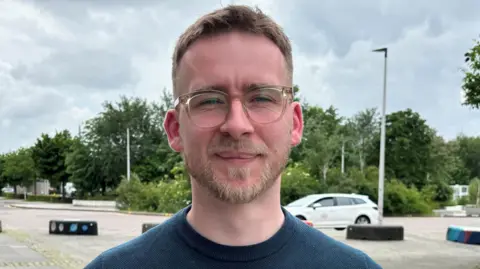
BBCFraser Stewart wants every town and village to have its own renewable power source - such as wind turbines or solar farms - and it is his job to turn this idea into a reality.
Stewart is head of local energy strategy for GB Energy, the company set up by the UK government to develop green energy projects.
The publicly-owned company, which is headquartered in Aberdeen, has been criticised for confusion over what it will actually do and whether its role has been watered down since it was first announced.
But Stewart is clear that his personal task is to deliver 1,000 community-owned renewable projects across the UK by 2030.
He hopes these will both provide power and generate a steady income for the towns and villages involved.
Wind turbines and solar panels are not popular with everyone, especially when they are confronted with the visual impact or disturbance, but Stewart insists they are vital part of Scotland's transition to a clean energy future.
He told BBC Scotland's Scotcast podcast that he's been talking about community ownership of energy for the best part of 10 years, long before he got his current job.
"The idea is that rather than relying on big energy companies to come in and build the wind farms and the solar farms, communities can do it themselves," he says.
Stewart admits these will necessarily be on a smaller scale and that big energy firms will still be needed for large-scale projects - but he says any town or village can get involved, provided they have good support.
"It is tricky to do," he says.
"It takes an awful lot of will and collective enthusiasm to get it done but when those assets start generating and they sell their electricity, the profits then get reinvested back into that community."
The town that's done it
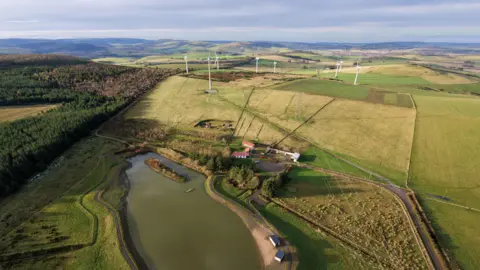
In the podcast, Stewart cites Huntly in Aberdeenshire, which has a population of 4,600, as an example of a town that has already taken up the community-owned turbine idea.
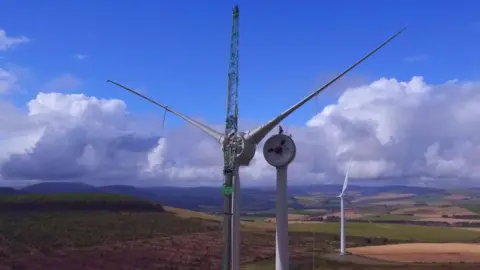
It owns a wind turbine, which sits alongside others which are commercially-owned on a hill above the town.
Donald Boyd, joint general manager of the Huntly Development Trust, said it had been "a long and drawn-out process" - but that he feels "very fortunate" that the project went ahead.
The idea began in 2010 but took six years before the community trust received its final boost of funding.
The overall cost for installation, purchasing, planning/consultation fees and to gain connection to the electricity grid was £1.5m.
Boyd says issues such as getting energy back into the grid are "humongously difficult and expensive" in Scotland.
The turbine generates a maximum of 500kW of electricity, which Boyd says is small compared to commercial projects.
It is paid for its electricity at a rate guaranteed by a pre-2019 feed-in tariff, which was put in place to encourage people to invest in green energy but has since been replaced.
Over the course of 10 years, it has brought £1.5m for investment into the local area after all operating expenses, loan repayments and maintenance.
As a result, Huntly town centre now boasts a refurbished cinema and co-working space as well as a banking hub from the generated income.
 Huntly Development Trust
Fraser Stewart, who is originally from Forfar, says he wants to see projects like this across the UK.
He is building on the existing schemes such as the Scottish government's Cares programme, which has been backing community energy for a number of years.
"There is more money in the local and community energy sector now than there ever has been in Scottish or UK history," he says.
"I would say to anyone who thinks this is a good idea 'now is the time, there is a gold rush on this stuff'.
"The good news is that where there has been difficulty in funding it in the past - where communities have relied on individuals championing it and driving it through despite the funding landscape - actually now there is real political momentum behind it and real will."
 Huntly Development Trust
Stewart says these projects will not necessarily be how the transition to renewable energy is powered, but that they can play a big part.
"It can be one turbine in Huntly or Orkney Council setting up really big wind farms that then power bits of the island and generate money for the community," he says.
It can also be small projects such as putting solar panels on school rooves, like he did when he worked as a community organiser in Glasgow.
"That was a fairly meagre amount of community benefit, the profits that get generated back, but all of it goes into the local community," he says.
"I think there has been a misnomer in the past that it is just for the leafy middle classes or you can only do it if you are out in a village somewhere and you have no other choice.
"Every type of community across the country is doing this stuff now."
'Ideological election promise'
GB Energy has not been without its share of criticism in the year since its inception.
Earlier this month, the firm was labelled "an ideological election promise" by Conservative Gordon and Buchan MP Harriet Cross.
Cross, who is also a member of the Scottish Affairs Committee, says GB Energy is one of the "largest white elephants we've seen in years".
Her comments came after it was revealed the publicly-owned company has just 30 permanent employees.
Cross said: "Labour promised GB Energy would create 1,000 direct jobs, but with just 30 permanent employees, it's little wonder that people across the north east feel like they've been sold a dud."
But Stewart told Scotcast: "The reality is GB Energy is a year old.
"So, it's a case of getting everything in place that you need to deliver investment in big energy projects.
"We're now at the point where we are ramping up that direct recruitment in Aberdeen."
He added: "In the next couple of years we will be employing 300 permanent staff, mostly based out of Aberdeen, which is part of the promise.
"But the bigger numbers around the jobs are attached to the investments we make in renewable projects."
