Can a 'secret sauce' help store renewable energy?

 BBC
BBCThe US-Israel war with Iran has led to higher electricity bills and put the issue of energy security back in the spotlight.
Now a pilot project inspired by a 100-year-old idea aims to store renewable energy.
Those behind the high density hydro demonstrator scheme near Plymouth say the technology can "turn small hills into giant batteries", as part of the transition away from fossil fuels.
"This is a first of a kind," said Stephen Crosher, CEO at RheEnergise, adding the scheme was now operating successfully.
The company was awarded a £8.25m small business research initiative contract from the government's Net Zero Innovation Portfolio to help develop the project.
What is hydro energy storage?
Traditional pumped storage hydropower works by releasing water from a higher point to a lower one so it passes through turbines to generate electricity.
The water can then be pumped back up to the higher reservoir when electricity is cheaper and released when demand is higher, means the scheme acts as an energy store or giant rechargeable battery.
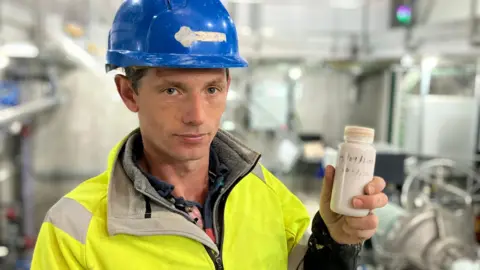
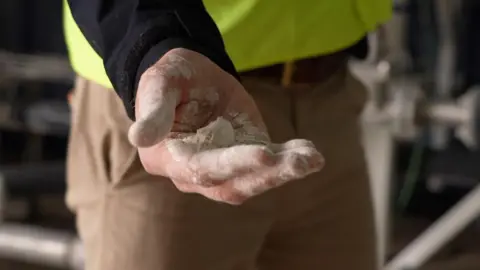
A key part of the pilot is what engineer Peter Hawkins calls the secret sauce; a liquid that is two-and-a-half times denser than water.
Using the denser fluid instead of water means that much smaller "drops" in terms of height are needed and installations can be built on "hills rather than in mountains".
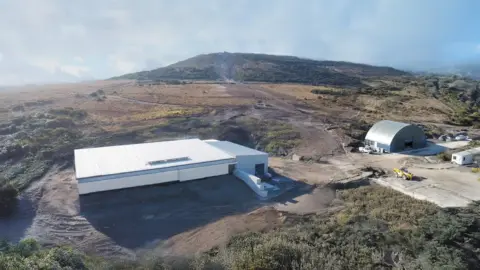
The demonstrator scheme at Cornwood has a peak power production of 500kW and could power 400 homes for one year, if run continually.
"This project takes 100-year-old technology - pumped hydro - and makes it work for the modern day," said Lizzi Gold, business development manager at RheEnergise.
She said the idea was scalable and could be built on hills "as low as 100 metres".
"As we move towards a renewable energy system, we need much more energy storage".
Gold added the idea behind the scheme was to provide "clean power when the wind isn't blowing or the sun isn't shining".

Rising wholesale costs caused by the US-Israel war with Iran are due to hit household bills for the first time next month with an expected 13% rise.
Batteries or pumped storage can help "balance" the system as we transition to using more renewable energy, said Prof Peter Connor, associate professor of sustainable energy policy at the University of Exeter.
"Historically we use a lot of coal and gas and we can turn that on and off whenever we need it," he said.
"In the future, we want to transition to low carbon such as wind or solar and it's not as easy to turn on and off," Connor added.
"Technologies like this are trying to help us make that shift."
 RheEnergise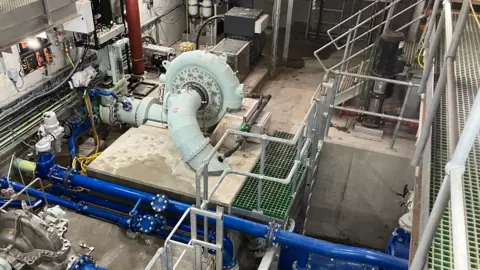
Crosher added: "We can see huge volatility in fossil fuel prices which is causing huge pain for consumers but it's also about the decarbonisation journey.
"The race is on for solutions that can decarbonise the world's power grids."
Follow BBC Devon on X, Facebook and Instagram. Send your story ideas to spotlight@bbc.co.uk.
