'Hospital's app was a lifeline when my son was critically ill'

 BBC
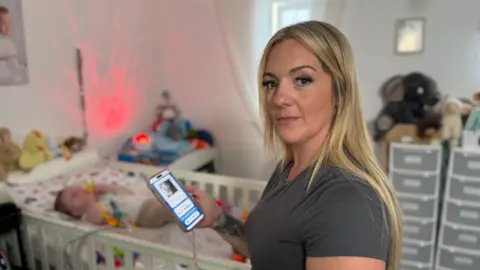
BBCHaving a child in intensive care can be scary, confusing and overwhelming for a parent - but could a new app developed by a hospital make the experience easier to navigate?
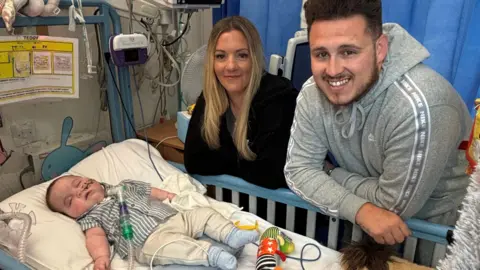
"I felt terrified. Actually terrified," recalls Claire, 34, when her son, Teddy, was admitted to the Paediatric Intensive Care Unit (Picu) at Addenbrooke's Hospital in Cambridge last year.
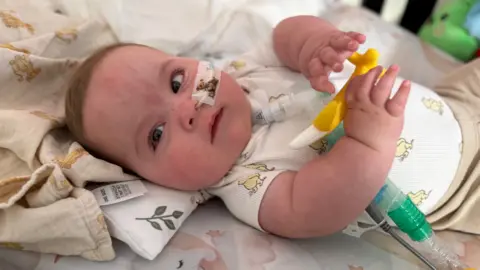
"He was six weeks old, white as a ghost and his breathing was horrendous.
"One of the hardest things was losing control, having to watch someone else help your child," says the mum-of-four from Northstowe, Cambridgeshire.
 Addenbrooke's Hospital
For Claire, the app called My Picu Story was a "lifeline" when her son spent several days in an induced coma while battling three infections.
"We took him to A&E and within five minutes they said 'this baby needs putting to sleep', he was intubated and transferred to Picu - my head was all over the place," she says.
"[The app] explained basic things like where to park, but also the terminology the doctors use which can be really confusing.
"It has a section where you can message the staff when you're not there and they can post pictures and updates on your child," she adds.
More from Cambridgeshire:
Claire found the app particularly useful at night when she had returned home from the hospital, adding: "That's when your baby should be beside you and he's not.
"I didn't know if he was going to make it through the night, so being able to see that he's calm was a lifeline."
Teddy, who is now nine months old, has a rare genetic condition connected to the PKDCC gene, which affects bone growth.
 Supplied
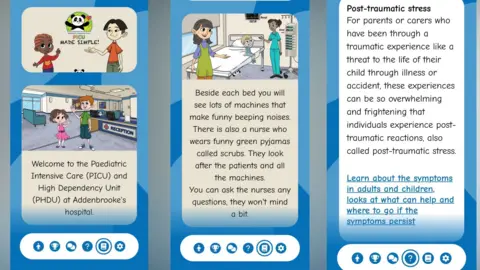
Claire says she and her partner James, 33, also found the app useful to explain Picu to their other three children to prepare them to visit Teddy.
"There's a cartoon we could just show the boys so they knew exactly what it was like, and they wouldn't be overwhelmed by all the machines beeping.
"It made a lot of difference. They were prepared. It was amazing," she says.
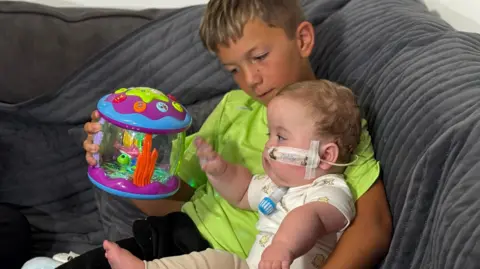
Claire's son Alfie, 11, agrees "[the app] made it easier to visit".
"Teddy was tiny. He couldn't open his eyes much, and you couldn't pick him up. It helps you not to be scared and to know who's there," he adds.
Every year more than 17,000 children in the UK are admitted to Picu.
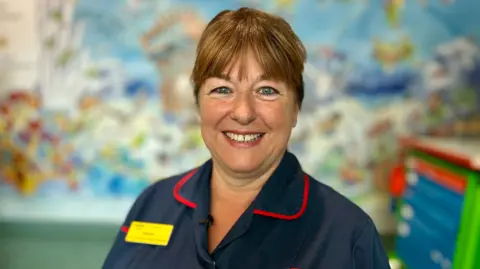
Sarah O'Driscoll, the family liaison nurse at the unit in Addenbrooke's Hospital, says parents often experience "shock and trauma" when their child is admitted to the unit.
"They never expect to see their child like this, surrounded by machines. They only usually see it on TV.
"It's very intense and it can have a significant psychological effect on families.
"We take children from all over the region, and sometimes London. So, some parents don't know the area or where anything is. We had one family who'd never left Norfolk before.
"We're always here for them and explain the support that's available but sometimes it's hard for people to take that in at the time," she says.
Similar apps exist for parents with babies in neonatal care units, but Addenbrooke's believes this is the first one for Picu parents, whose children have a wider range of conditions.
The hospital says the app has been designed with parental input and a key aspect is to provide mental health support for caregivers.
"After leaving a Picu, a third to half of families suffer post-traumatic stress, depression and anxiety," says Dr Nazima Pathan, a Picu consultant at Addenbrooke's, who led the project.
"The app helps parents to recognise the signs and direct them to support and resources to help them look after themselves.
"We want to give trusted information, as experts, because online searches don't necessarily give the right results," she adds.

Addenbrooke's Hospital provides access to a psychologist for Picu parents for a day and a half each week, but a "lack of funding" is a barrier to increasing the provision.
The hospital adds it is working to create "an additional post".
A study in 2020 found less than half of Picus in the UK provide structured in-hospital psychological support for parents and fewer than a fifth offer post-discharge follow-up.
The hospital says it is working with other trusts who have expressed interest in adopting the app.
Claire agrees that "being in an environment like Picu, affects your mental health, massively. To know that support is there, if and when you need it, is incredible.
"Unless you're told or shown, you don't know where to go for that help.
"You don't even think about yourself or realise you need help. The app makes you question 'how am I feeling?'," she says.
Teddy now lives at home but needs 24-hour care, a routine that Claire says the family are beginning to settle into.
She adds: "If your child is in PICU, 100% you need this app - without it you'd be lost".
Do you have a story suggestion for Cambridgeshire? Contact us below.
Follow Cambridgeshire news on BBC Sounds, Facebook, Instagram and X.
