'Dad didn't want to stay in hospital – I'm so glad he's being treated at home'

 BBC
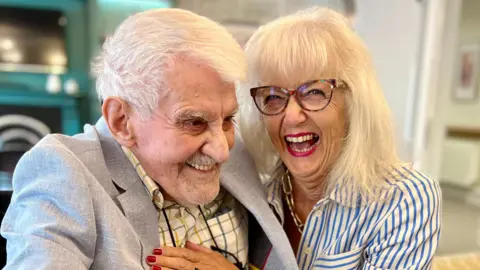
BBC"I don't want to be in hospital, of course not – I want to be free and easy," says Clifford Craske.
For the 96-year-old retired architect, hospital visits have become a familiar part of life.
But now, under a new initiative, he is among a number of residents receiving specialist care without having to leave their care home.
At Heathlands House Care Home in Cambridge, doctors are visiting residents in person, providing assessment, ongoing care and clinical support as part of the Enhanced Reviews in Care Homes (EnRICH) service.
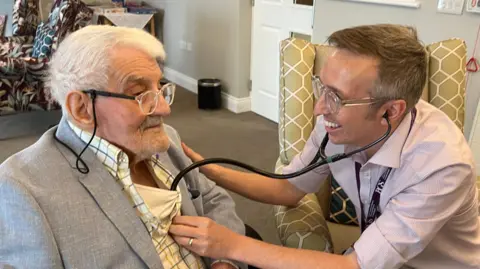
Clifford has several health issues including dementia, heart failure, diabetes, and COPD (a progressive lung disease) and has previously had a stroke.
In the year before the EnRICH service started at the home, Cambridge University Hospitals NHS Foundation Trust (CUH) says he attended hospital three times, but has since been supported by hospital geriatricians and avoided being readmitted.
On her father's hospital visits, Alice Craske, 67, says: "For him, it is very traumatic. As soon as he was in the hospital he didn't want to stay.
"By him being treated here, within the care home, it is much more settling for him and he is very happy here and sees this as home now, which is very important for us."
The retired nurse adds that the service "has actually prevented him from going to hospital".
"The scheme is absolutely invaluable [as] it is creating a bridge between the GPs and consultants within the hospital."
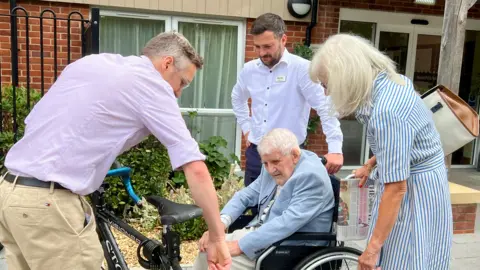
EnRICH was introduced by clinicians at Cambridge University Hospitals NHS Foundation Trust (CUH).
The initiative brings hospital geriatricians, who specialise in treating older adults, together with community nurses, pharmacists, care home staff and GPs.
Research published in the journal Age and Ageing states that since the introduction of the service, hospital admissions by residents from care homes have reduced by nearly 25%.
Prime Minister Andy Burnham has this week he would not want to leave office without bringing in "substantial change" to the social care system.
He told the BBC that if the government did not reform social care, the NHS would "collapse under the weight of trying to care for people who've really not needed to end up in the NHS system".
Statistics in Age and Ageing reveal the service has reduced the time patients spend in hospital by a third, saving 1,300 inpatient bed days a year.
CUH says it assessed the impact of the service at 11 care homes in Cambridgeshire over more than 12 months, finding that hospital admissions have fallen by 23% after the service was introduced, with the average length of stay for those residents admitted decreasing by 32%.
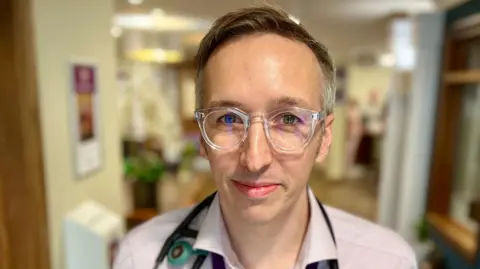
Dr Matthew Butler, a geriatrician at CUH, says the scheme "tries to follow residents throughout their whole healthcare journey", including if they are taken to hospital.
"We have got an ageing population and we are not going to build ever bigger hospitals, we need to be moving care out to the community," he says.
"Through assessments and conversations in the care home with residents and their families, we can work alongside our primary care colleagues to have a plan in place for residents to help reduce time spent in hospital."
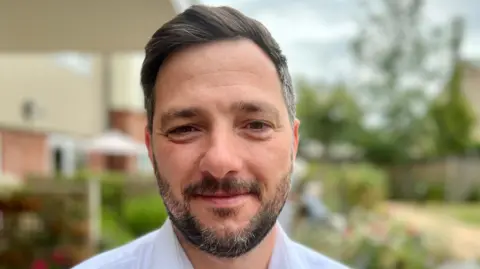
Heathlands House, which provides residential, dementia, nursing, respite and end-of-life care, was among the first homes to adopt the service in October 2024.
Razvan Stanbeca, manager, says the initiative is making "a massive difference to residents as instead of going to hospital they can get care in their home".
"Besides looking after residents, the team have helped our team to develop their knowledge and are very confident asking for help and assistance from the doctors."
On the number of residents being sent to hospital, he says: "In the last six months we have seen a reduction of about 50%."
The initiative has now expanded to 15 care homes with the highest frequency of hospital admissions in Cambridgeshire, funded by the NHS Central East Integrated Care Board.
CUH says the service could save about £700,000 annually due to hospital inpatient beds being freed up.
Clifford, meanwhile, is continuing to enjoy life and to limit his time in hospital wherever possible.
"Life is exciting as you do not know what is going to happen next, and that in itself doesn't worry me," he says.
"I might drop down dead tomorrow but c'est la vie, you have to accept these things."
Do you have a story suggestion for Cambridgeshire? Contact us below.
Follow Cambridgeshire news on BBC Sounds, Facebook, Instagram and X.
