'I had stage four cancer at 14, now I'm a doctor'

 BBC
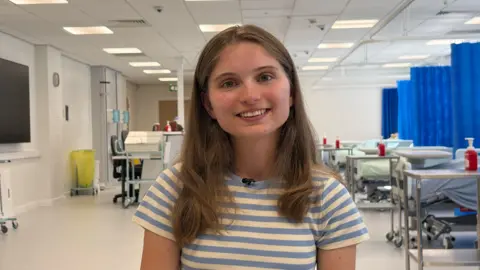
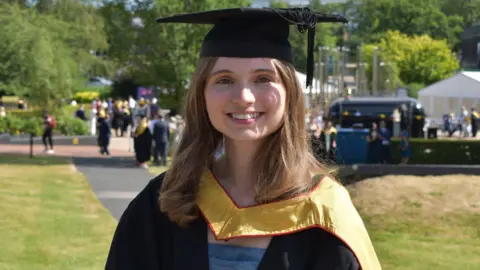
BBCA young woman who was inspired to pursue a degree in medicine after facing cancer herself as a teenager is celebrating graduating from university.
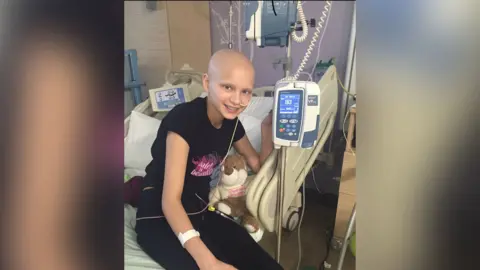
Diagnosed with an aggressive soft tissue cancer at the age of 14, Ellie Waters-Barnes was given a one in five chance of survival.
But the experience helped forge her career path and she said had given her a "superpower" that not every medic was able to tap in to.
Now 25 and still struggling in some respects physically, she has just graduated from Keele University and said her own experience of undergoing treatment gave her a better understanding what patients were going through.
She said news that she had stage four alveolar rhabdomyosarcoma in September 2015 turned her life upside down.
"I went from being a very healthy, fit teenage girl to having this very intensive treatment that made me very ill," Waters-Barnes said.
She underwent 18 months of treatment at Queen's Medical Centre in Nottingham.
"I lost lots of weight, lost my hair, I had to be tube fed," she said.
"The first nine months was intensive chemotherapy and then I had 28 sessions of radiotherapy, and then I had a year of maintenance chemotherapy.
"I'm all clear now, thank goodness, but at the time the cancer was very aggressive. I feel very lucky to be here today."
 PA / Ellie Waters-Barnes
Among other things, the side effects of her treatment saw her facing the menopause at the age of 15, along with other lifelong health issues.
"At the time [menopause] wasn't a big deal," Waters-Barnes said.
"At 15 I didn't really know what it was. My mum hadn't even been through the menopause at that point. I thought it was going to be a walk in the park.
"My oncologist didn't really counsel me on what it meant and the symptoms.
"My impression was that I had no periods and that was it, but after the years that followed I was getting bad night sweats, hot flushes, itchy skin, dryness."
She said she did not realise at the time those effects were due to the menopause.
However, Waters-Barnes was all too aware they were making her A-level studies harder, at what was as key time as she attempted to get the grades for medical school.
'My escape was studying'
Her cancer treatment itself brought its own challenges and Waters-Barnes had earlier decided to repeat Year 10 at school, although GCSEs became something of a release.
"I couldn't control what was going on with cancer, but I could work hard," she said.
"I actually quite enjoyed it, because I could forget about my problems when I was doing hard chemistry and maths questions.
"That's why I ended up getting very good grades, because I didn't have the energy to go out with my friends and do the things that normal young people do - my escape was studying."
Despite undergoing years of hospital treatment, it was not that experience that prompted her career choice, rather her way of switching off from it.
 Keele University
"Everyone [on the ward] was lovely but I didn't want to go back and be surrounded by reminders," she said.
"But when I finished treatment I couldn't stop watching medical documentaries. I would obsessively watch them.
"I grew a passionate interest for medicine. I started researching things I went through. I think I developed a passion for helping people as well."
She said her priorities changed when she went through cancer.
"I realised helping people in their most vulnerable state was more rewarding than earning a lot of money," Waters-Barnes said.
"I had a lot of amazing doctors and nurses treat me when I had cancer.
"You can definitely understand better what the patient's priorities are, what they want and what matters to them. It's definitely a strength rather than a weakness."
More than 10 years on from her original diagnosis, the 25-year-old is still undergoing regular checks, but looking forward to taking her medical training to the next level as a Foundation Doctor at the Royal Stoke University Hospital.
She said she hoped her experiences would make her a better doctor.
Follow BBC Stoke & Staffordshire on BBC Sounds, Facebook, X and Instagram.
