'I want to see my children grow' - terminally ill dad

 Family handout
A man with an incurable brain tumour has said he wants to explore every avenue available to stay alive.
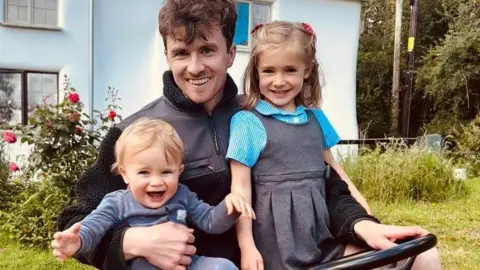
Elliot MacDonald, 35, from Devon, has two young children and has been told he has 12 to 18 months to live.
It has led him to question why NHS treatment is limited when brain tumours are the biggest cancer killer of under 40s.
The Department of Health told the BBC it had invested more than £25m to unlock the latest brain cancer treatments.
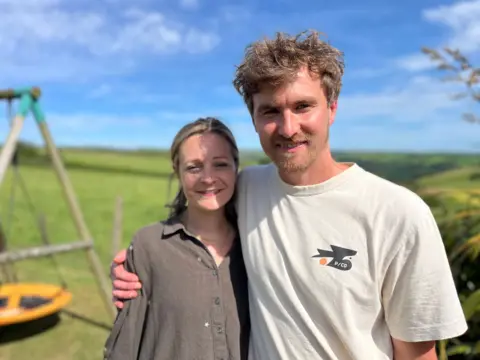
Elliot realised in late May that he was having trouble swiping his thumb across his phone.
The dad from north Devon then tried to put pen to paper but found he could not remember how to write.
Elliot went to hospital where it was discovered he had a mass on his brain.
"At that moment you don't realise what you're being diagnosed with," Elliot said.
His wife, Erica, said: "It's the fear of the unknown, isn't it?
"It's not knowing at that point what it might be but dreading the worst."
 Family handout
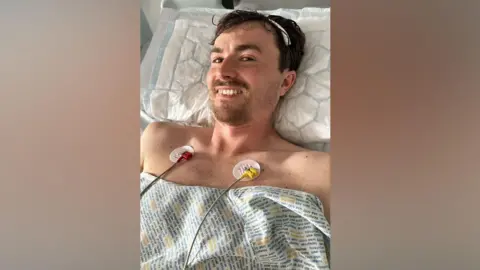
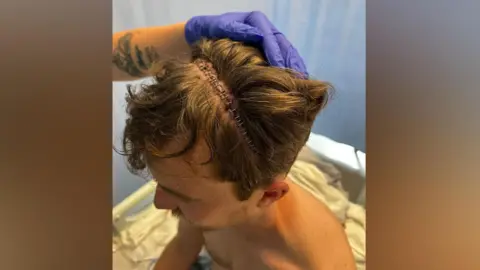
Elliot was referred to Derriford Hospital in Plymouth where a surgeon broke the news that he had a grade four glioblastoma – a fast-growing brain tumour, according to Cancer Research UK.
He had emergency surgery the next day to remove as much of the tumour as possible.
Since then it has been a whirlwind for the family, who have had to process the devastating diagnosis while swiftly becoming experts on brain cancer.
"You can't help but think about the children," Elliot said.
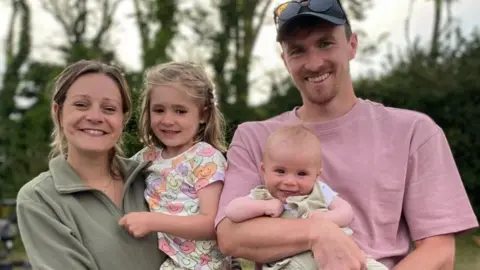
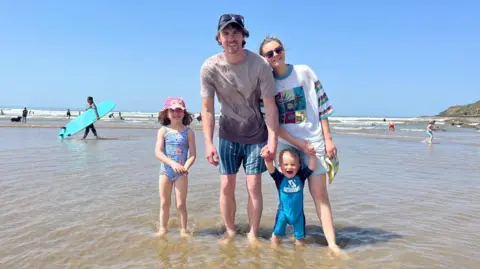
"We have a one-year-old and a five-year-old… we don't know what the future holds."
 Family handout
The couple said the NHS had been mostly fantastic but very early on they were told there were few options, which they do not believe.
"You do walk out of meeting the neurosurgeon thinking I've just got 12 to 18 months… with little hope to live," Elliot said.
Erica said: "We were prepared for it. Elliot's sister is a doctor and told us what to expect so we'd done a lot of research.
"If we hadn't, things would look very, very bleak."
 Family handout
Their research included looking at treatments unavailable on the NHS, which are as yet unproven in UK clinical trials, according to experts.
Dr Ola Rominyi, clinical lecturer in neurosurgery at the University of Sheffield, said: "We don't know yet how effective these treatments are.
"But we do know they offer hope to people in this [Elliot's] situation and are showing promising signs.
"There's a lot of optimism around some of these things - such as immunotherapies - and rightly so, but as it stands there's just not the evidence yet."
Brain cancer symptoms
According to the NHS, symptoms of a brain tumour can vary depending on the type of tumour and where it is in the brain.
Symptoms can include:
- new headaches, or headaches that are getting worse – these usually happen with other symptoms
- nausea or vomiting when moving suddenly – this usually happens with other symptoms
- seizures
- eye problems that are getting worse, such as blurred vision, seeing dots and lines or flashes of light, or not being able to see out of the corners of your eyes
- feeling very sleepy or fainting
- changes to behaviour or personality, such as problems with thinking and concentration
Clinical trials
Dr Simon Newman, from the Brain Tumour Charity, said brain tumours were the biggest cancer killer of children and adults under 40 in the UK, but brain cancer receives about 3% of cancer research funding nationally.
"We need more research," Newman said.
"We need a lot more clinical trials in the UK so we can identify new treatments to give people hope.
"And I think some of that research is still at an early stage but some of the ideas are going to bear fruit, it might just take a little bit more time yet."
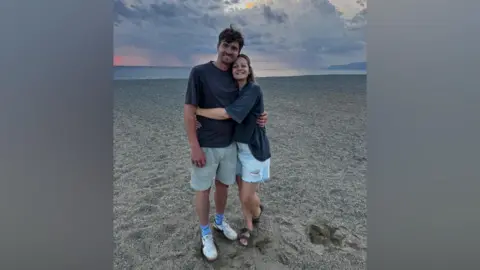
Elliot's friends and family have reacted to his diagnosis with a fundraising effort that has attracted attention across the globe.
They reached their £150,000 target in just 48 hours
It means Elliot has a chance to try treatment that is not funded by the NHS but is aware this is not the case for everyone.
"We're in a fortunate position," Elliot said.
"People who are less fortunate, without the support around that I have and the research that we've put in, their prognosis isn't good."
 Family handout
Erica said, thanks to the fundraiser, Elliot's story had attracted attention from others in a similar situation.
"So many people have reached out, which is fantastic," she explained, adding: "But it's also incredibly sad.
"These are young people, like us, with families that they're going to leave behind and it's just so sad that there isn't the research and funding there."
'Boost to research'
The Department of Health said its thoughts were with Elliot and his family "at such a difficult time".
A spokesperson told the BBC: "The National Cancer Plan will improve survival for rarer cancers, including brain cancer, through earlier detection and improved treatment.
"The Rare Cancers Act is now law, meaning a further boost to research and clinical trials.
"On top of this we are continuing to invest millions to unlock the latest brain cancer treatments and boost cancer research."
 Family handout
Elliot and Erica said they had been as honest as they could be with their children.
"Elliot's focus is to stay alive, and my focus is to think about what happens if we can't do that," Erica said.
"How do I manage our kids, how do I guide them and then dealing with my own emotions. Yeah it's tough."
The couple hope that by raising awareness of glioblastomas they can help other people, many of whom are receive the same prognosis, in the prime of their lives.
"We want to create a foundation," Elliot said.
"Obviously, we don't come from a medical background but just to be able to give the guidance to people in a similar position."
Erica said: "Maybe this was unfairly handed to us but we have to make something out of it.
"Families like us are going through hell and there isn't much help, and if there was then that pressure on everyone involved would be slightly alleviated."
Elliot added: "We have to try everything. I want to stay here as long as possible – I want to see my children grow."
