The road signs that teach travellers about France

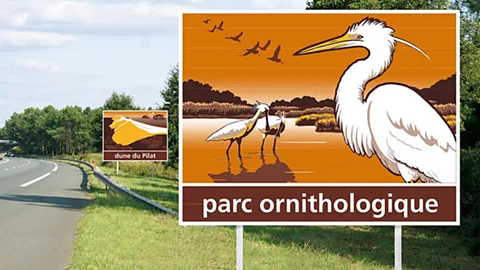 Philippe Collier
For more than 50 years, France's brown motorway signs have done far more than point the way: they've sold the country's history, culture and identity in seconds.
Most visitors to France notice the food, the villages and the landscapes. Fewer clock one of the country's most distinctive attractions flashing past the car window.
Across the country, thousands of illustrated signs in muted shades of brown point motorway drivers towards monuments, vineyards, famous local dishes and national sites. One might direct you to the Millau Viaduct or the Royal Abbey of Fontevraud. Another might highlight a region famous for its cheese. Some commemorate darker histories. On the motorway between Grenoble and Lyon, one panel marks the Izieu Memorial where 44 Jewish children and seven adult staff were arrested in 1944 on the orders of Klaus Barbie and deported to Auschwitz.
Taken together, the signs form one of France's most overlooked cultural projects: a vast open-air gallery designed to sell the country to itself and to anyone passing through.
"I visited a monastery thanks to one of the brown road signs just the other month," a colleague told me. "I've grown up seeing these signs, and I'd heard of Brou Monastery [near Bourg en Bresse], but I didn't know it was open to the public."
A crash course in France from the driver's seat
The unique motorway signs first appeared in 1972, multiplying to more than 500 in the seven years that followed. The state-commissioned panels promoted sites of interest like castles and manor houses, and elements of regional culture and identity – architectural styles, gastronomy and wildlife.
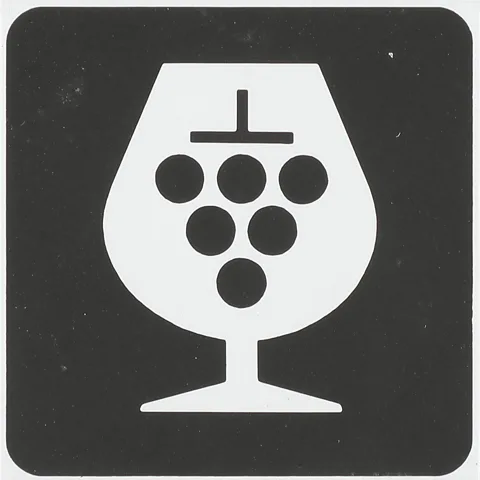 Fabrice Lindor/Collection du Centre national des arts plastiques
In an era where drivers rarely wore seatbelts and often smoked at the wheel, and there were very few radars to prevent speeding, they also encouraged motorists to slow down. Rather than being a distraction, the brown signs served to break autopilot mode and were thought to improve road safety.
The earliest signs were created by Swiss-born designer Jean Widmer, who died last month, and his former wife Nicole Sauvage, a husband-and-wife team whose work also shaped some of the most recognisable visual symbols in modern France, including the Centre Pompidou logo. Their motorway signs were simple and graphic: three planes for Toulouse, a hub of the aerospace industry; chicory, endives and potatoes as a nod to the agriculture of Hauts-de-France; half-timbered houses for Alsace; and grapes in a Cognac glass.
See the signs
More than 400 of Widmer and Sauvage's designs are now held by the Centre National des Arts Plastiques (CNAP) in Paris. CNAP is not usually open to the general public, but several original road signs will be on display at the Espace Culturel Decauville in Île-de-France from mid-April to mid-July as part of an exhibition on holidays.
"The road signs were designed to promote tourism by showcasing France's heritage, crafts and local industry," says Véronique Marrier, a conservationist at the Centre National des Arts Plastiques and former close friend of Widmer. "Widmer's approach was mathematical and pragmatic, inspired by the Bauhaus movement."
The science behind the art
The signs had to be simple and work at speed. Since 1974, France's motorway speed limit has been 130km/h (81mph), which meant drivers had only seconds to absorb what they were seeing. Each design was usually replicated on two panels, 200 to 300m apart. The first would only have the pictogram – a château, for example – to pique the driver's interest, while the second would name it, often with an arrow to direct the driver. The simple brown-and-white palette was chosen as it showed up clearly under headlights and distinguished the cultural signs from the blue-and-green signage used for motorways and major roads.
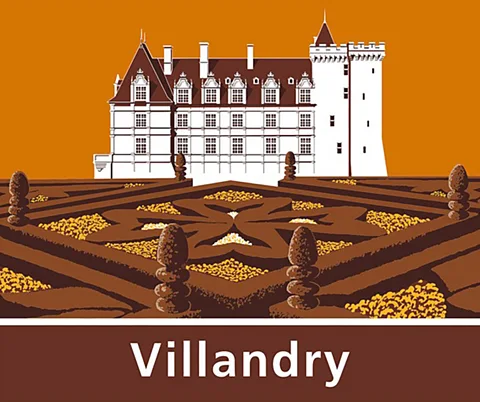 Philippe Collier
The images functioned as a universal language, able to be understood by all nationalities. When they were accompanied by text, it was almost entirely in lower case Helvetica, the typeface that Swiss typographer Adrian Frutiger had deemed the easiest to read. The French state chose each pictogram's subject, without the input of the local community. After that, it was up to Widmer and Sauvage as to how to interpret it.
"Widmer didn't patronise his viewers, he believed they were intelligent enough to understand that a fish in a dish was meant to be fish soup, for example," says Marrier, moments after I prove otherwise by incorrectly identifying a potato as a Jerusalem artichoke on one of the signs. "He deplored the road signs that came afterwards."
From minimalist symbols to illustrated scenes
In 1984, Vinci, the company that currently operates around half of France's motorways, decided the signs should become more modern and detailed. They hired Philippe Collier, a graphic designer who'd trained in fine art and spray painting, to create a new generation of panels. This time, local communities had a say in what they wanted to highlight, whether a monument, a dish, a piece of history or a regional claim to fame. For each commission, Collier travelled to the site, met with residents and built a design around what they felt defined the place. It became his life's work and he created around 950 signs over the course of his career.
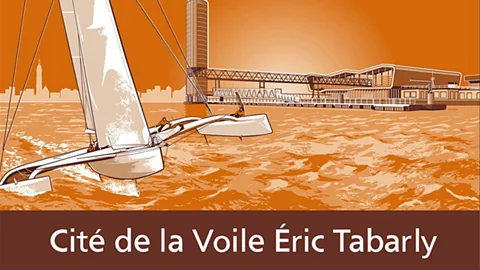 Philippe Collier
"I'm not retired, I'm on standby," says Collier, adding that the "châteaux of the Loire were my favourites to design, particularly the bridge castle, Chenonceau".
Collier wasn't allowed to sign his work, making him arguably the most visible anonymous artist in France. His designs were far more detailed than Widmer and Sauvage's and used a broader colour palette, including oranges and yellows – anything that fell under the broad spectrum of brown. The motorway sign for Saint-Malo, a historic, fortified port city in Brittany, showed the town ramparts, a square-rigged sailing boat and a seagull on the rocks in front of white-tipped waves. Clos Lucé, Leonardo da Vinci's former home in the Loire Valley, was illustrated not only with the château itself but with illustrations of his flying machines circling above it. In Bayeux, the cathedral rose behind the famous tapestry.
A national gallery at 130km/h
While Collier's signs can still be seen across France, the original Widmer-Sauvage panels have almost disappeared. APRR/AREA, the operator that runs around 30% of France's motorway network, has removed all the original brown signs from its roads over the last two decades, saying that they had become old, damaged and in some cases a safety hazard.
More like this:
Instead, using a team of eight illustrators, they've replaced some 600 panels since 2014, promoting tourism and French history — often the overlooked parts. As well as the Izieu Memorial, they've commissioned road signs on several famous French women, including painter Rosa Bonheur, writer Colette, sculptor Camille Claudel and Joan of Arc.
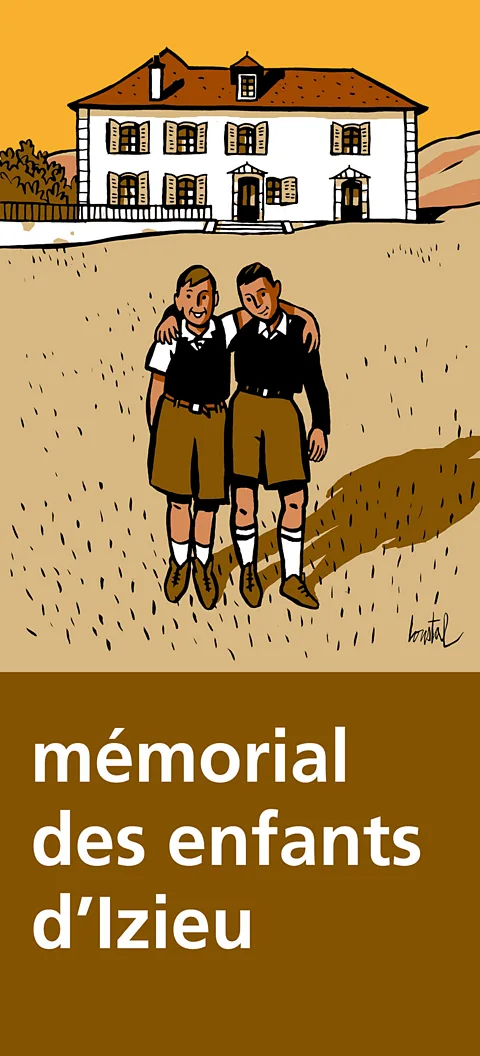 APRR-AREA
The approach is still highly exacting. At 130km/hour, a driver has about three seconds to digest a sign, which means the text, lower case and Helvetica, continues to follow Frutiger's model. The colour palette still sits in the brown palette but now ranges from sand to acacia. Unlike Collier, the artists are allowed to sign their work, showing their different styles across France's open-air art gallery.
Widmer may not have appreciated the brown signs that followed his original designs, but their purpose has remained largely unchanged for more than 50 years. They're still there to tempt motorists off the motorway and to teach them something about the country rushing past the window.
That might mean learning that the Auvergnat town of Moulins is famous for theatre costumes, that the Vercors mountain range was a huge Resistance hideout or that there are still lynx living in the Vosges. For drivers crossing France at speed, they offer something better than directions: a crash course in the nation itself.
--
If you liked this story, sign up for The Essential List newsletter – a handpicked selection of features, videos and can't-miss news, delivered to your inbox twice a week.
