Hartlepool power station balls prompt beach survey

 Jacqui Harrison/Marske Litter Action
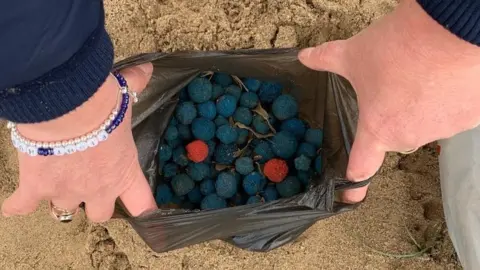
A survey is under way to map how many small balls have washed up on beaches across Teesside.
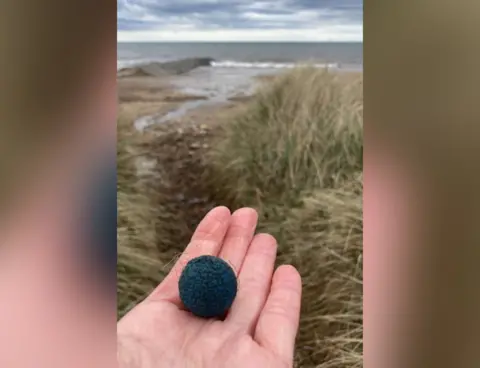
The balls, made from sponge and rubber, are used at Hartlepool nuclear power station to clean its cooling system, but some have ended up in the sea.
EDF Energy said they "pose no risk" and "naturally" biodegrade in seawater but wildlife groups are concerned birds and marine life may consume them.
The data will be used to track their locations to assist with the clean-up.
Tees Valley Wildlife Trust said the findings would help to map where currents are depositing the balls on local beaches.
 Carolyn Granthier/Marske Litter Action
Taprogge balls are usually caught at the end of the cleaning process, but are sometimes released into the sea.
While releases are unusual nowadays, the trust said many balls remained.
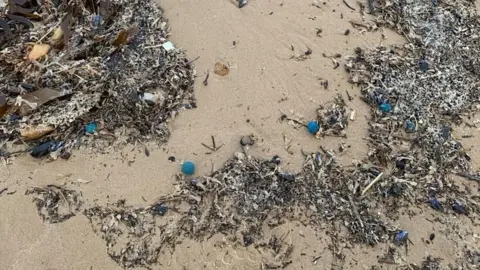
There have been sightings on beaches in Redcar, Marske, Saltburn and Seaton, as well as further down the coast in North Yorkshire.
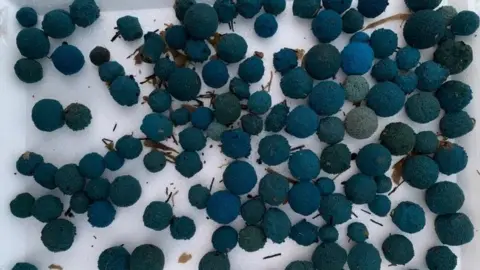
"There are a lot, they have been out there for years, and you can tell which are older because they are different shades of blue," said Jacky Watson, wilder coast officer with Tees Valley Wildlife Trust.
 Jacqui Harrison/Marske Litter Action
"They have been sat somewhere along the seabed and a big sea has got them and washed them out to shore," she added.
Local groups met the energy provider and they decided to work together to find out where the balls have washed up.
The firm already carries out weekly beach cleans.
 Jacqui Harrison/Marske Litter Action
It is hoped the initiative in Teesside will inspire similar work between heavy industry and community groups across the UK.
Tees Valley Wildlife Trust asks anyone who spots large numbers of balls to get in touch.
Mark Lees, station director of EDF's Hartlepool Power Station, said the balls are used to clean certain stretches of pipework but "occasionally, and under exceptional circumstances" some may be released to the environment.
"The balls are made from a natural sponge rubber which poses no risk and which naturally biodegrades in seawater," he said.
"Sometimes tide patterns or weather events can wash older balls on to beaches.
"We take our environmental obligations very seriously and when we are made aware that balls have washed ashore our teams carry out beach walks to collect any that we can find."
Update 19 April 2023: This article has been amended to include a statement from EDF Energy.

Follow BBC North East & Cumbria on Twitter, Facebook and Instagram. Send your story ideas to northeastandcumbria@bbc.co.uk.
