Wildfire risk 'very high' as hot weather continues

 Devon & Somerset Fire & Rescue Service
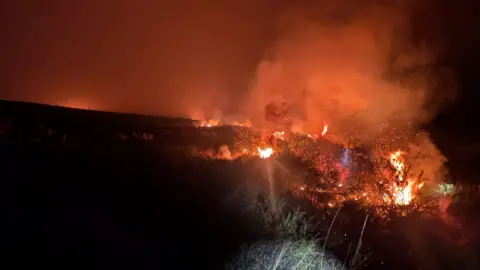
There are warnings that the risk of wildfires on Dartmoor is "very high" as the hot weather continues, with a Met Office amber warning in place for Devon and much of Cornwall.
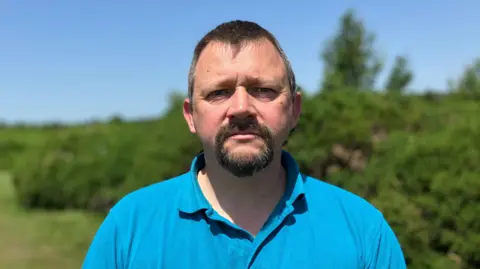
Conditions on the moor are "tinder dry", with Dartmoor National Park Authority Head Ranger Simon Lee urging visitors to leave barbeques at home and picnic instead.
The Met Office said it expected Devon and Cornwall's heatwave to "increase in intensity" in the days ahead, with the potential for "health impacts, as well as transport disruption and more incidents near the coastline".
Met Office meteorologist and presenter Alex Burkill said: "Climate change is increasing the frequency and intensity of heatwaves world wide."
A huge wildfire destroyed more than 1,000 acres (405 hectaes) of moorland in May 2025, with Dartmoor farmers taking steps to try and reduce the risk.
Lee said: "It's incredibly hot and it's incredibly dry.
"Fires can start and spread very quicky are can be absolutely devastating for communities, livestock, wildlife.
"We're asking people to leave their BBQ at home and bring a picnic instead, and reminding people that open fires are not permitted on Dartmoor."
Devon and Somerset Fire and Rescue Service has also issued advice on how to safe during a heatwave.
Firefighters said they were urging people to enjoy the sunshine safely and take extra care around open water, as well as in the countryside and at home.
Anyone outside should avoid entering rivers, lakes, quarries and reservoirs, and should not have campfires and barbecues in the countryside, they said.
Alex Burkill said the heatwave "will increase in intensity on Wednesday and Thursday" and bring the "potential for health impacts, as well as transport disruption and more incidents near the coastline".
He said: "Some stations across Devon and Cornwall could see June temperature records broken.
"The figure to beat for Devon in June is 33.5 [92.3F], which was set during the 1976 heatwave.
"No matter what the figure that is reached as part of the heatwave, this will heat will be very disruptive for many, and that is partly down to the humidity, which means it's harder for bodies to stay cool.
"High night-time temperatures, possibly staying over 20C [68F] overnight, also reduces the recovery time for many.
"We know that climate change is increasing the frequency and intensity of heatwaves world wide.
"This latest event, where more national records are likely to fall, is another marker in the changing UK climate and reaching temperatures that were previously unthinkable."
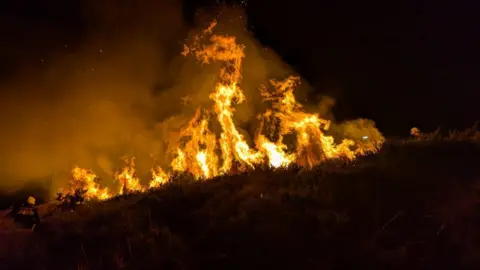
Recent hot summers and extended spells of dry weather reduce the soil moisture content of our moorland and heathland areas.
Extended high temperatures force vegetation to pull water from the ground; when soil dries, the water content inside leaves and branches drops and dry, stressed vegetation is highly combustible.
With climate change this water stress in summers is becoming increasingly common.
High growth of vegetation with milder, wetter winters and springs produces an abundance of vegetation and when this dries out it becomes a very flammable fuel.
Wildfires also need a spark and whilst we often consider a summer thunderstorm as a welcome relief from the heat, they are a source of spark to create wildfires along with human outdoor activity when the weather is nice.
What we can expect with human induced climate change is our summers to be hotter and drier, and when rain comes it will be intense and often thundery, so ideal conditions to create wildfires
Follow BBC Devon on X, Facebook and Instagram. Send your story ideas to spotlight@bbc.co.uk.
