Case dropped against woman charged over anti-abortion protest

 BBC
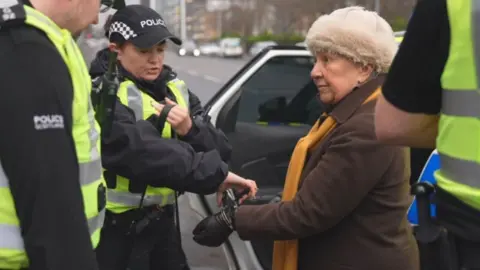
BBCA woman who was arrested and charged for taking part in an anti-abortion protest outside a hospital in Glasgow has had her case dismissed.
Rose Docherty, 75, became the first person charged under the Abortion Services (Safe Access Zones) Act after holding up a placard outside the Queen Elizabeth University Hospital (QEUH) in May, and again in September.
Under the laws, introduced in 2024, activities which could "influence or alarm others around hospitals and clinics where terminations are carried out" are prohibited.
A spokesperson for the Crown Office and Procurator Fiscal Service said: "COPFS notes the decision of the court and will consider it carefully."
Doctors at the hospital have previously told BBC Scotland News that the protests, which have been held outside the hospital for about 10 years, were upsetting and intimidating for patients and staff.
 PA Media
The Abortion Services (Safe Access Zones) Act prevents any protests or vigils from taking place within 200m (650ft) of 30 clinics around the country.
It is a criminal offence to behave in ways that could influence the decisions of women and staff to access services within the buffer zones.
Stopping women and staff from entering the clinics or otherwise causing alarm, harassment or distress is also an offence.
Anyone who breaks the buffer zones law could be fined up to £10,000 or an unlimited amount in more serious cases.
'Judgemental protests'
Docherty was arrested close to the QEUH holding a sign that said: "Coercion is a crime, here to talk, only if you want."
She previously told BBC's Scotcast that the arrest was an "alarming" and "surreal" experience.
At the time, she told the programme: "I don't feel I was breaking the law because I feel this law is an unjust law.
"I was just standing with a sign that was stating a fact that coercion is a crime.
"I was there to speak with people only if they wanted to speak with me. I wasn't approaching anyone, I wasn't behaving in a manner that was intimidating or harassing anyone."
Dr Greg Irwin, a doctor at the QEUH, was pictured confronting a group of protestors in February 2023, saying that they "cause emotional upset to patients, but also to staff members".
He previously said: "One in three women will make use of abortion healthcare, so judgemental protests at the hospital gates have a real and unpleasant effect, particularly on these staff members.
"But they also affect other staff, like myself, who find it infuriating to know that there are protesters outside the hospital intimidating patients on their way in.
"It's such an unbelievably cruel and unkind thing to do, and it bothers me throughout the protest period."
