'My 17-year-old was brutally killed, but I'm glad she fought for freedom'

 Family handout
An abandoned Myanmar military camp sits atop a wooded hill, overlooking a picturesque lake which is well known in these parts because of its unique heart-like shape.
Landmine canisters and spent bullets litter the ground. Yellow wildflowers have sprouted through piles of corrugated tin sheets strewn about where soldiers’ barracks used to be. Hastily dug trenches line one part of the camp.
Warning: You may find some of the details in this piece disturbing
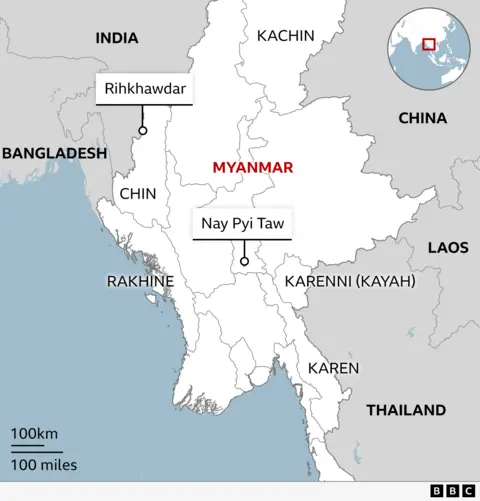
Under the overcast sky, a flag flutters in the wind - red, white and blue horizontal stripes with the picture of a hornbill at the centre – the flag of the Chin National Army (CNA), an ethnic armed group fighting against Myanmar’s military junta in the western Chin state.
Seven months ago the CNA, along with local armed civilian groups, pushed Myanmar’s army out of this camp at Rihkhawdar – a border trade town with India – and from other areas in the Chin state. It’s an unprecedented advance for Chin insurgents fighting against Myanmar’s military dictatorship which crushed the country’s fragile democracy in a coup in 2021.
It is the first time that the military has lost control of these areas, and the BBC has had rare access to see these rebel advances in the west of the country.
The win at Rihkhawdar was not straightforward. It came after multiple offensives were launched for more than a year. And for some families it came at an excruciating cost.
 BBC/Aakriti Thapar
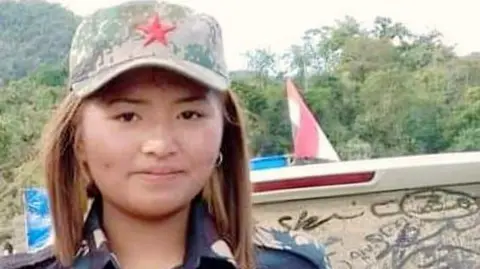
Seventeen-year-old Lalnunpuii loved dancing. Her social media feed was full of her imitating trending viral videos.
“She used to sassily dance around all the time. But she was not into dressing up. She used to idolise soldiers and would listen to songs all day that talked about soldiers who dedicated their lives for the country. She was brave and strong, and not scared of anything,” says Lalthantluangi, Lalnunpuii’s mother.
After the coup, the teenager convinced her parents to allow her to join the armed civilian movement in their village Haimual. In a handwritten essay at school, in English, she explained why.
“Myanmar is broken now… The soldier of Burma are enemy for me because they have no mercy... My future is People Defence Force and I like it,” it read.
In August 2022, armed civilians from her village along with other groups launched an attack on Rihkhawdar camp.
“We rained drones on them for 13 days straight. Most of the bombs were made by me as I was the main welder for my unit,” says Lalzidinga, Lalnunpuii’s father. A truck driver before the coup, he became one of the organisers of the People’s Defence Forces in Haimual.
They were unsuccessful in taking the camp during this attempt, but there were casualties on both sides.
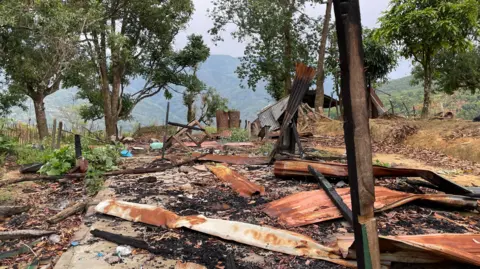
On 14 August 2022, in an apparent retaliation for the attack, the Myanmar army stormed into Haimual village. Residents tell us they torched nearly a dozen homes. We saw the remains of many such houses. There are accusations against the Myanmar army of burning tens of thousands of civilian homes in the north and west of the country, in a bid to suppress the resistance.
In Haimual, Lalnunpuii and her fifteen-year-old brother Lalruatmawia were among 17 people taken hostage by the army. All except the siblings were released. Their family believes the army was taking revenge against their father.
Two days later, their bodies were found by villagers in a shallow grave in a forest outside Haimual.
Both had been brutally tortured and bludgeoned to death with the butt of a gun. Lalnunpuii had been raped. Her brother’s chest, arms and genitals bore burn marks from boiling water. The BBC has seen detailed photographs of the bodies and the post-mortem reports.
Myanmar’s military is yet to respond to the BBC’s questions about these allegations.
 Family handout
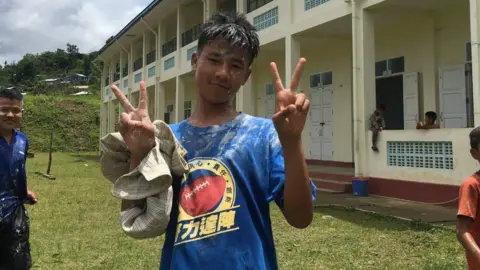
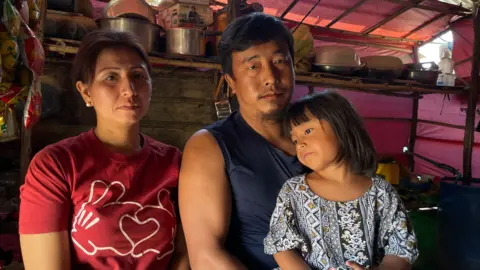
“I don’t have the courage to think of what happened to my children,” says Lalzidinga, pausing for a moment, struggling to find words. “My children were martyrs. I didn’t deserve them.”
A bit later he continues. A proud father speaking lovingly of his children. “My son had become two inches taller than me. He was talkative and he didn’t hesitate to do any work around the household,” he says. “The two were inseparable. My daughter brought joy and laughter to gatherings.”
Lalthantluangi wipes tears from her face and cradles their youngest daughter, four-year-old Hadaci.
“I tell my husband not to be discouraged by our children’s deaths. It’s not just about us. The coming generations too need freedom. Living in such a state where you don’t have any rights, where you’re at the mercy of the military, that is not correct. It is a fight worth sacrificing one’s life for. I am so proud of my children,” she says.
 BBC/Aakriti Thapar
Through our time in Myanmar we meet people dressed in military fatigues, some carrying assault rifles and other guns – not professional soldiers, but farmers, students, ordinary people displaying remarkable resolve in the face of a savage conflict.
Commander Vala of the People’s Defence Forces points to the lush green valley below Haimual and tells us with a smile that the Myanmar military has been pushed out of all of it, and their closest base is now more than 30 miles (48km) away as the crow flies. At the local cemetery he shows us fresh graves, covered with pink and white plastic flowers.
“These are the people who died fighting against the junta,” says Vala as he straightens a bouquet that’s fallen over near the grave of his brother-in-law. We also spot Lalnunpuii and Lalruatmawia’s graves.
 BBC/Aakriti Thapar
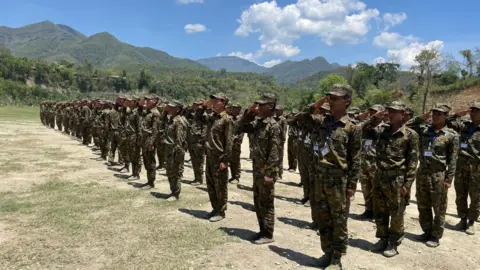
Most of the civilians we meet were trained in the CNA’s Victoria Base, south of Haimual. Driving on winding, bumpy roads through dense forests and mountainous terrain we arrive at the base.
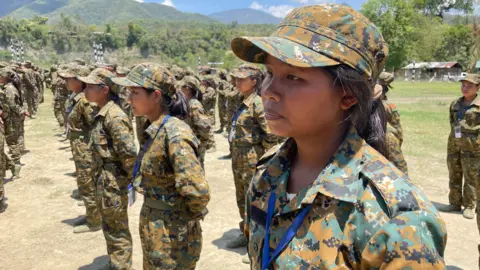
We see hundreds of youngsters, new recruits in uniforms, marching in an open field.
“Our motherland, the land we love, we’ll defend it with our blood and life,” they sing as the drills end.
It’s followed by weapons training. We hear shots ring out later.
We’re told they are all over the age of 18, but many looked younger. Masses of teenagers who had a taste of freedom when Myanmar moved towards democratic rule in 2011, and who now find military rule unacceptable, have chosen to abandon their dreams to join the uprising.
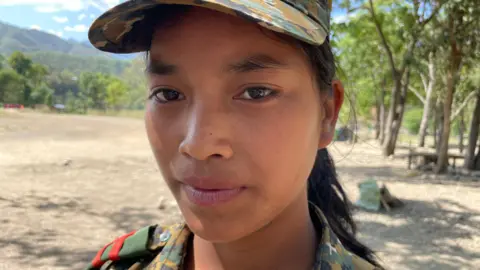
Nineteen-year-old Than Dar Lin had aspired to be a teacher.
“The first year after the coup wasn’t too bad. But then the military began shelling our village. It destroyed our home. Troops entered our village, burnt houses and killed people, and even our animals. We fled to the jungle, so many of us, that the jungle itself became a village,” she says.
“My uncle was cruelly shot dead. I hate the military, and so to defend my country and my people I joined the CNA,” she says.
 BBC/Aakriti Thapar
Almost everywhere we go, we see Myanmar’s young swept up in a wave of revolution.
Thousands who worked for the Burmese state have also switched sides.
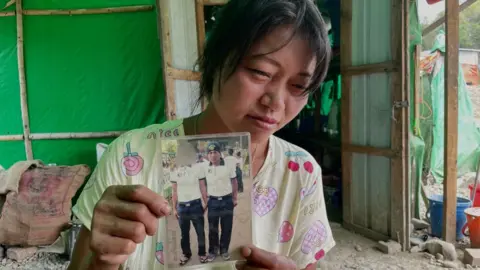
Twenty-two-year old Vanlalpekthara was a policeman.
“He used to earn a comfortable salary. We were happy and content. But then the government was overthrown in a coup and he decided to join the resistance,” his mother Molly Khiang tells us, bringing out three well-worn photos of her son from when he was in police training.
 BBC/Aakriti Thapar
Speaking of her own youth, spent under military rule, she says, “There wasn’t a single day of joy back then. We were so scared of them. That’s why I supported my son’s decision.” Six days after he joined rebel forces in March 2022, Vanlalpekthara was killed.
“My son was stabbed here and here,” says Molly pointing to her chest and back. “He was brutally assaulted. His foot was cut off,” she continues breaking down. “It’s hard to talk about it.”
Vanlalpekthara’s wife was pregnant with their child when he died. Their baby boy, now nearly 18 months old, is living in a refugee camp further away.
Molly pumps her fist in the air when I ask about how she felt when the military was pushed out of her village. “I’m so happy, but I want to see full victory.” Her second son is also part of the People’s Defence Forces.
 BBC/Aakriti Thapar
It’s this support of swathes of ordinary citizens that has propelled relatively weaker rebel forces to turn the course of this conflict and push the far more powerful and well equipped Myanmar military on to the backfoot.
“They appeared to be winning at first. But whether it’s war or politics, without the support of the people, no one can win. They may have superior weapons, but they do not have the people on their side,” says Pa Thang, a politician who’s been named “prime minister” of a parallel government established by rebel groups in Chin state. He’s also a member of Aung San Suu Kyi’s National League for Democracy.
The parallel government claims to control nearly 80% of the territory of the state, although Myanmar’s military still controls most of the strategic towns including the capital.
But the rebels have momentum – earlier this week they took over Tonzang township.
 BBC/Aakriti Thapar
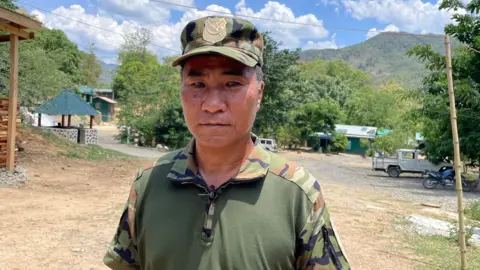
“This is our land. It’s not the land of the Burmese military. We are winning because we know every corner of it intimately,” says the CNA’s spokesman Htet Ni.
Another key reason for their success is that a number of rebels groups in different parts of the country have aligned together, forcing the military to choose where to focus their efforts. The CNA says it’s allied with the Kachin Independence Army, the Karen National Liberation Army and the Karenni Army.
The biggest challenge facing rebel forces is infighting among different groups. Numerous factions operate within Chin state alone, and traditionally many of them have been hostile to each other.
Pa Thang insists they can maintain unity, and also says they have a plan for the future to operate under the National Unity Government (NUG) which represents the elected civilian government led by Ms Su Kyi, who was jailed by the military following the coup.
“We are diligently writing laws and a constitution. We will have two ministers and one deputy minister from the Chin State as part of the NUG. We are keeping everything ready for when the Myanmar army concedes defeat,” he says.
What’s evident among everyone we met is a belief they can win.
“It won’t be long," Pa Thang says. "It’s not good to make predictions about such things but I have faith that we won’t be fighting for more than two to three years.”
Additional reporting by Aakriti Thapar and Sanjay Ganguly
