Why was 'awful' school toilet paper a bestseller for so long?

 Alamy
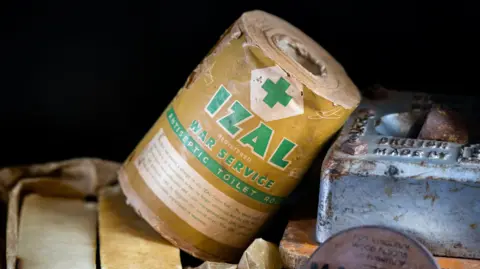
AlamyIf you were born before 1980 you will probably remember Izal medicated toilet paper, a staple of schools, hospitals and many households.
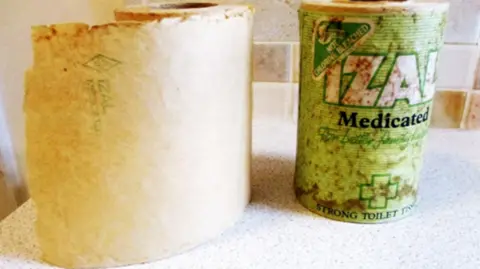
Hard, shiny, barely absorbent, and smelling of disinfectant – even some of those who sold it agreed it was "awful". So why was it a bestseller for so long?
Writer and broadcaster Adrian Chiles, who was born in 1967, still remembers using Izal toilet paper both at home and at school.
"It seemed normal to me until I noticed the other kids didn't like going to the toilet because they couldn't deal with the toilet paper," he says.
He has no idea why his mum bought it but says he still has a fondness for it.
"I'd love to have a pack of it now just for nostalgia's sake.
"I'm fully aware of its many limitations but I used it until I was 7 or 8."

Izal medicated toilet paper was invented by a coal-processing company in Sheffield called Newton, Chambers & Co Ltd.
"The story is that workers at the coke ovens were getting some of the tar on their hands and arms, and they noticed their cuts and abrasions were healing very quickly," Sheffield historian Joan Jones told the podcast Toast, which examines successful brands that still eventually failed.
"So the firm appointed a chemist called Jason Hall Worrall and he discovered the by-product [from the tar] had germicidal i.e antiseptic qualities."
It was used to make a new disinfectant called Izal in the 1890s and soon it was being added to all sorts of products, including a new toilet paper.
Alice White, digital editor at English Heritage, says people were "used to hard toilet paper" in the early 20th Century, with many using alternatives like newspaper.
"One other brand of toilet paper - its selling point was that it wouldn't give you splinters!" she says.
The addition of disinfectant to its toilet paper was a selling point for Izal. Its adverts in the 1930s called it "an invisible guardian against risks to health".
"A lot of the claims were based around what people knew the disinfectant could do rather than what the toilet paper could do," says White.
"So the disinfectant did disinfect, but one researcher wrote in their notes: 'It seems that the antiseptic or disinfectant qualities of the paper are nil. It is pure eye wash.'"
 Raymond Banyard
Newton Chambers initially gave the toilet paper away to local authorities who placed bulk orders for their liquid disinfectant.
It meant the medicated toilet paper began appearing in public toilets, hospitals and schools.
Softer alternatives were viewed with suspicion – seen as unnecessary, even frivolous, or not strong enough to do the job.
But in the mid-20th Century new competitors approached the market differently, emphasising comfort rather than hygiene.
White says brands such as Andrex made the contrast clear, promoting the idea that toilet paper should be "soft not stiff, shiny or scratchy".
Sales of the softer varieties began to take over.
Izal introduced its own soft toilet paper, but the brand's old image was hard to shake.
Its hard toilet paper survived for years as a niche product.
Jayne Howe, a former marketing director at Jeyes which bought the Izal brand in 1986, recalls that people would write to the company asking where they could buy it.
"Most of the letters were coming from older people, 70-plus, that had grown up with it," she says.
Falling demand led to lower production volumes, which pushed up costs and made it harder to keep the product widely available.
Attempts to reinvent it as a moist toilet tissue were ruled out.
"It was associated with this awful product that nobody really could understand why anybody had used it," says Howe.
"So you just couldn't see how you could modernise to a wet wipe and put that name on it."
In the face of falling financial returns, Jeyes discontinued Izal toilet paper in 2010.
A product that had once dominated the market and been used on millions of suffering bottoms quietly disappeared.
