The 'mysterious' Long Man of Wilmington

 Getty Images
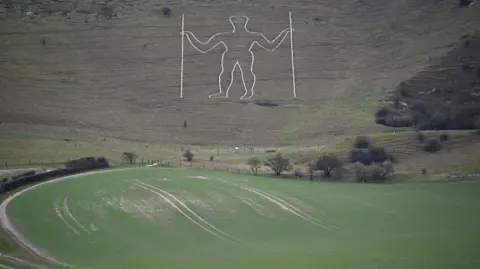
The "mysterious" Long Man of Wilmington, one of Britain's most recognisable chalk figures, sits proudly on the steep slopes of Windover Hill in East Sussex.
According to the Sussex Archaeological Society, the giant, depicted as a standing human figure holding two long staves dates back to at least 1710 when the surveyor John Rowley illustrated the figure.
James Neal, who looks after the figure on behalf of this charity, says it is accompanied by "a lot of mystery".
"No-one really knows the true origins of the outline of the figure. Some people think that it's Neolithic, some people think that it's Iron Age, Roman, the Druids claim him for their own as well," he told Secret Sussex.
Neal said the figure was originally thought by some to be "an indentation in the side of the hill".
This tallies up with Rowley's drawing which suggests the original figure was a shadow or indentation, rather than a solid line.
Until the 19th Century when it was marked out in yellow bricks, the Long Man was only visible in certain light conditions.
Since then the figure has been redrawn and restored several times, and during the World War Two it was deliberately obscured with green paint.
The yellow bricks were replaced in the 20th Century.
Neal said: "Although he looks like a chalk figure, he is actually made out of concrete blocks at the moment which were put in in 1969."

When asked why the Long Man is in this specific location, Neal says the true answer is unknown but the area does have "a strong relationship to the constellation of Orion".
This enduring mystery feeds into the "spiritual undertones" which Neal says he feels characterises the entire area.
Whether it was intended as a territorial marker, a religious symbol, a piece of early landscape art, or something else entirely is still unknown, and may never be.
Follow BBC Sussex on Facebook, on X, and on Instagram. Send your story ideas to southeasttoday@bbc.co.uk or WhatsApp us on 08081 002250.
