University facing 'worst crisis since WW2' as staff begin five-week strike

 BBC
BBCThe University of Dundee is facing the worst financial crisis of any British higher education institution since World War Two, its principal has said as lecturers begin an unprecedented five-week strike.
Prof Nigel Seaton, interim principal and vice-chancellor, made the claim as staff take industrial action over the threat of compulsory redundancies.
Members of the UCU union will not take part in lectures, seminars or tutorials until after 23 October.
The vote for "last resort" industrial action is the latest move in a dispute that began almost two years ago when the university announced a £30m deficit.
Since then, 675 jobs have been lost through voluntary redundancy, and the university has received bailouts of £40m from the Scottish government and £22m from the Scottish Funding Council.

The latest of wave of cuts was announced in June proposing to close 187 posts. However, that figure fell to 154 job losses by August.
Since the announcement, UCU bosses said there had been 149 applications for voluntary redundancies, which should now rule out the need for compulsory redundancies.
Dr Melissa D'Ascenzio, co-president of the Dundee UCU branch, told BBC News: "None of our members want to go on strike for five weeks, this is absolutely last resort that we've come to.
"The university is still refusing to remove the threat of compulsory redundancy.
"There has been no attempt from the university to try to find common ground and try to avoid five weeks of disruption."
She later told BBC Radio Scotland Breakfast that the university had "no way of knowing" how many lectures and tutorials would be impacted.

Prof Seaton said he expected most classes to run as normal and that the university would seek to minimise the impact on students.
He said: "We're committed to ensuring the university recovers from this very deep financial crisis, and unfortunately, very regrettably, we can't afford to pay the level of staff for the level of staffing we have now."
He told BBC Radio Scotland Breakfast: "We have been in the worst financial crisis to affect any British university at least since the Second World War."
Prof Seaton said the university would do all it could to avoid compulsory redundancies, adding that 85 people had been offered voluntary redundancy and new jobs offered to eight at risk of redundancy.
After unions disputed the amount of savings required, he insisted that the university's audited accounts were "correct".

The interim principal said he was "pretty confident" that most classes would go ahead, and that there was "light at the end of the tunnel" for the university.
He described the latest round of redundancies as "particularly regrettable because this crisis was caused by poor leadership and inadequate corporate governance was not caused by the staff of the university".
Prof Seaton added: "The staffing levels have been reduced by almost a third, which is an astonishing number, but it reflects how very substantially overstaffed we were before."
The University of Dundee is the only one of Scotland's 19 higher education institutions to have suffered a financial collapse.
A House of Commons report published earlier this year found that while no English university had ever closed due to insolvency, 24 higher education institutions were at risk of financial collapse.
Welsh universities are also facing financial difficulties, recording a joint deficit of £116m for 2024-25.
No assessment boycott
Lecturers previously went on strike for three weeks in February last year. Two voluntary severance schemes have now run at the institution, with previous rounds focused on professional services staff who work alongside academics.
But the latest round of redundancies over the summer was aimed at lecturers and researchers.
Union officials said they were keen to highlight the impact of previous cuts to student services and the student experience.
BBC News understands that while lecturers are not required to notify the university in advance of taking strike action, some academics told students during freshers week that their classes might not be on.
Iain Ellis, co-president said: "New and returning students will be impacted at the start of term, which is hugely regretful, but we're also clear that university management cutting more jobs and more staff leaving will have a major and long-term impact on students' education and the university."
Tom Christisen, president of the students' association (DUSA), said he recognised that the action could have a significant impact on students.
He said: "At the same time, we recognise why staff have reached this point. The prospect of compulsory redundancy has created significant uncertainty for colleagues about their jobs and futures at Dundee.
"Our responsibility is to stand up for students throughout this period, while continuing to press the university to address the circumstances that have led to industrial action.
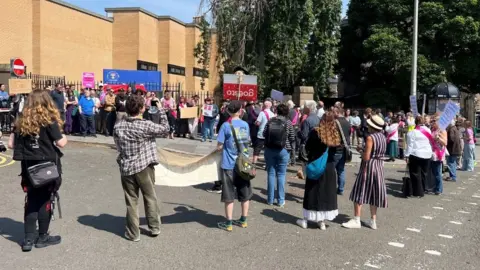
UCU members at the campus are already working to contract, refusing to carry out "extra" unpaid tasks, such as attending weekend open days.
This is unlikely to stop unless the dispute is resolved. It does not currently include a marking or assessment boycott.
In previous strikes, a "no-detriment" policy was applied to prevent students being penalised and removing untaught topics from assessments.
UCU officials told the BBC they would expect this to apply again now.
UCU members are now striking each weekday for over a month, as the university refuses to rule out compulsory redundancies.
A Scottish government spokesperson said: "Industrial action is in no-one's best interests – least of all students' – so while the Scottish government cannot intervene directly, we encourage universities and trades unions to engage constructively and seek resolution to these disputes."
