Silvertown Tunnel cuts delays in first year, says TfL

 PA Media
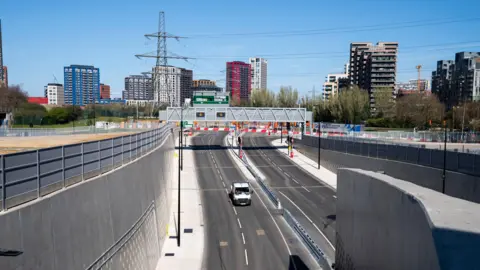
The £2.2bn Silvertown Tunnel has reduced congestion in its first year of operation, according to a new Transport for London (TfL) monitoring report.
The 1.4km (0.9 miles) toll tunnel, which opened in April 2025, links Silvertown and the Greenwich Peninsula in east London.
The scheme was designed to ease pressure on the Blackwall Tunnel, which drivers had previously used for free, and TfL says it has largely succeeded.
Sir Sadiq Khan said it was a success that was "not only cutting journey times but encouraging more sustainable transport", but the Stop the Silvertown Tunnel Coalition said a year was "too soon to assess the long-term impact" and argued the toll, not the tunnel, had cut delays.
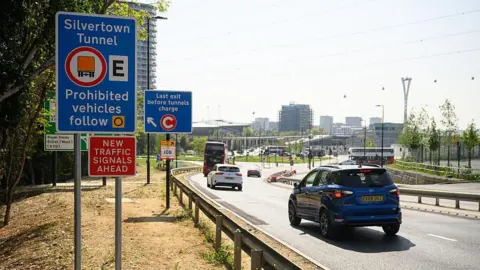
Drivers using both tunnels pay up to £4 per crossing during peak hours, which TfL says helps to pay for traffic management and the cost of running them.
'Journey times cut'
TfL's 12-month monitoring report said journey times had fallen significantly around the Blackwall Tunnel, with northbound journeys between Sun in the Sands and the tunnel being, on average, 58% quicker during the morning peak and 47% quicker in the evening peak compared with 2024/25.
The report also found:
- Morning peak journeys on the route were 126% faster, while southbound journeys between Bow Roundabout and the Blackwall Tunnel were 70% faster
- There was a 2% decrease in weekday northbound traffic on the A12
- A 23% reduction in over-height vehicle incidents at the Blackwall Tunnel since the new tunnel's opening - before the Silvertown link opened, the Blackwall Tunnel saw 700 closures a year which were often caused by stuck HGVs
- Journey times at the Rotherhithe Tunnel had increased, with weekday traffic rising by 3%, but attributed this to issues in key operating systems.
- Demand for the Woolwich Ferry also stands above pre-Silvertown Tunnel levels, with operations also affected by technical problems
- Average nitrogen dioxide (NO₂) concentrations in the area had fallen by 17% compared with the year prior to the tunnel opening, but this had also been declining over the past five years
- Traffic across both east London river crossings has remained below pre-tunnel levels, with no increase in weekday cross-river journeys despite the opening of the Silvertown Tunnel
TfL said more than 11% of all tunnel trips were now made by bus, a 290% increase on levels before the tunnel opened, with more than 10,000 journeys crossing the Thames each day on routes 108, 129 and SL4.
When the tunnel opened, TfL offered free bus journeys on routes using the Silvertown and Blackwall tunnels. This offer ended on 26 May 2026.
TfL said a free cycle shuttle service was used between 100 and 130 times each weekday between April and October 2025, with much lower demand during winter months.
Alex Williams, chief customer and strategy officer at TfL, said: "By making it easier to travel by bus across and near the river, we're also seeing a surge in customers choosing to travel more sustainably."
 Getty Images
A number of concerns were raised by councillors and campaigners before the tunnel opened, many of which remain a point of debate.
The Greenwich Society, a community group that opposed the project, said the new tunnel had shifted traffic elsewhere rather than solving congestion.
A spokesperson for the society also said the tunnel charges had pushed drivers towards toll-free crossings, including the Woolwich Ferry, Tower Bridge and the Rotherhithe Tunnel.
Concerns were also raised about how the tunnel would operate.
Newham and Greenwich councils both originally called for the tunnel to be repurposed exclusively for public transport, while campaigners questioned plans allowing HGVs to use the dedicated bus lane.
TfL previously said it expected to repay about £100m a year through toll revenue. The transport body said the repayment for the last financial year was about £67m.
Responding to TfL's latest assessment, the Stop the Silvertown Tunnel Coalition said it stood by its view that the tunnel was an "immense waste of public money".
The group said: "The solution was always to toll the Blackwall Tunnel and invest the £100m per year proceeds in modernising London's public transport and active travel infrastructure."
It added the report showed fewer vehicles were crossing the Thames in east London than before the Silvertown Tunnel opened and that the improvement in traffic was mainly down to the new tolls discouraging people from driving, rather than the extra tunnel capacity.
But Khan, London's mayor, said he was "particularly pleased to see major reductions in congestion at the Blackwall Tunnel benefitting businesses and local residents".
Listen to the best of BBC Radio London on Sounds and follow BBC London on Facebook, X and Instagram. Send your story ideas to hello.bbclondon@bbc.co.uk
