Inside UK's 'most complicated' bridge demolition

 BBC
BBCIt has been nearly 500 days since the sudden closure of the Gateshead Highway flyover, prompted by "serious concerns" about the possibility it might collapse. This week, the structure's demolition finally begins in earnest.
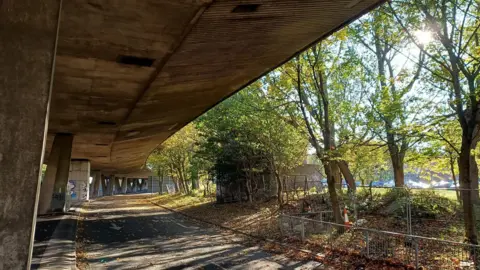
But what does it take to knock down a bridge that goes over two large roundabouts and lies next to shops, blocks of flats and a school? Not to mention the fact it runs above tunnels through which the Tyne and Wear Metro runs.
"It's probably the most complicated demolition project going on in the country at the minute," says one of the people leading the project, Jim Smyth, from construction company Bam.
Here is what is known so far about the demolition, how it may affect your commute, and what consequences there may be for those living or working nearby.
At the end of 2024, the 0.6 mile (0.95km) A167 flyover was carrying about 40,000 vehicles a day
But the 1960s post-tensioned structure was closed on 13 December that year after inspectors flagged serious concerns about one of its supporting pillars. It was subsequently revealed the flyover had major issues with drainage and there was water seeping through it.
The demolition, approved last year, was estimated to take six months and be complete in October.
 Gateshead Council
The first stage in any demolition is figuring out which method to use. Blowing the flyover up was one of many options considered by Smyth and his team. But this "just wasn't feasible", he says, given its proximity to other buildings, roads and the Metro.
Another problem with this method was the need to "pre-weaken" the structure first, to ensure it collapsed in a controlled way.
"Everyone lost their appetite when you thought - oh, you've got to pre-weaken a weak bridge," Smyth says.

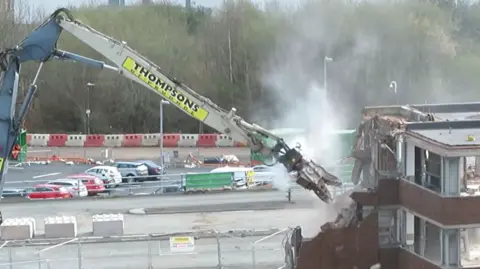
Eventually the team decided they would break down the flyover mechanically, piece by piece, using machines colloquially known as munchers.
These claw-wielding cranes will methodically crunch and pulverise the concrete.
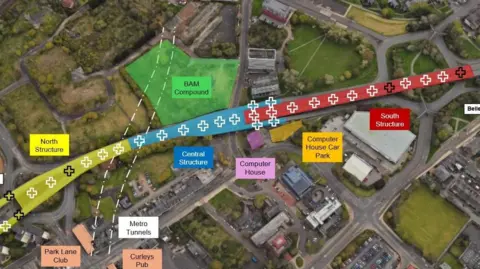
Estimated to cost up to £18m, the demolition will be split into three main phases: the destruction of the central section, then the sections above the two roundabouts and, lastly, the part which lies directly above the Metro tunnels.
But, to do this, the team had to consider two of the bridge's main design features.
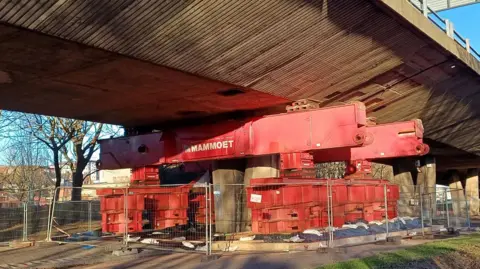
The first is the fact the bridge is constructed like a seesaw in that it is balanced in the middle. This means one side cannot be demolished without the other side becoming unbalanced and tipping over.
"We have to work from either side at the same time," Smyth says, comparing the action to using a typewriter.
 Gateshead Council
The team's other key consideration is the post-tensioned steel cables which run throughout the flyover to reinforce it. These cables generally cross multiple sections, so demolishing one part of the bridge may affect the support provided by the cables elsewhere – creating a risk of collapse.
To account for this, the team will use steel props to support one part of the bridge while another is being destroyed. These props will move along the flyover in tandem with the demolition.
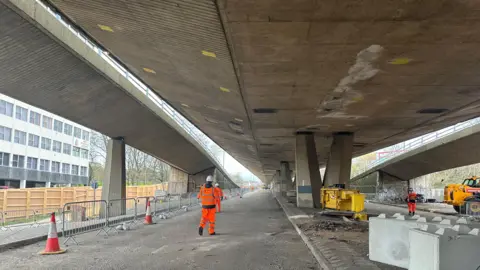
Gateshead Council is yet to say exactly how traffic will be affected during the six-month project. It is still finalising its plans with major routes unlikely to be affected until later this summer, it says.
Nevertheless key roads, and Park Lane and Bellevue roundabouts,are expected to be shut for multiple weeks and some bus routes and footpaths have already been diverted.
A scaffold screen has been put up to protect nearby office building Aidan House from debris but the local authority has not said what plans it has for a nearby blocks of flats.
 Gateshead Council
Some 24-hour working during the project is expected, says Smyth. This could include breaking down the bridge during the day and then loading and removing rubble overnight.
The council says it expects Metro trains to continue running through the tunnels underneath the demolition.
The team has put sensors in the rail tunnels so they will be alerted if the demolition causes even miniscule shifts in the structures.
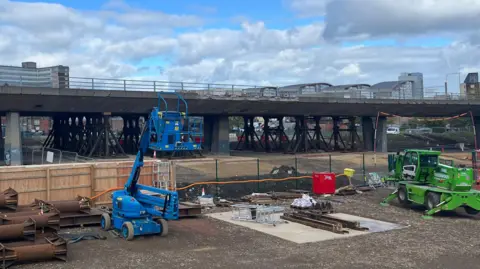
Smyth says the project has generated interest from engineers across the country.
"There's not a bridge of this size, of this design, which has been demolished before that we're aware of," he says.
But there are multiple similarly designed bridges all around the UK, built about the same time as the Gateshead flyover, so he does not believe this will be the last demolition.
"Concrete only has a given lifespan," he says.
"There will be plenty more."
