Why is Hertfordshire preparing to bin its councils?

 Getty Images
An announcement is expected from the government this week on a major shake-up of Hertfordshire's councils.
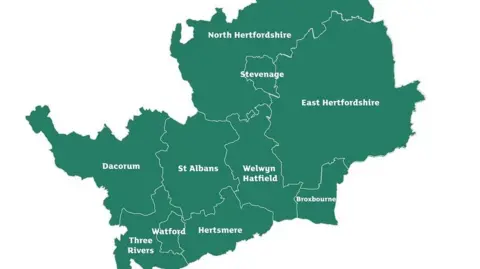
The existing county council with 10 districts and boroughs could be replaced with as few as two all-purpose authorities.
The government says it wants to make the system more financially sustainable and make it easier for residents to get the help they need.
But what could all this mean for people in Hertfordshire?
 Hertfordshire County Council
Why is the shake-up happening?
At the moment, Hertfordshire has a county council which looks after services such as social care, highways and education.
There are also 10 district and borough councils which handle more local duties such as planning, leisure, housing and waste collection.
This means it can be difficult for residents to work out who to talk to about a particular service.
The government believes creating bigger councils will save money and make it easer for residents to understand who is responsible for different services.
It also feels reducing the number of councils will ease local competition for staff, as well as cutting costs associated with elections and councillors.
Both Bedfordshire and Buckinghamshire already have unitary authorities covering Milton Keynes, the rest of Buckinghamshire, Luton, Bedford and Central Bedfordshire.
What are the options for Hertfordshire?
The existing councils were asked to submit proposals to the government.
Ministers said the new all-purpose or "unitary" councils should have a population of 500,000 or more - although they suggested there would be some flexibility.
The option of having one unitary authority for Hertfordshire has been rejected, but there are still proposals on the table for two, three or four councils covering the county.
What would a two-council county look like?
 Hertfordshire County Council
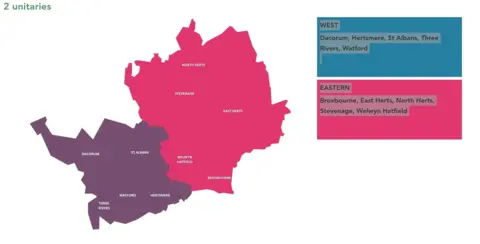
The option of two councils is favoured by Hertfordshire County Council and St Albans City and District Council.
Both authorities are Liberal Democrat controlled.
A West Hertfordshire Council would group together:
- Dacorum
- Hertsmere
- St Albans
- Three Rivers
- Watford
An East Hertfordshire Council would group together
- Broxbourne
- East Herts
- North Herts
- Stevenage
- Welwyn Hatfield
Proponents argue that the two council solution would create councils that are big enough to "drive system-wide change" and yet small enough to stay close to local communities.
Opponents say a West Hertfordshire Council would be too large to be able to react to local concerns.
What about the three-council option?
 Hertfordshire County Council
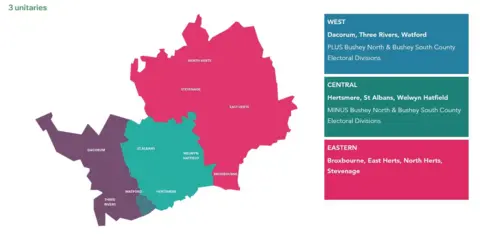
Creating three unitary authorities is the preferred option of East Hertfordshire, Three Rivers and Watford - all of which are either wholly or partly led by the Liberal Democrats.
Under this proposal, an East Hertfordshire Council would combine:
- North Hertfordshire
- Stevenage
- East Hertfordshire
- Broxbourne
There would be a Central Hertfordshire authority consisting of:
- St Albans
- Welwyn Hatfield
- Hertsmere
The final member of the trio would be West Hertfordshire, made up of:
- Dacorum
- Three Rivers
- Watford
- The town of Bushey (currently in the Hertsmere area)
The councils felt that the vast majority of people in Bushey visited the town of Watford, which is in the West Hertfordshire area, and many worked there.
Therefore, it was right to move Bushey into the West council.
The councils believed this solution created agile authorities with the "scale to deliver where it matters, but with the flexibility and local focus to empower every individual".
Who joins with who in the four council option?
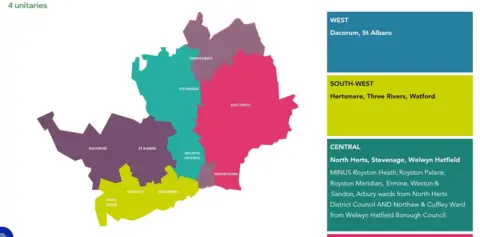 Hertfordshire County Council
The remaining existing councils favour a quartet of new authorities.
This would create North West and South West councils, alongside those covering the centre and east of the county.
A North West Hertfordshire Council would contain:
- Dacorum
- St Albans
A South West Hertfordshire Council would have:
- Hertsmere
- Three Rivers
- Watford
A Central Hertfordshire Council would bring together:
- North Hertfordshire
- Stevenage
- Welwyn Hatfield
And an East Hertfordshire Council would amalgamate:
- Broxbourne
- East Hertfordshire
- Royston (from North Herts)
- Northaw and Cuffley (from Welwyn Hatfield)
Supporters say this option would mean: "Each council is large enough to deliver essential services yet small enough to stay rooted in its communities."
So what happens now?
The government has confirmed there will be an announcement about the future of Hertfordshire this week.
Once we know which of the three options will be pursued, funding will be provided to help councils with the transition to the new system.
Elections will be called in May 2027 for a shadow group of councillors to set up the new authorities, while the existing councils continue to run services.
Then, on 1 April 2028, the present councils will cease to operate and will hand over all their assets and responsibilities to the new bodies, on what is known as "vesting day".
It is fair to say that the changeover to unitary authorities around the country has not been a complete failure nor a total success.
Despite promises of savings being made, few people have seen their council tax go down, and there is little to suggest that the advent of unitary councils has seen services improve.
Hertfordshire awaits its own fate with interest.
Do you have a story suggestion for Beds, Herts or Bucks? Contact us below.
Follow Beds, Herts and Bucks news on BBC Sounds, Facebook, Instagram and X.
