Island community 'could be cut in half by 2100'

 Jennie Dennett/BBC
A coastal community could be cut in half by rising sea levels over the next 70 years, academic experts have warned.
Walney Island at Barrow, Cumbria, could see a a potential rise of 20cm (7.8in) by 2050 and 60cm (23.5in) by 2100, according to modelling by Lancaster University.
Dr Paul Cureton, a senior lecturer in design, said changes of that scale could "potentially divide" communities with sea defences having been breached.
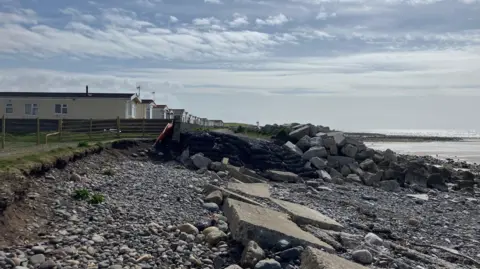
Resident Peter Wheeler said the coastline had already "changed dramatically over the last 20 years".
Wheeler, who lives at West Shore Park, said he had seen an area of grassed banking and part of a road washed away during that time.
"It's getting worse and worrying everyone," he told BBC Radio Cumbria.
Asked what he fears the effects might be in another 20 years, he replied: "We'll all lose our homes."
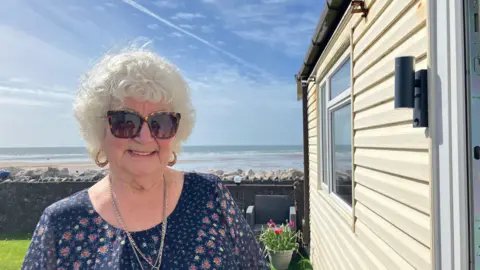
Fellow resident Pat Lumb, who has lived in the area for about 30 years, said at one time "when you looked out of your window all you saw was green grass".
"And the road was being used," she said. "You could drive down and park camper vans there. It was totally different."
Cureton said the university had created a "3D game environment" using Environment Agency data to model "what's happening or potentially going to happen".
While stressing there was a "high degree of uncertainty" around such outcomes, he said: "We can have what is called overtopping, when water breaches defences, and potentially divide Walney in half or even in thirds in some extreme scenarios.
"But these are extremes. Practically, it's about trying to find what interventions we can make as a community."
 Jennie Dennett/BBC
In January, the government announced £30m funding to help communities across the country affected by changes to the coastline.
Cureton welcomed that measure but called for long-term projects to be part of the solution at Walney and elsewhere.
"The natural thing for people to say is 'we need more rock armour' and that may be the right decision, but sometimes rock armour can have a short life," he said.
"The financing of that is also difficult in some cases so in our game solution we modelled five major groynes across the west of Walney Island and looked at how sediment would change if they were added.
"I recognise there are some immediate concerns, but it's important we make the right decisions."
The university has been holding community workshop sessions on the island in recent weeks, designed to help people living there understand possible measures.
