Miles of film and a bulb as hot as the sun - projecting The Odyssey

 BBC
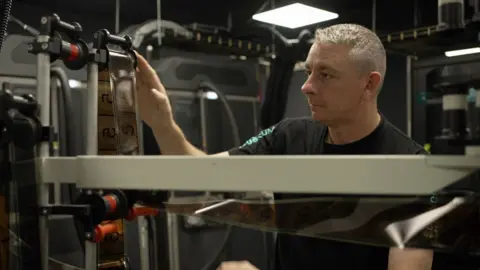
BBCJust before the matinee screening of The Odyssey, Matthew Raymond is running around the projection room in South Kensington, threading film and making checks.
He is the IMAX technical manager at the Science Museum - one of only 41 places in the world that can show Christopher Nolan's epic to full effect.
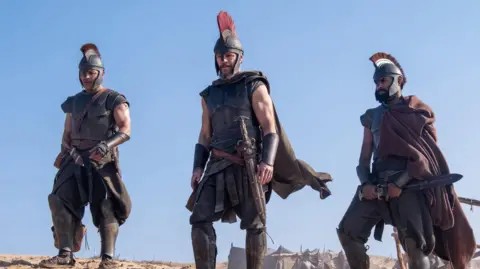
The Odyssey cost $250 million to make and was the first feature film ever to be entirely shot on IMAX 70mm cameras.
To see it as the director intended takes some precision work behind the scenes, and there are few projectionists that still have the knowledge.
Matthew says it is "nerve-wracking" taking care of the valuable film stock and he needs a "little bit of paranoia" to keep him focused so nothing goes wrong.
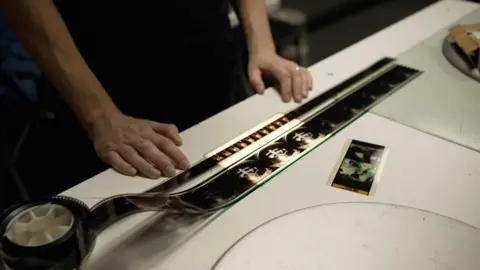
In the carefully controlled humidity of the projection room at the Science Museum, Matthew stretches out two pieces of film over a light box.
The room can't be too dry or the film might curl or flake.
He wants to show me the scale of the IMAX 70mm, compared to the 35mm film typically used "back in the day" in most multiplex cinemas.
"There's no audio on the IMAX frame," he says, "they use the full image area for just the picture. The sound is separate on a hard drive."
By the time it is beamed onto an IMAX 1.43:1 screen - a rare, nearly square aspect ratio - audiences get a full frame immersion.
Matthew holds an old strip of IMAX 70mm up to his shoulder, the other end touching the floor.
"This is approximately one second of film - just under six feet (1.8m) long," he says.
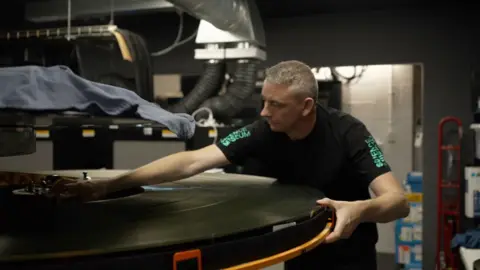
The whole print is a vast reel, 10 miles (16km) in length and as Matthew begins to lace it through the feed units, he can only just reach the middle.
"It's a very big stretch. Even me, being 6ft 3in (1.9m). Some people need a stool!"
He added: "All this I'm touching with my hands is just spare film - it's wrapped around to protect the main film. Anything that goes on screen we never touch with our hands."
According to IMAX this reel of celluloid costs $50,000 (£37,400) to replace.
To scratch or mark the film stock would be an expensive mistake and there is no margin for error.
 Universal Pictures
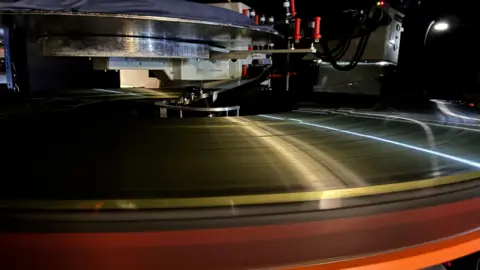
Matthew threads the film into the projector and thoroughly cleans the lens.
"For me it's one of the most crucial parts. If you don't get this clean and right then you're sat there for three hours stressing about bits of dust," he says.
Matthew and his fellow projectionists watch the whole film, each time it is screened, pressing a button that makes the lens twitch to remove a speck.
The Odyssey is 173 minutes long and being shown twice a day, so it is dedicated work.
You don't get these issues with digital versions of films we typically see at the cinema.
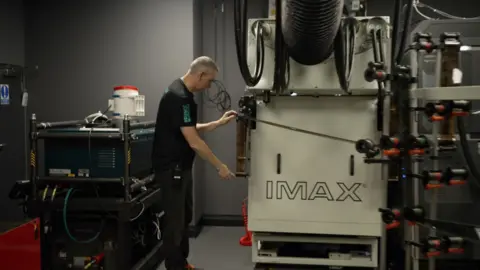
Matthew squeezes into a space by the projector to do the final loops and link ups.
"It's a bit tight because we're crammed in next to the digital system," he laughs, "but the plus side is we can run both systems simultaneously so should we have any fault with the film system, we can switch over to digital."
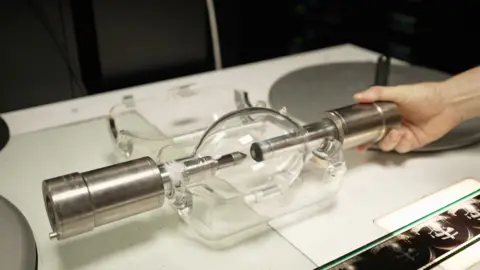
The bulb that beams light through the film inside the projector lasts 1,000 hours and costs £6,000 to replace.
The ultra-bright IMAX 15kW lamp is needed to create the crisp image on the big screen.
It works by a small charge of electricity being shot between the anode and cathode, igniting the xenon gas inside the bulb. That creates a ball of plasma "as hot as the surface of the sun," Matthew explains.
When the projectionists change the bulbs, they wear stab proof vests.
"If it explodes, we'll be picking out bits from the projector, and also - our skin."
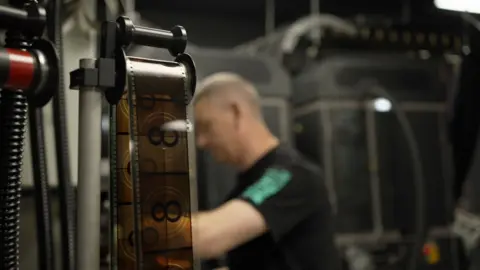
Matthew has been with the Science Museum IMAX projection team since 2005 and while he has worked with 70mm film before, nothing on this scale.
They will show the film more than 100 times and it is sold out - a huge undertaking for his team.
"Even with us three it would have been a daunting task running The Odyssey over the whole summer, but thankfully I was able to draft in a former team member."
He added: "The most rewarding part is knowing you have done everything you can to deliver the best presentation of the film that many people have been working years to deliver.
"You are the final piece of all that expertise and dedication."
Listen to the best of BBC Radio London on Sounds and follow BBC London on Facebook, X and Instagram. Send your story ideas to hello.bbclondon@bbc.co.uk
