'Race against time' to rescue native crayfish

 BBC
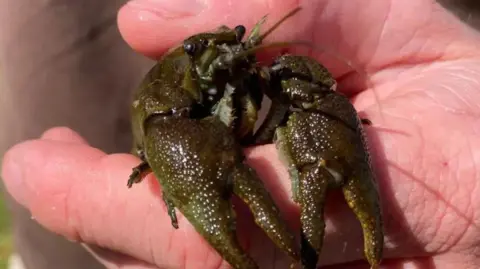
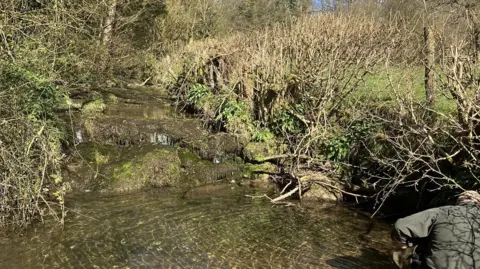
BBCNative crayfish discovered living in a brook in Derbyshire face a "race against time" to be saved from an invading species.
When a population of the under-threat white-clawed crayfish - the UK's only native crayfish - was discovered in the west of the county, a rescue mission was launched to move the aquatic animals to a safe location.
If left, the white-claws faced being outcompeted and infected by the arrival of invasive American signal crayfish and the crayfish plague they carry.
More than 80 have been rescued so far - with the Sea Life Centre in Birmingham agreeing to quarantine batches of the crayfish before they were taken to a secret "ark" site in Staffordshire.
Kath Stapley, living rivers officer at Derbyshire Wildlife Trust, said: "This site used to be a great stronghold for our native white-clawed crayfish, but it is unfortunately now colonised by signal crayfish too, and they are currently living side by side.
"However, this won't be for long, as the signals will wipe the white-claws out."
 Nick Mott
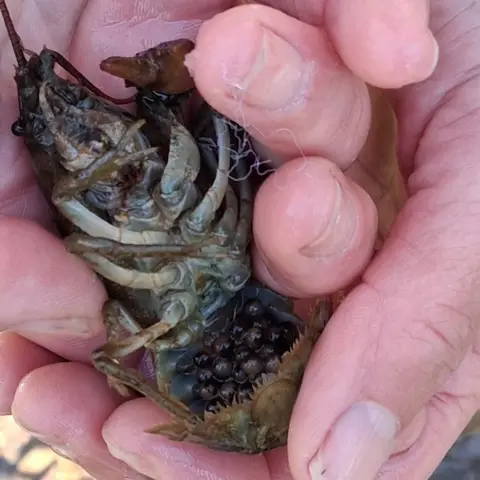
Due to this threat, the crayfish in Derbyshire needed to be removed and relocated to a protected environment.
In 2025, 60 crayfish were relocated. During a second visit in December, it was found the invasive American species had arrived.
The Sea Life Centre in Birmingham stepped in and agreed to host 23 crayfish until they could be verified as free of plague and safe to move to Staffordshire.
These have now been released into the ark site.
Natalie Emmerson, assistant curator at Birmingham Sea Life Centre, said: "We are always delighted to be able to play our part, working with such a dedicated network of people for the conservation of a native species."
 Liz Oldring
Liz Oldring, from Buglife and the Midlands Crayfish Partnership, said the plight of our native crayfish was similar to that of the red squirrel.
According to Natural England, a major cause of the decline of native reds was the introduction of grey squirrels - and the squirrelpox virus, which is fatal to red squirrels only - from the USA and Canada in the late 1800s.
She said the signal crayfish were brought to the UK to be farmed in the 1970s, but escaped into our watercourses with devastating impacts on the native white-claw population.
Liz said: "This is now a race against time - without intervention, the loss of this entire native population is inevitable.
"However, the establishment of the ark site gives us real hope for the future."
Listen to BBC Radio Derby on Sounds and follow BBC Derby on Facebook, on X, or on Instagram. Send your story ideas to eastmidsnews@bbc.co.uk or via WhatsApp on 0808 100 2210.
