Your Voice: New councils for Devon - your questions answered

 Miles Davis/BBC
Devon is going through a complete overhaul of all the councils that run services, from bin collections to fixing potholes, as the government carries out the biggest reorganisation of local government in more than 50 years.
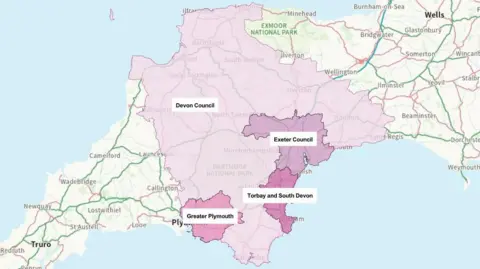
All the district councils and the county council are being abolished and the county will be split into four authorities with three urban councils of Greater Plymouth, Exeter Council and Torbay and South Devon, with Devon Council representing the rest of Devon.
With all of these changes we asked you to get in touch through BBC Your Voice with any questions about what the reorganisation might mean.
Below we try to answer some of those questions and look at the impact of these planned changes on everything from recycling to leisure centres.
 Devon County Council
As people and businesses concentrate in cities, will economic growth do the same?
There is clearly widespread concern about the sheer size of Devon Council - originally known as Coast and Countryside - and the current county council has started a legal action to challenge the government's decision.
But the Labour administrations on Plymouth and Exeter City Councils who put the plans together say the size of the new Devon Council should be a benefit with "services tailored to the challenges of dispersed, older, populations, market towns and isolated areas".
Devon Council will be the biggest council both geographically and in terms of population, with about 455,000 residents.
Plymouth and Exeter claimed the new Devon Council area would keep "sufficient scale and tax base to operate efficiently".
But the new boundaries will mean Exeter will take over key areas of investment with potential for economic growth such as the Science Park and Exeter Airport and surrounding area.
Plymouth will expand its control over areas of the South Hams which are part of the Plymouth and South Devon Freeport - while Torbay will gain a 67.2% increase in its tax base.
The government said financial viability was "one of the key criteria" in assessing all of the proposals.
Was the public properly consulted on these plans?
When the government said all of the county councils and district councils were being abolished, it asked local authorities to come up with plans for how to replace them.
Devon County Council wanted a large new unitary council under existing boundaries while some of the district councils pushed for a three-way split between Plymouth, south west Devon and a third unitary bringing the north and east of the county together.
The government's public consultation results show Devon County Council's plan was the most popular – with 43% supporting it, though 44% responded negatively.
The Plymouth and Exeter plan - ultimately backed by the government - proved the second least popular, with 68% opposing it and just 20% responding positively.
Which of the new councils will my area fall under?
Many people are likely to be uncertain as to which new council area they fall into – particularly if where they live is close to the boundary between two new authorities.
Ilfracombe, Bolberry and Holne all fall within the new Devon Council which encompasses most of rural Devon.
For anybody who wants to find out more about their own locality, Devon County Council has produced this very helpful interactive map.
In the fullness of time the new councils will also appear on the definitive Ordance Survey Election Maps – but not yet.
Will this change the recycling centre I use?
As councils restrict the use of recycling centres to residents living within their boundaries this will bring changes for some people.
At the moment people living in the Torbay area, for example, are not allowed to use the recycling centre in Newton Abbot, run by Teignbridge Council.
But that will change after reorganisation when Newton Abbot will form part of Torbay and South Devon.
At the same time some people may find they can no longer use their nearest facility once the new authorities come into force.
This map from the Devon County Council website shows most of the recycling sites in the county – minus those in the existing unitary authority areas of Plymouth and Torbay.
Will this change the hospital I go to?
Hospital services are not tied to council areas.
Derriford Hospital in Plymouth, for instance, serves a large area of West Devon and East Cornwall, already crossing multiple local authority boundaries and it is the same for Torbay Hospital.
Neither are you restricted to the nearest hospital offering the care you need.
If a GP needs to refer you for a physical or mental health condition, in most cases you have the legal right to choose the hospital or service you would like to go to.
However, that the government is keen to have the administration of as many public services as possible on the same regional footprint.
Health is no exception and the separate Cornwall and Devon Integrated Care Boards – which oversee the NHS in each county – have now been formally "clustered" together as a prelude to merging.

Will this change who runs my leisure centre?
In some areas the ownership and management of leisure centres is expected to be handed over to new local authorities.
In Exmouth, for example, leisure services are currently managed by East Devon District Council but under the new arrangement Exeter Council is expected to take control of running leisure services in that area.
At the moment you do not have to be a resident of North Devon, for example, to use leisure centres in that area - so people should still be able to choose whichever centre has the best services on offer for them.
Also, it may be that residents of Exeter, for example, will in the future have access to a wider range of services in the wider local authority area that will be covered.
 PA Media
Will this save money and will it affect my council tax?
The potential to achieve savings is one of the drivers behind moving from the two-tier county and districts model to unitaries.
According to Plymouth City Council and Exeter City Council, which proposed the new structure for Devon - now approved by the government, the transition to the new councils will cost £70.1m over four years.
Half of that is "allocated to workforce transition and redundancy costs".
This, they say, is "manageable" with the existing councils having sufficient reserves to fund the process.
Beyond that, they claim "financial modelling projects payback within three years, with cumulative savings of over £400m over 10 years".
The government has said it would contribute £3.6m towards transition costs.
There are discrepancies in council tax rates between the existing Devon councils and this process will throw together areas with different rates inherited from the old councils.
Plymouth currently has the lowest average B and D council tax at £1,965, Torbay is at £1,983, Exeter at £2,001 and the rest of Devon at £2,014.
What this will mean for householders and their bills in the four new council areas is difficult to say.
Follow BBC Devon on X, Facebook and Instagram. Send your story ideas to spotlight@bbc.co.uk.

