Has stopping a school's merger really saved it?

 Andy Watson/BBC
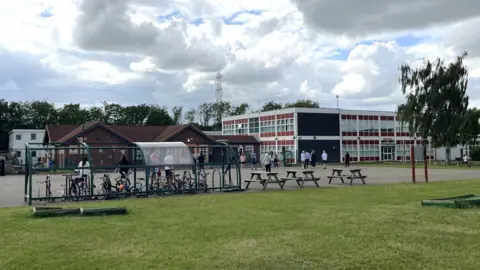
On Wednesday, teachers and parents celebrated a decision to halt plans to close their school and send its pupils to another nearby.
North Tyneside Council had proposed to close Hazlewood Primary School in Wideopen and send its students to Greenfields Primary School, due to structural problems with the building.
The plan was blocked by Schools Adjudicator Bryan Slater, who found a number of "shortcomings" in the council's proposal.
But Slater's report was not all good news for Hazlewood's supporters, as he also made clear the primary school's closure was "inevitable" and suggested the council would need to come up with a new plan.
What is a school merger?
According to Slater, a school merger takes place when one or more schools are closed and the displaced students are moved to a different, existing school.
This can involve enlarging the surviving school or changing the age range of the pupils it teaches.
Slater said this is usually carried out to merge separate infant and junior schools to form a new primary school, or to amalgamate separate single-sex schools to form a mixed school.
Was the Hazlewood plan a merger?
Technically the proposal to close Hazlewood was not a merger, according to Slater.
This is because the only changes made to Greenfields would have been to its catchment area and to increase the maximum number of Reception pupils it could teach.
Slater said the lack of changes meant Greenfields was not involved in a merger.
The plan was for Hazlewood to close and for spaces to be made available at Greenfields for students "should parents want them".
"Simply closing a school and saying that it is 'merging' with another named school does not have the effect of turning what were two schools on separate sites into a single entity on the site of the second named school, as I think the local authority imagined is the case," Slater said.
Would Hazlewood pupils have had to go to Greenfields?
The Schools Adjudicator said the council's plan made no requirement for Hazlewood pupils to move to Greenfields and parents would have had the right to apply for their child to study at another school.
"This latter statement should of course be clearer in saying that if a parent seeks a place at a school where there is a place they must be admitted," Slater said.
However, the report makes clear there is enough space in Greenfields to accommodate all of the pupils at Hazlewood.
What would have happened to the teachers?
Slater said although matters of staffing were not part of his remit, he had found information given to staff was not "wholly accurate" during the council's plan.
He said template letters provided to the school governors implied "all staff from Hazlewood would transfer to the employment of Greenfields", but this might not be the case.
The number of Hazlewood staff moved to Greenfields would have depended "entirely on the number of children whose parents choose to take up the offer of a place there".
This meant it was unclear whether Hazlewood staff would have be made redundant.
Could Hazlewood be repaired?
Hazlewood's building is suffering from structural problems caused by weak and brittle concrete but the council also wants to close it due to falling student numbers.
Slater requested details of how much it would cost to repair Hazlewood and was presented with three options:
- Installing a temporary profile metal deck to support the damaged ceilings, at a cost of £1.76m
- A full internal rebuild, costing £3.88m
- A full rebuild, costing £6m
North Tyneside Council would be responsible for paying for the work and said it was unlikely this would be seen as a "good use of taxpayers' money", especially since its total budget to maintain schools was only £4.3m.
What did the Adjudicator rule?
Ultimately, the Schools Adjudicator halted the plans because he found a number of shortcomings in the council's proposal.
However, he did not object to Hazlewood being closed and said although the school could continue to function in its current building it should not do so "indefinitely".
The proposal was rejected because it was not capable of "creating a truly 'merged' school", which was the council's intention.
Could the school actually be merged?
Slater said by the time Hazlewood's closure became inevitable he expected the council would have a "legislative route" to create a merged school.
The council previously said closing both schools and creating a replacement would have been more "complex" than its proposal.
The Schools Adjudicator agreed the laws at the time would have made it difficult for the council to open a school unless it was an academy.
However, the Children's Wellbeing and Schools Act 2026 will allow councils to create community or foundation schools in the future.
The act has received Royal Assent and Slater said he expected it to come into force "in the near future".
He said it was now down to the local authority to "bring forward further proposals", which could include merging the two schools correctly or simply making it clear Hazlewood is to be closed.
So, while the plans are halted, it could only be a temporary win for Hazlewood's supporters.
