How a shipwreck, a DNA test and Facebook solved a family puzzle
It is the story of how a shipwreck, a DNA test and a Facebook friend helped bring together relatives who lived more than 1,000 miles apart.
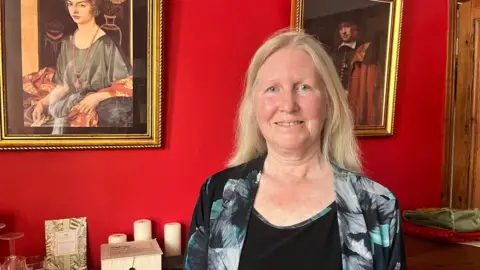
"Two years ago I took a DNA test," says Yvette Holly, from Hull. "And the DNA test told me something that I didn't know, which was I'm half Icelandic.
"I'd known for some time that I didn't know my father and I thought, right, OK, I need to find out who he was."
Yvette used a genealogy site to find the names of people she believed were her cousins, as she has been telling the Hidden East Yorkshire podcast.
One of those was a man about her age called Barour Jon Grimsson, or Bari for short.
His Facebook profile said they shared a mutual friend in Alec Gill, a leading historian of Hull's fishing industry. So Yvette got in touch with Alec.
"Alec said, 'Oh, it's because he was looking at a ship called Pamela, which was stranded off the coast of Iceland near where his grandfather lived.'
"I thought, 'Wow, what are the chances of that happening?'."

In 1915, the Pamela, a steam trawler, was stranded in bad weather in a fjord on the north-west coast of Iceland.
Bari explains: "They had to abandon ship and there were 12 men on board and they couldn't refloat it and so it stayed there and it was broken up."
More than a century on, parts of the ship survive today. Bari discovered them after his grandfather passed away in the town of Isafjorour in 1977.
"There was an outhouse, where they were just throwing all kinds of stuff away," he recalls.
"Then I saw that sign and the name on it, Pamela, with the copper letters. It was a beautiful sign.
"My grandfather, he had bought it from a company which bought the ship when it was stranded and all the stuff from it."
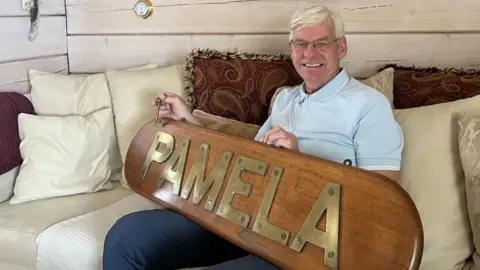 Barour Jon Grimsson
After the ship was abandoned, it was sold for 4,000 Icelandic krona (£24) and broken up. The wheelhouse became part of a garden room, while the metal plating was used to make garden fences.
Along with the sign, Bari's grandfather had a mirror and a large brass key to the wheelhouse.
Bari adds: "So the ship for many years in its various places was actually still in Iceland, just not in the fjord."
Alec has been researching the story of the Pamela. It was built for fishing in the North Sea as part of a "box fleet" system, where groups of trawlers would fish together.
Initially, they fished on the Dogger Bank off the coast of Yorkshire, but when World War One broke out, the North Sea became a battle zone and the trawlers had to go elsewhere, with Iceland an obvious place.
"They weren't built for the Icelandic rough waters," Alec explains. "They were uncharted waters.
"The skippers were very brave. Some went to Bear Island and the White Sea and maybe even Greenland.
"They were vulnerable to the elements up there. That's how I think she was washed ashore."
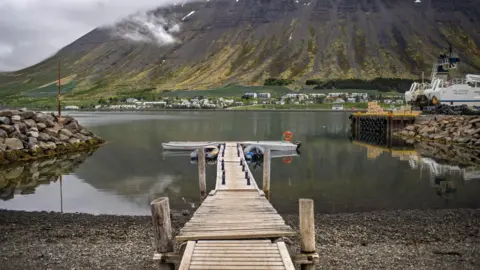 Universal Images Group via Getty Images
Bari worked on a trawler in the North Atlantic in the late 1970s and early 1980. He says fishing is in his blood.
"All my grandfathers were fishing, they live on fish and die with fishing. That was just life.
"When you are a trawler fisherman in the North Atlantic in the wintertime, you cannot tell people how bad the weather can be, because you have to live it yourself.
"These little ships, 100 years ago, coming all the way up to north Iceland with all this old equipment to try to catch all the fish just to live at that time, that was a hard job."
Bari turned out to be a distant cousin of Yvette and helped put her in touch with her first cousins.
"I gave him the names and he got in touch and, of course, they thought this is a scam, this can't be real, nobody knew anything about an Yvette in England. And it's because my dad never knew about me.
"Since then, I've been to Iceland, I've met a cousin and I've seen where my dad lived."
Yvette, whose father died in 1978, says the people of Hull and Iceland have a shared history.
"We lost 6,000 men over a couple of hundred years. That's a lot of men, that's a lot of families being brought up by their mum.
"It's a very similar story in Iceland because I found quite a few relatives now who have drowned while they were out fishing, and that's in small boats, ships, everything.
"So we have the same story, just 2,000 miles apart. It's all about connections, strange, unknown connections."
Listen to highlights fromHull and East Yorkshire on BBC Sounds, watch the latest episode of Look North.
Download the BBC News app from the App Storefor iPhone and iPad orGoogle Play for Android devices
