Jodrell Bank cuts a disappointing gamble, says Sky at Night host

 BBC
BBCFunding cuts to Jodrell Bank Observatory are "a gamble on the future of UK science and scientific research", a BBC Sky at Night presenter has said.
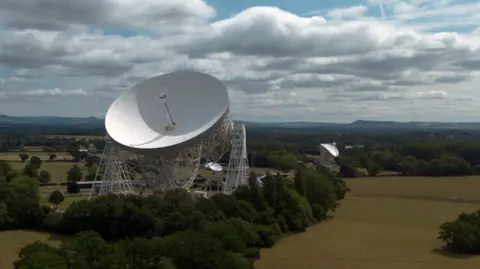
The government has pulled £2.8m from the Cheshire site - home to the third-largest steerable telescope in the world - putting 28 jobs at risk.
Dr George Dransfield, an astrophysicist and Sky at Night presenter, said the decision could see the UK "lose our place in these big international scientific collaborations".
She said the observatory was also valuable for training young scientists who "then go on to be scientific leaders and even go into industry and support industries that are priorities for the government".
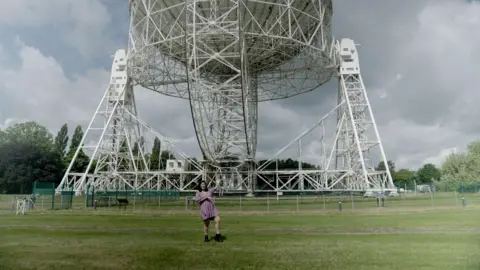
The Lovell Telescope, once the largest radio telescope in the world, is a key part of a system of six other telescopes in England that make up the e-Merlin network.
Together, they can focus on objects across deep space and help researchers work out how planets and stars form and galaxies evolve, and study other space phenomena.
 Reuters
The observatory site, chosen by radio astronomy pioneer Sir Bernard Lovell as research base for the University of Manchester in the 1940s, is a Unesco World Heritage Site.
"What's really disappointing is that it takes decades to set up this kind of infrastructure," Dransfield said, adding scientists would leave the country to work elsewhere without this kind of cutting-edge technology.
The UK Research and Innovation (UKRI) agency announced the £2.8m cut to the observatory's annual budget due to rising lab and research costs.
Dransfield said "no-one's arguing with the fact that budgets are finite" but described the decision as short-sighted given the UK's leading role in radio astronomy on the international stage.
She began presenting on the Sky At Night in 2023, and recently did a show on Jodrell Bank's history and the research there.
"Every time I get to visit there, it's such an awesome place. And you can feel not only like the history of the place.
"But also just what's going on still. It's buzzing with activity. There are scientists there doing amazing work."
A campaign has been launched to find alternative streams of funding to secure the site's future by 2028.
The University of Manchester, which owns the observatory, has said it is committed to ensuring scientific research continues there.
Henri Murison, the chief executive of the Northern Powerhouse Partnership, told the BBC: "Eminent physicists have made the case for why this is particularly worrying, because it will lose physics talent across the country."
"But I think the question we have to ask the funding councils, not just those who've made this decision, but UKRI, who in the end oversee all of this, is what is the North West going to get in terms of wider investment into innovation and diffusion because this is a relatively small amount of money."
Listen to the best of BBC Radio Manchester on Sounds and follow BBC Manchester on Facebook, X, and Instagram. You can also send story ideas via Whatsapp to 0808 100 2230.
