Jackdaw owner says gas field will 'not materially influence' climate change

 Adura
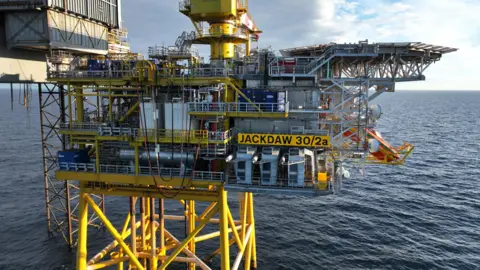
AduraEmissions from the controversial Jackdaw gas field in the North Sea will "not materially influence" global warming, according to a new report from its owner.
Adura's updated Environmental Impact Assessment (EIA) said the project would account for less than 0.02% of annual global greenhouse gases during its lifetime.
The new assessment was required by the industry regulator, after it found several areas had not been adequately addressed in a previous submission.
The report was ordered by a judge who ruled that ministerial consent for Jackdaw was unlawful, following a legal challenge from environmental groups.
Campaigners had called on the UK government to reject both the Jackdaw gas field and the Rosebank oil field developments.
The previous revised EIA - submitted in November - said the Jackdaw field could produce up to 35.8 million tonnes of carbon dioxide emissions or equivalent during its lifetime, which is around 90% of Scotland's total emissions.
The updated assessment, requested by the Offshore Petroleum Regulator for Environment and Decommissioning (Opred), required Adura to provide additional context on how emissions would affect global ambitions to limit climate change.
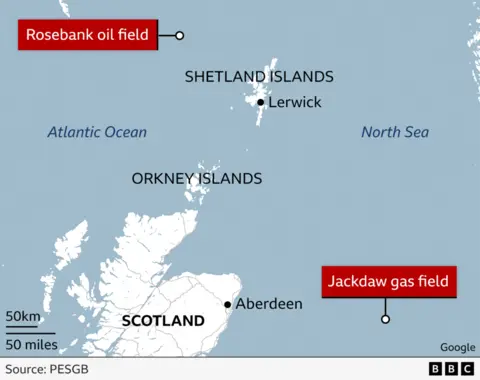
Adura is a joint venture between UK energy giant Shell and Norwegian firm Equinor.
Its 159-page submission said that displacing imported liquified nature gas (LNG) from the United States with gas from the Jackdaw field would save the equivalent of four million tonnes of CO2 equivalent.
It says that could result in around 20% more emissions from imports compared with gas produced domestically.
Those "losses" would principally come from eliminating the need to liquify, transport and then regasify the imported product.
It also said the climate effects would be "minor" because the UK has a "well-regulated industry, with targets and commitments that are aligned with the expectations of the Paris Agreement", a legally binding commitment to limit global warming to between 1.5 and 2C.
 PA Media
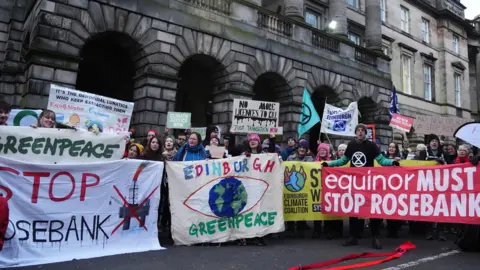
Last year, the Court of Session in Edinburgh ruled that both Jackdaw and Rosebank had been unlawfully approved, because the government failed to take into account the climate impact of burning extracted oil and gas from the fields.
The legal case had been brought by environmental groups Uplift and Greenpeace.
In his judgement, Lord Ericht required a more detailed climate assessment and fresh approval from the UK government before production could begin.
Tessa Khan, executive director of Uplift, said Jackdaw would have "no impact on our energy bills and do precious little to increase our gas supply".
She added: "The reality is, after 50 years of drilling, the UK has now burned most of its gas and a relatively small gas field like Jackdaw will do next to nothing to reduce our dependence on imports."
Greenpeace said that "self-serving claims" in Adura's assessment should not be taken at face value.
Doug Parr, Greenpeace UK chief scientist, said: "Any new oil and gas field approval is wholly incompatible with keeping global warming to 1.5°C, the internationally agreed limit for avoiding the worst impacts of climate breakdown.
"Ignoring that reality for a tiny amount of gas - which won't lower energy bills or materially strengthen the UK's energy security - is reckless and indefensible."
