'We can't live with years of railway construction'

 BBC
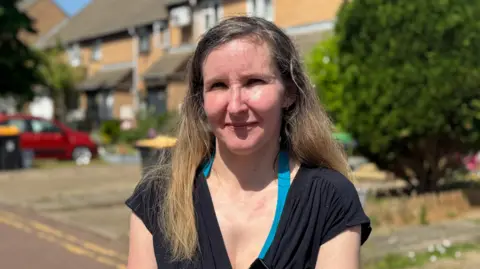
BBCJulia Virdee is proud to be "born and bred" in Bedford.
That is why, 17 years ago, she and her husband bought a house around the corner from her parents. The small cul-de-sac of 25 terraced homes is in the Poets area of the town - so called because streets are named after writers.
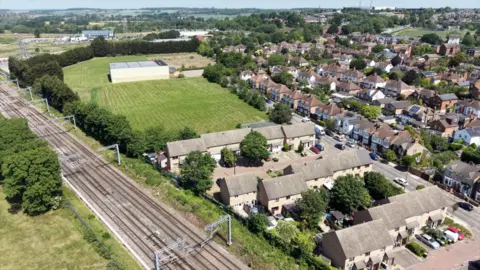
The street is next to the railway line, but under the East West Rail (EWR) plans, part of it will become the railway line.
"Eight houses at that end are due to be demolished to make way for construction lorries and a new track," says Virdee, as she looks out of her front door.
"We're also getting a construction compound at the back of the house."
'You can get used to trains, but not this'
EWR is a new £6bn railway being built to link Oxford and Cambridge.
As the final public consultation prepares to close, Virdee is among many across Bedfordshire and Cambridgeshire who say they "can't live with" years of building work.
"My husband works from home and we have a child," she adds.
"We don't know if we'll have times without power or water. We won't be able to open windows or spend time outside because of the noise and dust.
"The work will be all around us from eight until six, and sometimes outside those hours too.
"When you live near a railway line, you get used to the train noise, but not this.
"We lived here through pile driving for the Midland Mainline. It was during the night so it didn't disrupt services, but it was awful for us. It went on for weeks and we're expecting much more with EWR.
"I can't live with that. I can't put my family through that. It's changed how I feel about the area and my home.
"We had plans to extend it to make it a home-for-life but that's been taken away from us. The idea of moving is heart-breaking."
Bedford Borough Council has opposed the demolition of homes, but EWR has suggested it would reduce construction time.
 Ant Saddington/BBC
Across Bedford, work to rebuild and modernise the two railway stations - moving Bedford St John's closer to the hospital, together with new car parks and tracks - will mean the closure of roads and bridges, bringing significant disruption to an "already congested" town centre.
"I don't think the town will cope," says Peter Grimes. "There were lots of issues when Bromham Bridge was closed and that was just one road."
Cyclist Sarvesh Khope says: "I'll have to take longer routes and it'll take much more time and effort."
Emma Cummins is concerned about disruption to existing train services.
"I take the train to London every day," she says. "It's expensive so I hope this work doesn't affect my journey, but Bedford station does need improving."

The EWR Company says it takes "those concerns extremely seriously".
A spokesperson added: "Whilst we believe the scheme will be transformative, we continue to take feedback on our proposals and how we can minimise disruption during construction... alongside developing clear commitments around access, noise, dust, traffic management and support for those most directly affected."
The design has already changed to lessen the impact, including lowering some of the tracks in Bedford so that major bridges in the town should need strengthening rather than rebuilding.
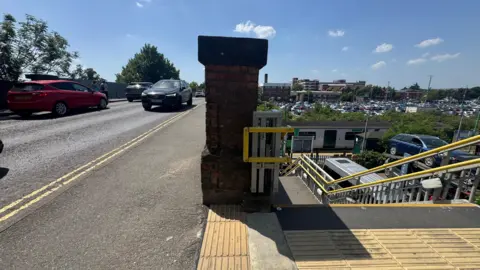
Construction will take place around Bedford Hospital, which says its operation is "fundamentally dependent on reliable access for ambulances, patients, staff and deliveries, and this cannot be compromised".
EWR says it "will ensure there is no overall loss of car parking spaces during construction or once the work is complete" and it is working closely with the hospital trust and all emergency services to ensure safety.
Although the EWR disruption will be significant, people in Bedford will eventually have easy access to the line, but 25 miles (40km) east in Cambridgeshire, that is not the case for communities who also face years of construction.
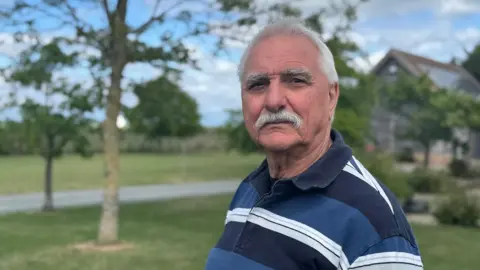
The new track will skirt the village of Haslingfield, where retired surveyor Brian Sewell has lived most of his life.
"I'm very attached to the village. I played soccer here until I was 38 and cricket into my 50s. I know every blade of grass on that recreation ground," he says.
Ten years ago, he built his "forever home" looking out over Chapel Hill "where we used to go scrumping apples and plums as kids".
"It'll just be carnage"
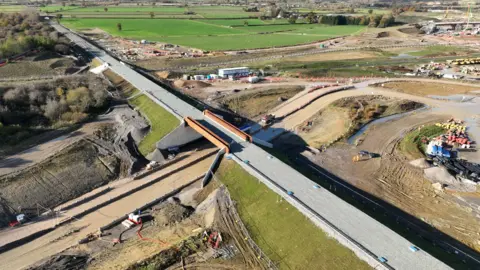
EWR plans to tunnel the railway line into the hill. There will also be a construction compound a few hundred metres from Brian's home.
"We'll be surrounded. There'll be roads blocked, traffic lights. It'll just be carnage.
"And there's the dust.
"When the farmer's drilling, we shut all our windows because the dust carries, but it'll be like that the whole time. EWR says it'll spray the ground with water but it'll take an awful lot of water.
"We went out past Bletchley to see where EWR meets HS2 and there were mountains of spoil everywhere you looked and temporary offices several storeys high.
"I reckon we could have six years of it.
"I'm hoping beyond hope that it won't happen. If it does, that will really hit my gut because we'll have to move. I don't want to think about that yet."
 HS2
HS2EWR offers a Need to Sell scheme for those who have to move but whose house price has been negatively affected by EWR plans.
It allows EWR to buy the homes directly and is in addition to a scheme covering properties that are being demolished.
As of March 2026, EWR figures show 22 applications had been received. Of those four were withdrawn, eight approved and six rejected. Six purchases have been completed at a cost of £2.37m.
But Virdee says the scheme won't apply to many of those on the edge of the construction work.
"You have to show a pressing need like a new job, a health issue or financial problems, but I don't want to have to give my medical details and bank statements to a panel of unelected people."
EWR says: "We ask for evidence of a compelling reason to sell so that public money can be targeted towards those most in need."
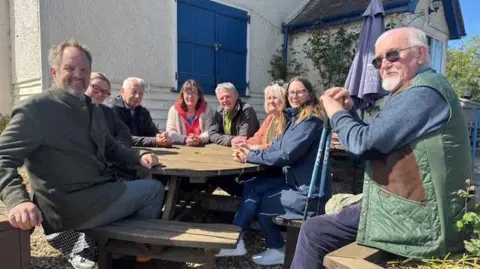
In Harlton, a Cambridgeshire village of around 120 homes, Alex MacIntosh, says there is now "great fear as people realise how significant the construction is going to be".
He adds: "These large infrastructure projects are important for Britain, but they have to be done carefully.
"They're going to build a bridge at both ends of the village, and the tracks will go about 400m behind our houses, so there'll be years of disruption, dust, noise and vibration."
The main road through the village is designated a primary route for construction vehicles.
'A nightmare'
Norman Hammond, a resident of 52 years, says: "Many houses here have shallow foundations, cob walls and thatched roofs, and they weren't built to withstand heavy traffic. We get vibrations from agricultural machinery."
Michael Warburton is concerned about safety because "the road isn't wide enough for large vehicles to pass without mounting the pavement".
He adds: "You can see the kerbs outside my house have been broken. It'll be a nightmare."
Access is a worry for Annalise MacIntosh.
"We have no amenities in this village apart from the pub," she says, "so if we want food, a doctor, a school, we have to leave, and when the construction starts there'll be blockages and it will be very hard to live with."
EWR says "published construction routes are subject to further evaluation as stakeholder engagement progresses".
It added: "This is why we are encouraging people to provide feedback on our proposed construction routes during our consultation."
Do you have a story suggestion? Contact us below.
Follow East of England news on X, Instagram and Facebook: BBC Beds, Herts & Bucks, BBC Cambridgeshire, BBC Essex, BBC Norfolk, BBC Northamptonshire or BBC Suffolk.
