Exploring the life and work of 'reclusive' writer

 United Press Photo/AFP
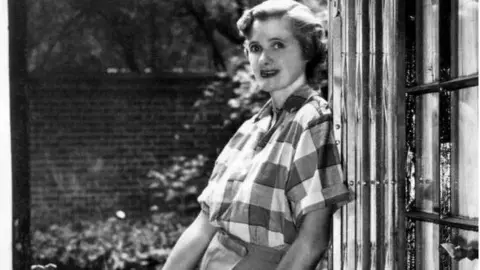
Her dark novels allowed generations of readers to fall in love with dramatic Cornish landscapes and the multi-dimensional characters her books evoked.
Best known for novels Rebecca and Jamaica Inn, interest in Daphne du Maurier's work and private life has never waned; new adaptions of her stories continue to grace cinema and television screens decades after her death.
Yet little is known about the enigmatic writer who ensured her privacy would continue long after her death by signing a 50 year embargo on her most private journals and notebooks until 2039.
Now a new play being shown in Devon and written by a local author has used biographies and letters which are available to tell the life story of one of Cornwall's most famous authors.
The official Daphne du Maurier website describes her as someone often thought of as reclusive: "She was perhaps solitary, comfortable with her own company and the make-believe world that she lived in and which enabled her to bring us her wonderful novels and short stories."
Daphne, The Secret Lives of Daphne du Maurier, which opens this weekend at the Northcott Theatre, delves further into the enigmatic personality of the writer.
The play begins with du Maurier, who was born in 1907 and died in 1989, preparing to sign a 50-year embargo locking away her most private journals and notebooks until 2039.
The audience is then taken on a journey through the author's private life, from the age of seven and into her 80s, exploring her relationships with those around her.
It shows a life that defied the conventions expected of women of her generation. But there were still aspects of it, that she clearly wanted to keep private, even after her death.
 Lillie Sherry
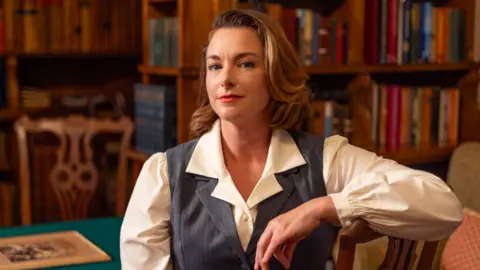
Emma Stansfield is the actor portraying a woman who resisted any kind of pigeon holing.
"She blazed a trail in her own glorious way and that's so exciting to play," Stansfield said.
But there's also scenes in this, where she has to put her mask on, and has hidden parts of herself."
She added: "I think that's what created the darkness and tension in her stories."
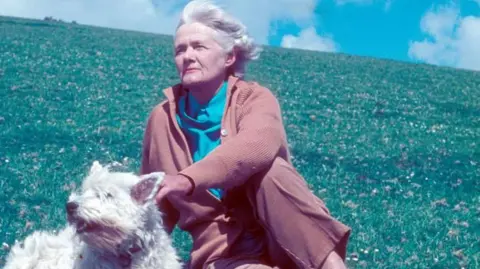
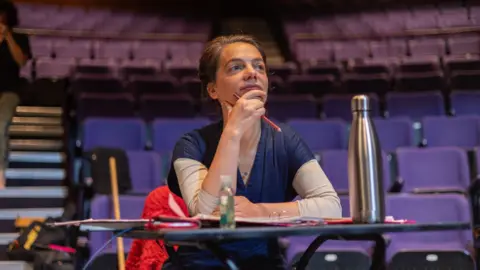
Rosie Race, the Totnes playwright behind the play, said the intriguing embargo on du Maurier's notebooks was what led her to explore the writer's attempts to control her own life story.
She said: "It's her saying no-one owns me completely. Everyone has a different version of Daphne du Maurier."
We are lucky to have her biographies and all of her back catalogue, and at Exeter University campus we have her archive.
"I spent days leafing through her hand written letters, but we never know of course exactly who she is."
Race said she was "surprised and delighted" no one had created a stage play about the author's life, and would love to revisit it in 2039 when the embargo on the journals and notebooks was finally lifted.
 Lillie Sherry
Both du Maurier and her work defied classification. Critically and commercially successful, she rejected being called a "romance novelist" and spent much of her life fighting definition by others.
Helen Taylor, author of the Daphne du Maurier Companion and professor of English at the University of Exeter, said the writer was a "feminist really before her time" who "stood up for herself."
She added: "People have greatly underestimated the great variety of her writing. She has a very dark side to her writing as well as romantic side."
Global fan base
Her most successful novel Rebecca, gave Daphne du Maurier a global fan base and after the film adaptation by Alfred Hitchcock, interest in her private life only intensified.
It was exacerbated by a court case in America which claimed the novel had been plagiarised. She was exonerated in court, something which is also examined in the play.
The du Maurier family have not yet had the opportunity to see the play to comment on this latest portrayal of the writer life.
It was commissioned by the Northcott Theatre and directed by Martin Berry.
Daphne, The Secret Lives of Daphne du Maurier, runs from Saturday 4 July for one week.
