Hospital first to use AI for spotting infections

 Mark Norman / BBC
A Kent hospital is the first NHS trust in the country to use a potentially life-saving artificial intelligence (AI) tool that can help clinicians identify infections at an early stage.
East Kent Hospitals NHS Trust (EKHUFT) is using AI at Kent and Canterbury Hospital to analyse clinical information such as blood tests, blood pressure and temperature to generate an individual infection risk level for each patient.
The software, called MEMORI, is part of a collaboration between the trust and Sanome, a UK health technology company.
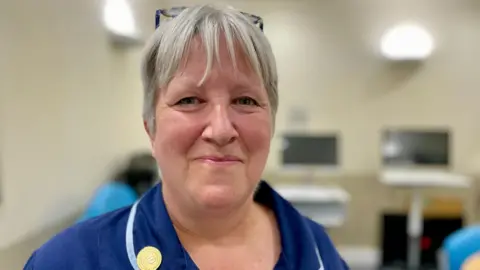
Ward manager Julie Jones said it created time to "actually be with our patients, to spend time to care for our patients, rather than having to trawl through notes".
The NHS 10-year plan sets out an ambition to move from analogue to digital and supports the use of more AI tools such as MEMORI, which is fully licensed as a healthcare device.
It analyses routine clinical information already included in patient records, including observations, medications, and demographics, to generate an infection risk level.
Staff in east Kent, including nurses, healthcare assistants, consultants and therapists, worked on its development to ensure it supported real clinical practice.
"It comes up with a score, which is going to indicate whether a patient's at risk of developing an infection before we actually see an infection develop," Jones said.
Asked if it was likely to replace staff, she said: "It absolutely is not. It's just about supporting.
"It's going to be a win-win situation. It's going to be good for the patient, good for their rehab, good for bed flow for the whole hospital. So it can only be positive."
 Mark Norman BBC
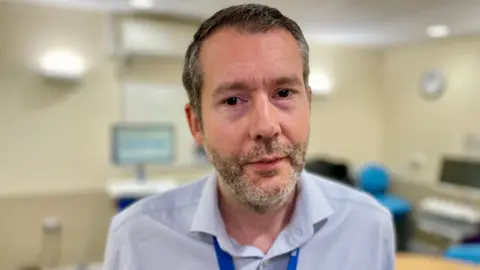
Dr Mike Bedford, chief clinical information officer for the trust, said: "This is just the beginning.
"The tool that we're using is there to predict hospital acquired infections, but in the future we want to use this collaboration to do so much more."
Bedford said that more importantly it will bring "clinicians back to doing more of what they should be doing, caring for patients rather than what has become a laborious task interacting with the digital and interacting with the IT technology".
Sanome was founded by Benedikt von Thüngen after his father developed sepsis.
"People work in healthcare because they want to provide care and comfort, not go hunting for information or analysing that information," he said.
"What we have seen is that 85% of clinicians are using the tool every single day.
"If you get a patient on the right treatment quickly you can prevent deterioration from happening. If a nurse or a doctor can trust the information they get, they can do what they're really good at, which is providing care."
Follow BBC Kent on Facebook, on X and on Instagram, and listen to BBC Radio Kent on Sounds. Send your story ideas to southeasttoday@bbc.co.uk or WhatsApp us on 08081 002250.
