Mum fears son, 5, may not get lifesaving liver transplant

 BBC
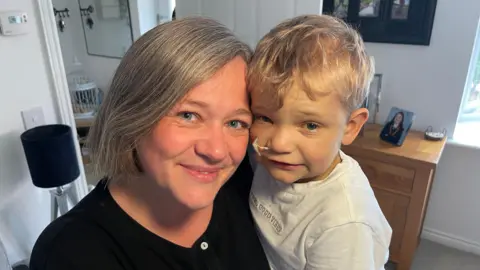
BBCFor 15 months Kirsty has been patiently waiting for the phone call that could save her five year old son's life.
Harrison has Alagille Syndrome a rare disorder that affects the organs, eyes and the skeleton. He has already had to undergo open heart surgery, but he now needs a liver transplant to save a life.
Despite legal changes in England designed to increase organ donations, Kirsty says long waits remain common.
"Harrison was born with the condition and he underwent heart surgery two years ago just so he was able to be put on the transplant list.
"It's heartbreaking and so cruel, because since he went on the list 15 months ago a match hasn't been found."
The law was changed In 2020, when an "opt-out" donation system was introduced in England. The law change presumes consent to donate organs for all adults when they die, unless they explicitly remove themselves from the list.
'Waiting list at record high'
However, Kirsty says that families and next of kin can overrule a potential donor's decision.
"The waiting list is at record high and I don't have much hope in finding a liver for my son.
"I'd like the organ donor law to be looked at again by government so that no one can overrule the process."
The NHS argues however, that the law change has helped bring down waiting lists for transplants.
"Last year, donation proceeded in almost 90% of cases when someone had confirmed their decision on the NHS Organ Donor Register, compared with 45% when no decision was known," the Blood and Transplant Service (BTS) said in statement.
Data, which is released weekly, shows that as of 10 July, 8,500 people were waiting for an organ transplant in England, indicating the record levels Kirsty talks about.
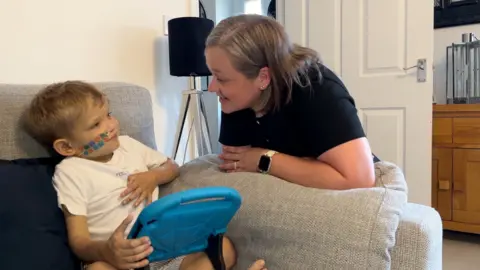
The lengthy waiting list led both Kirsty and her sister Natalie to be tested to see if they could be a living donor - but unfortunately neither are a match for Harrison.
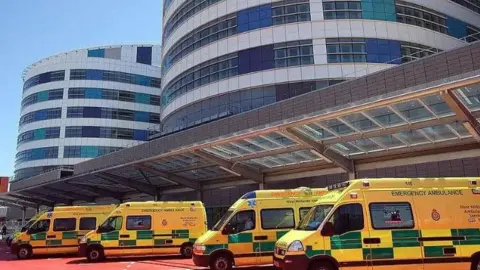
Queen Elizabeth Hospital Birmingham is one of three places in the UK where such procedures take place with the liver, the body's only organ with regeneration properties.
Donors go through months of testing and even if they are a match, a transplant may not still be able to go ahead.
However, those who make a donation normally go on living healthy lives.
'Transplant not always a cure'
But Michelle Wilkins of charity Liver UK, which supports those living with liver disease, says that while on paper it sounds like the liver is the easiest organ to donate, that isn't always the case.
"I really admire Kirsty's bravery in talking about Harrison's condition and we wouldn't wish Harrison's wait on anybody," she said.
"That's where our role comes in, we support patients and families through that long wait.
"It's really important to remember that a liver transplant isn't always a cure, it's a treatment."
She stresses that those who receive one "often have weaker immune systems, but life will become so much better".
"I really encourage anyone who wants to be on the organ donor register to check they've been opted in and to make their wishes clear because it helps people like Harrison so much," Wilkins added.
 Getty Images
In its statement, the BTS acknowledges the act of donation is "incredibly special".
"Yet it comes at a time which is especially difficult for the families who are approached about it," it explained.
"While our specialist nurses will always inform families if their loved one has registered a decision and encourage them to honour it if they feel able, there are many reasons why families may choose not to go ahead".
Problems can also arise because not every donation results in a transplant operation.
Figures show that between 2024-25, of the 418 liver donations received after patients suffered a circulatory death, 313 were successfully transplanted.
Those figures also indicate that the number of donors in patients who suffered a sudden brain death, fell by 11% to 612, while transplants from donors fell by 4% to 561.
Follow BBC Stoke & Staffordshire on BBC Sounds, Facebook, X and Instagram.
