'Dunwich can take heart from our wildlife recovery'

 Shaun Whitmore/BBC
The founder of a nature reserve ravaged by fire four years ago has told other sites not to lose hope, as nature has a "wonderful ability to bounce back".
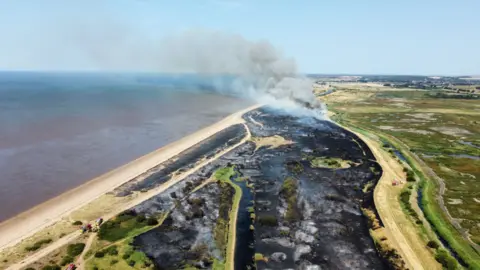
In July 2022, a "significant" amount of wildlife was destroyed at Wild Ken Hill in Snettisham, Norfolk, following a fire which affected 81 acres (33 hectares) of land.
A major incident was declared in Suffolk last week due to a blaze at Dunwich Heath and RSPB Minsmere, with experts saying it could take up to 25 years for the area to recover.
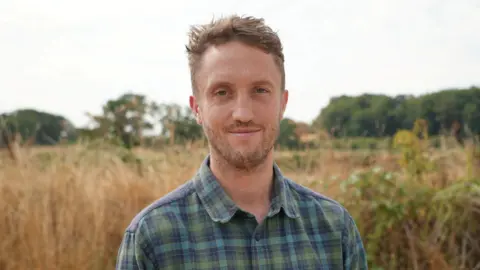
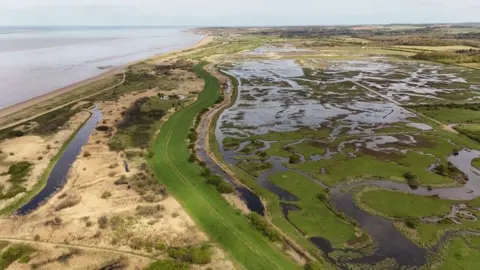
Dominic Buscall, founder of the Snettisham site, said: "There's still a way to go but within four years it actually looks pretty special once again, and that's really a wonderful thing."
The Suffolk blaze made its way across 371 acres (150 hectares) of land, with more than 100 firefighters tackling it at its peak.
Four years ago, Wild Ken Hill found itself in the same position when a huge chunk of reserve was consumed by flames.
Wildlife including mammals, reptiles, amphibians and a variety of rare birds perished at the site.
Since then, the landscape has started to regenerate, and species that once called the site home have returned.
Buscall said: "Nature has this wonderful 'bouncebackability' we sometimes take for granted.
"Within a year we started to see the grasses and the reedbeds green up again.
"We are now seeing regeneration of the shrub species, in which we found things like turtle doves and various warbler species."
More stories on Wild Ken Hill's nature recovery
 Andrew Waddison
 Shaun Whitmore/BBC
However, the risk of another fire is ever-present.
At the end of July, the Environment Agency declared a drought across more than half of England - including East Anglia.
This year the Snettisham site has seen only 260mm (10.2in) of rain, and Buscall said he would have expected to see more than double that by now.
He said: "These are extraordinary times in the middle of a climate emergency. I think the risk today is probably as high as it will ever be for wildfires."
Last week, Norfolk Fire and Rescue Service was called out to five wildfires on the same day.
Buscall said a number of measures had been introduced to prevent future fires, including introducing cattle to graze on the vegetation - so there is "less standing dry stuff" during the summer.
"It's really important to be clear, everyone has a role to play in managing fire risk," he said.
"The vast majority of fires are caused by people so prevention is critical, and that means all of the basics we've got to get right. No littering, no open flames, no disposable barbecues - absolute vigilance from all of us."
 Shaun Whitmore/BBC
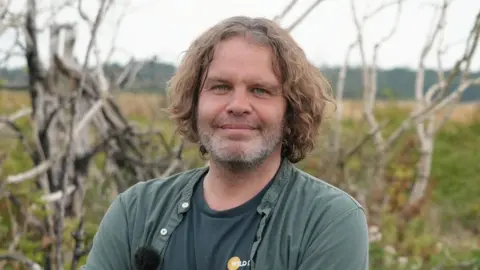
Community engagement and working with the fire service had also been key, said Andrew Waddison, from the reserve.
"Almost everybody that passes through here respects it and enjoys it," he said.
"There will always be one or two that tosses a cigarette or have a barbecue, and that's just common sense that people really need to be aware of what's going on."
Seeing the ongoing regeneration at the site was "astonishing", he added.
"It's not been four years and two weeks since this looked like Mars. It's quite remarkable that nature is recovering... I'd like to see what it's like in another four years from now.
"As the habitat is starting to recover, and so the animals are starting to return. It's a simple case - if you build it, they will come.
"I think there's hope. If this has just happened in four years, I think Dunwich can recover and become the magical place it once was."
Do you have a story suggestion for Norfolk? Contact us below.
Follow Norfolk news on BBC Sounds, Facebook, Instagram and X.
