'It's often easier for people to sing than to speak'
Specialist choirs for those living with an aphasia, a difficulty with language, are supporting dozens of people across Gloucestershire.
The condition is usually associated with those who have had a stroke which can lead to feelings of isolation if their speech or mobility is affected.
Satyam Makoieva, a music therapist with ReConnect Gloucestershire which runs the choirs in Churchdown, said: "Most of the members of our choir are there because they find it hard to articulate.
"I often think it's a bit like when you go to a country and you're just trying to learn the language."

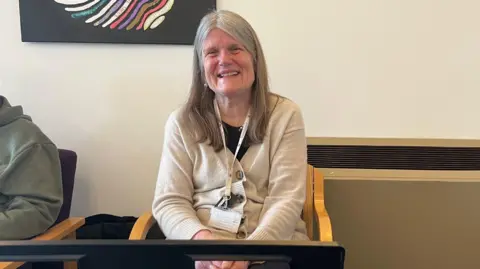
She said: "You've just worked out what you want to say and the conversation's moved on."
Speaking to BBC Radio Gloucestershire, Satyam said that music stimulates many different areas of the brain because of the different elements like silence, loudness and pitch.
She said music helps people communicate as they relax, with the brain's job simplified during a well-known song.
"If you did a brain scan of somebody playing or singing music, their brain would light up like a Christmas tree," she added.
"It's not like a Hollywood move, they don't just burst into song, although it can happen."
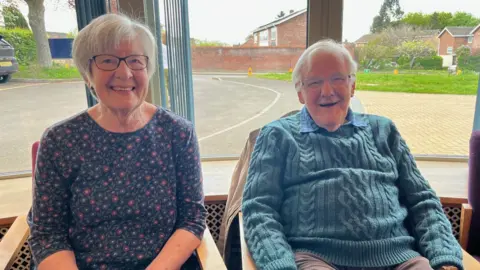
The group has become invaluable to people like John Bishop from Staverton, who had a stroke last year and now comes along with his wife, Sandra.
He said: "It's nice seeing people with similar problems. I can't necessarily say the right words and people wonder 'what is he talking about?'
"When others here speak differently, I understand."
For his wife Sandra, it has also become a vital support network.
She said: "Everyone was so friendly and welcoming last time. It's nice for both of us to be with people who've got aphasia, or had a stroke.
"If he's talking to people outside [the group] then it's more difficult because they don't understand.
"It's a hidden disability, because he looks very well, but the mind has been affected."
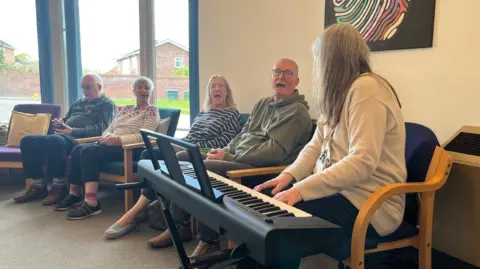
As well as singing, members of the choir are encouraged to play musical instruments such as tambourines and drums.
Satyam says this is good for those who find communicating particularly difficult, or if a stroke has weakened one side of the body.
She said: "All the time you're watching and you're looking for the songs when there are moments when it's easy for someone to land on a sound or to articulate something.
"It helps not to put the pressure on speech all the time."
ReConnect Gloucestershire's Aphasia Choirs run online, in Churchdown and in Rodborough.
If you have been affected by any of the issues in this story, help and support is available at BBC Action Line.
Follow BBC Gloucestershire on Facebook, X and Instagram. Send your story ideas to us on email or via WhatsApp on 0800 313 4630.
