'Frankenchickens': The debate about welfare and sustainability

 BBC
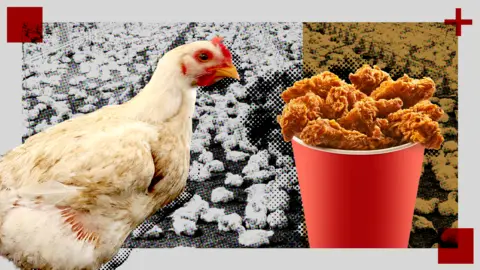
BBCChicken is big business with an estimated billion birds reared for food every year in the UK, with Northern Ireland producing six million a week.
Campaigners have for a long time voiced concern over the welfare and conditions these birds are kept in.
But with everyone's protein goals pushing demand for poultry to an all time high, how much do we really think about how chickens are reared?
Modern broiler chickens - bred for their meat - can reach their slaughter weight in a little over a month.
This has led to campaigners branding them "Frankenchickens" and a row has erupted about industry standards.
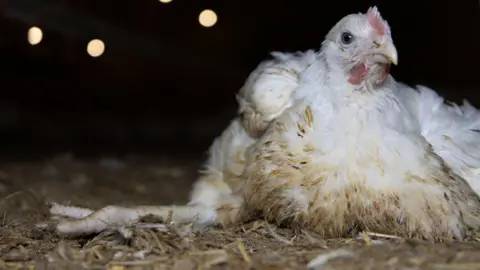
Animal welfare groups argue the industry's reliance on this faster-growing breed causes widespread suffering, with the animals more likely to suffer health problems like being unable to stand when their growth outpaces the strength of their legs.
Campaigners have spent years urging food companies to adopt higher welfare standards through something called the Better Chicken Commitment (BCC), which was designed to phase out intensive production practices.
It says that poultry houses should offer more light, they should offer enrichment to the birds, and most importantly that they should be using slower-growing breeds.
But in February, major chicken chains ditched the Better Chicken Commitment, and instead adopted the industry-led Sustainable Chicken Forum.
They argue that farming slower-growing breeds produces more greenhouse gas emissions than farming faster-growing breeds.
They also claim, with 95% of the UK population consuming chicken, slower breeds can't keep up with growing demands for lean protein.
What is a "Frankenchicken"?
 Anima
AnimaThe term "Frankenchicken" was coined by animal welfare campaigners to describe genetically selected, fast-growing breeds.
The standard organic chicken grows to its weight for slaughter in 81 days. In fast-growing breeds it takes less than half that time - just over a month.
Hannah Yates from the Humane League said "Frankenchickens" are "bred to grow so fast that their bodies simply can't keep up... They're often forced to lie in their own poo as a result because their legs are so painful".
However, the fast-growing breed is considered the industry standard and is the more widely used breed.
Why does NI eat so much chicken?
 Press Eye
O'Kanes of Ballymena were one of the first to bring broiler chickens, which are bred for their meat, over from America to the UK in the 1950s.
By 2009, O'Kanes was producing almost a million chickens a week, before it was purchased by rival Moy Park in 2010.
And now by far the largest chicken processing firm in Northern Ireland, it processes more than a third of the UK's total chicken consumption.
So why do we love chicken in Northern Ireland?
BBC News NI's Business and Economics editor John Campbell points to one man who's helped turn chicken into big business in Northern Ireland.
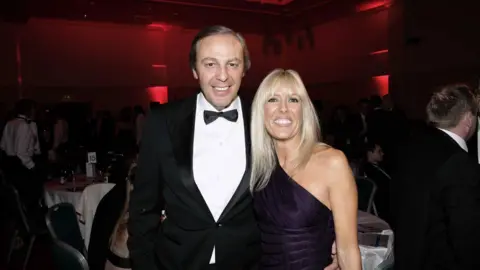
Michael and Lesley Herbert built up the UK's largest Kentucky Fried Chicken (KFC) franchise starting back in the 1980s, which they sold in 2020 for an undisclosed fee.
"So maybe you had a Northern Ireland consumer who was kind of much keener and much more conditioned to wanting fried chicken," said John Campbell.
Why did major chicken chains ditch the Better Chicken Commitment?
 Getty Images
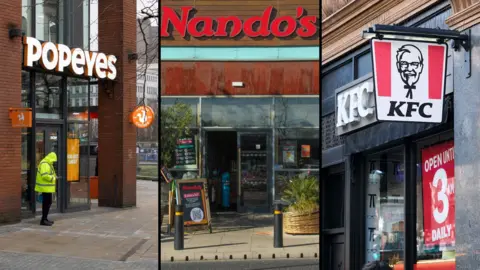
KFC, Nandos and Popeyes were all signed up to the BCC, and were prepared to stop using faster growing breeds and adopt slower growing ones.
But they made a U-turn in February 2026.
John Campbell says the industry has come to a point where they can "no longer justify the trade-off between finances and what is demanded in terms of ethical production".
"The industry has said 'we need to re-calibrate to balance the three trade-offs between net zero goals, welfare goals and also economics - about how much we can charge consumers'."
In a statement on their website KFC said "we want to see a system where welfare goes hand in hand with environmental improvement and consistent supply of chicken.
"At the moment slower-growing breeds don't fit into that system, as they have a higher environmental impact and would reduce supply.
"We want to be honest about the system we want to see, and our commitment to creating it. And that is why we helped to set up the Sustainable Chicken Forum."
What is the Sustainable Chicken Forum (SCF)?
The Sustainable Chicken Forum is an "industry-led approach", according to BBC News NI's Environment and Agriculture correspondent Louise Cullen.
It's an alternative to the BCC, focusing on "environmental impact, carbon reduction and consistent supply."
The SCF maintain that slower growing breeds require more feed, more water and produce more greenhouse gases throughout their longer lives and are therefore worse for the environment and net zero goals.
Allen Simpson, CEO of UKHospitality, the trade body representing the businesses which have formed the SCF, said "consumer demand for chicken continues to soar".
"However, this demand comes at a time of acute chicken supply pressures and operators rightly have to ensure consistent and secure supply chains, while continuing to improve welfare standards and cut their environmental impact.
Simpson said he's "pleased that businesses are committed to enhancing their ongoing work across welfare and the environment, and the Sustainable Chicken Forum will play a vital role to make even more progress, as well as overcoming this shared supply challenge".
However, not everyone is convinced, some campaigners say the SCF is green washing.
Yates said the SCF "is made up of companies who essentially have banded together and colluded to be able to rid themselves of their responsibilities under the guise of sustainability".
Impact on Northern Ireland
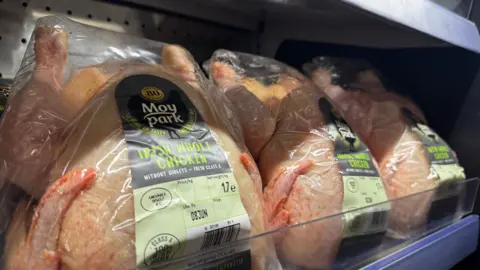
Chicken production in Northern Ireland is a huge industry that is dominated by one name - Moy Park, the company that produces more than six million chickens a week.
Moy Park told BBC News NI they are the UK's largest producer of Better Chicken Commitment standard chicken, all of which is produced on family run farms in Northern Ireland.
So now that major chains have abandoned their pledge to adopt slower growing breeds, will farmers in Northern Ireland have to adapt?
Not quite.
Moy Park said "the majority of our farmers have 2-3 poultry sheds and produce to a dedicated standard thus enabling a diversified offering to our customers," meaning they develop both fast and slow growing breeds to meet the needs of their customers.
