VAT cut on household electricity bills will not apply in NI

 Getty Images
A VAT cut on household electricity bills announced by the prime minister will not apply in Northern Ireland.
Instead Stormont ministers will get extra money from the UK government to use on cost of living measures.
In Great Britain the VAT rate on electricity bills will be cut from 5% to 0% in October, saving the typical customer £45.
The amount of money coming to Northern Ireland and how and when it will be spent is so far unclear.
The VAT cut is not being applied in Northern Ireland because of complications related to the region's Brexit deal.
 Reuters
The Treasury said: "Under the terms of the UK's exit from the EU, EU VAT rates apply in NI on goods, including electricity.
"Agreement from the EU to implement in NI would be necessary.
"Therefore to ensure that households in NI receive the same support as quickly as the rest of the UK, the NI Executive will receive comparable funding to enable it to support NI households with the cost of living."
VAT in Northern Ireland first emerged as a post-Brexit issue in 2022 when the then Chancellor, Rishi Sunak, reduced VAT on "energy goods" such as solar panels and heat pumps from 5% to 0%.
That cut could not be automatically applied here due to EU rules limiting the range of goods to which can be sold without VAT.
The issue was partially addressed in the Windsor Framework deal in 2023 and the VAT cut was then applied in Northern Ireland.
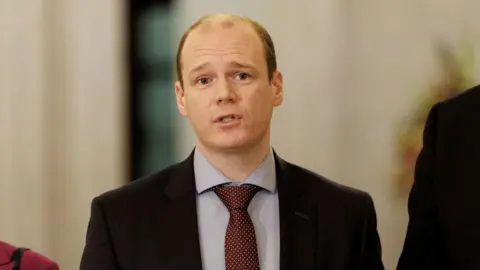
Speaking on BBC Radio Ulster's The Nolan Show, Communities Minister Gordon Lyons criticised the government's decision to compensate Northern Ireland through extra funding rather than applying the same VAT changes as the rest of the UK, arguing it would create unnecessary complexity.
He said that, instead of extending the VAT cut, the government were effectively saying: "Here you go, we'll give you the money and you can sort that out yourselves."
Lyons said it was too early to say how such an arrangement would work.
"I don't know what that will look like yet. I haven't had time to talk to my own team about that but I can assure you that it will not be simple."
He also criticised the government for failing to seek a solution with the EU, arguing there was "no threat to anybody else in the EU" from such an arrangement and that the situation highlighted "the nonsense of the new rules that have been put in place".
 PA Media
Lyons, who is also responsible for housing, said he will be pressing the prime minister to approve reforms to the NI Housing Executive (NIHE) which will allow it to start building houses again.
There is cross-party agreement in NI that the NIHE should have the same borrowing powers as public sector landlords in England.
This requires Treasury approval which has not been forthcoming.
The minister said last year that the process had "hit a brick wall."
Prime Minister Andy Burnham has said he wants to deliver "the biggest council house building programme since the post-war period."
Lyons said that unblocking this in NI would be consistent with that ambition.
"The Prime Minister has it in his power to make this change and it will be a major test of his commitment to delivering more housing across the UK," he said.
First cabinet meeting
The new cabinet met for the first time on Tuesday, after Burnham became prime minister on Monday.
During the meeting, Burnham told ministers "we need to be a cost of living government".
Earlier, a Downing Street spokesperson said Burnham also had calls with the first minister of Scotland, the first minister of Wales and the first minister and deputy first minister of Northern Ireland on Tuesday.
"The prime minister said he was serious about creating a new politics - rooted in finding common ground based on collaborative, practical and pragmatic relations with the heads of the devolved governments."
The spokesperson said Burnham was "focused on practical measures, not constitutional changes like further referendums, to give families more breathing room by helping them with the cost of living".
