Scientists warn of possible chemicals in beach foam

 Peter Moore
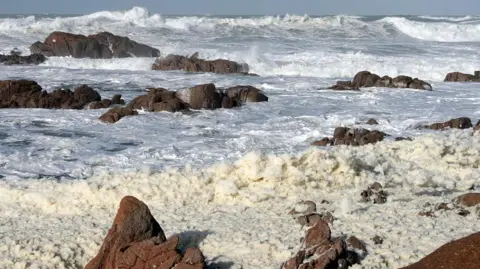
People should avoid touching sea foam which accumulates on beaches in Jersey and wash themselves, children or pets if they do touch it, experts say.
A report by the Independent PFAS Scientific Advisory Panel found naturally occurring sea foam could collect higher levels of PFAS than the seawater beneath it.
PFAS, often called "forever chemicals" because they take a long time to break down, have been linked to health conditions, including kidney and testicular cancer.
Public Health said while it was safe to swim in the sea, the "organic matter" churned up in sea foam could contain substances that "can irritate the skin, upset the stomach, or affect breathing, especially in children and pets".
The report said children and pets should be kept away from thick, long-lasting sea foam where possible, and anyone who comes into contact with it should rinse exposed skin and wash their hands before eating or drinking.
'Swimming not a problem'
Professor Ian Cousins, the panel's environmental expert, said swimming in the sea was still safe.
"If you want to swim in the water, you're fine, but there can sometimes be an accumulation of foam on the shore and you want to discourage your kids going and playing with that because the PFAS concentrations can be extremely high," he said.
The panel collected two sea foam samples last summer, finding PFAS levels of 1,005 nanograms per litre at St Brelade's Bay and 1,806 nanograms per litre at Le Grouet slipway near Corbiere.
By contrast, the four PFAS chemicals tested were not detected in seawater samples around Jersey. The report said this was expected because "normal seawater levels are often so low that standard small samples cannot measure them".
As waves and wind create naturally occurring sea foam, the chemicals become concentrated in the foam and "stick to bubbles", even though the surrounding seawater contains much lower levels.
Professor Cousins said this was not unique to Jersey: "You'll see that in any coastline on the UK as well, the seawater around Jersey isn't particularly contaminated. It's the same as anywhere else," he said.
The panel also highlighted sea spray as another potential way PFAS could move from the sea on to beaches and nearby land, although it said "further research is needed" to understand how people were exposed to the chemicals.
Ministers are due to respond to the report in more detail later this year.
Follow BBC Jersey on X and Facebook. Send your story ideas to channel.islands@bbc.co.uk.
