How can we help our gardens survive the heat?

 Austin Design Works
The UK has had three heatwaves so far this year, exposing us to dangerously high temperatures.
But humans are not the only ones struggling to cope – nature is suffering too.
In our gardens and vegetable patches, that might mean a decline in the critters that birds eat and scorched plants.
Gardeners may be facing a range of other problems too – such as increasingly high water bills as they try to keep plants hydrated.
Thankfully, there are several ways that we can save our wallets and keep our green spaces thriving in hot weather.
Plant trees
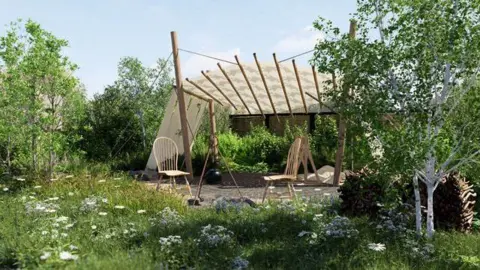
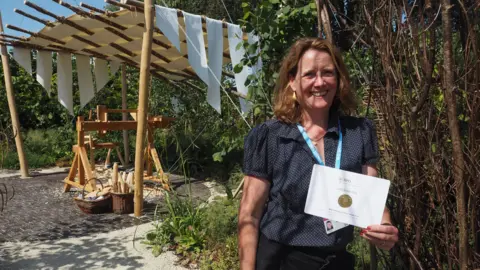
One of the ways that we can keep our gardens cool is to plant trees, says landscape designer Rachael Austin, who won gold at this year's Royal Horticultural Society (RHS) Badminton Flower Show in South Gloucestershire.
Austin's entry, called the Artisan Woodland Craft Garden, and sponsored by the Ruskin Mill Trust, is based on a woodland edge, with hazel coppice, open clearings and layered planting.
The garden demonstrates how trees can improve cover and make gardens cooler.
"It's a little bit like having a parasol up," Austin said.
"The larger the canopy cover, the cooler it can get and you can lower the temperature by about 10C in a woodland."
 Emma Bradshaw
According to the RHS, only 2.5% of the UK is covered by natural woodland, and built-up environments are increasingly affected by the "urban heat island" effect.
This term refers to the elevated temperatures felt in towns and cities compared with rural surroundings.
However, the UK has approximately 30 million residential gardens and Austin believes everyone can do their part to bring ground level temperatures down.
"We have seen a huge decline in nature and the UK is doing particularly badly," said Austin.
"We have far less canopy cover than in the rest of Europe, we are really behind there and we need to replant and we need to do our best as gardeners," she added.
Collect water
Last summer brought droughts and hosepipe bans across the country.
This was followed by a wet winter – and advice from professional gardeners that we try to save as much rainwater as possible.
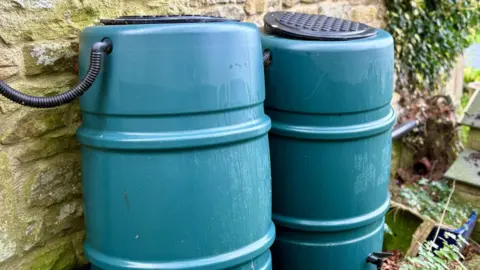
"The first thing to do is get as many water butts as possible," said Marcus Bergin, from Gloucestershire, who has been a professional gardener for more than 25 years.
Water butts are containers, usually made of plastic, which connect to gutters to collect and store rain for watering plants.
"In the winter, our water butts can fill up quite quickly, so we use that first of all [before mains water]," Bergin said.
There are other ways to preserve water for use in the garden, Bergin added.
That includes use of grey water – excess water from our showers, baths and sinks that is diverted into butts after installation of grey water systems in our homes.
 Getty Images
Waste water from kitchen sinks and toilets are not usually included in grey water systems.
"[Unfortunately] we can't use dish water because that contains chemicals and we don't want to put those into the ground," Bergin explained.
According to the RHS, grey water can be used to tide plants over in a summer drought but plants can eventually show signs of salt stress if, for example, dishwasher water is used.
As for when to water a garden, it's a job best saved for first thing or late at night, said garden designer Charlotte Sanderson, who has also won a gold award at this year's RHS Badminton Flower Show.
Shaded areas can still be "very dry", she said, so gardeners shouldn't neglect these spots.
"The most effective way [to water a garden] is an automatic irrigation system of leaky pipes," she added.
Her garden was created in partnership with charity Dorothy House, which offers free palliative care across Wiltshire and Somerset.
It is now being moved to the charity's hospice in Winsley, Bradford on Avon.
Protect the soil
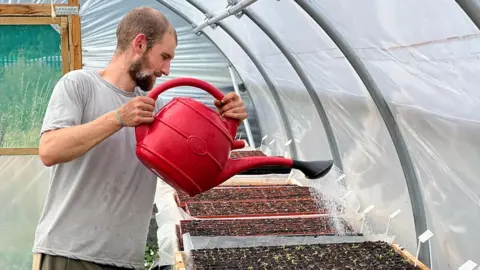
Those growing vegetables can follow the advice of Ollie Jamieson, director of Lush Greens, a market garden in Bristol that sells vegetable boxes and supplies food banks.
 Lush Greens
Jamieson said heatwaves causes some vegetables to finish early, such as peas, or dry out, such as onions.
Spreading a layer of mulch is one way to help.
"Trying to make sure there is a mulch on the soil surface, whether that's compost or even cut green material from other plants, to protect the surface from drying out [makes a difference]," he said.
"It's just about having something between the sun and your true soil.
"If you have a layer of mulch on top it might dry out but the soil underneath will remain moist."
Jamieson said even weeds can be used as mulch, along with straw or cardboard.
Keep critters happy
It's also worth thinking about protecting insects, snails and slugs in our gardens, according to entomologist Dee Patel, from Glastonbury, Somerset.
After all, gardens are an ecosystem and taking care of critters can ultimately help plants during hot summers.
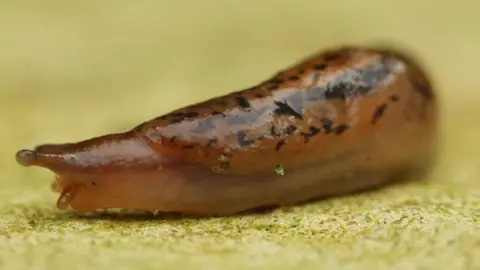
Patel said there have been declines in slugs and snails this year due to the heat – which is not actually a victory for our gardens as they are "vital ecological assets".
"Some people think they're pests, but we need them for the birds and the hedgehogs," said Patel. "Nature needs nature."
Other predators of slugs and snails include frogs, toads, slow worms and ground beetles.
Gardeners can help slugs and snails by leaving out decomposing organic matter for them to feed on, such as dead leaves, and ditching slug pellets, even if they're organic, according to the RHS.
 PA
PAAs for insects, some are enjoying a bumper year due to the heat.
For example, flying ants may be having their biggest moment in 100 years, Patel said.
"We're seeing a huge increase in swarming insects in general," he added.
The Royal Entomological Society's tips for insect-friendly gardening include avoiding pesticides, leaving patches of long grass on lawns and creating a water source such as a chemical-free pond.
Even a smaller water source can be helpful for wildlife – Charlotte Sanderson's RHS Badminton Flower Show garden features a shallow water bowl made from porous cement.
She said the bowl "was submerged into the soil and it was essential to keep it topped up for the birds and insects".
In contrast with swarming insects, bees have been in decline in Somerset recently due to very wet winters.
"We've had very heavy damp winters and this can lead to mouldy honey stores, which really affects bees come the spring," Patel said.
Gardeners can help, said Patel, by planting lavender and wildflowers – which are rich in nectar – to help bees build up honey stores that they can use in summer.
Follow BBC Gloucestershire on Facebook, X and Instagram. Send your story ideas to us on email or via WhatsApp on 0800 313 4630.
