We swapped our London flat for a houseboat
It's a beautiful sunny day on the Grand Union Canal near Watford, with colourful painted narrowboats moored along the towpath.
Many of them are occupied by young people unable to afford a flat in London, but seeking stability amid rising rents.
However, the houseboat lifestyle is not for the faint-hearted.
"Loads of people buy a boat and then move back on land when they realise it's not for them," explains Jan Gazda, who bought a houseboat with his partner Lizzie Jones seven years ago.
They live on their boat with their dog Hilda. The floating home cost them £40,000, with annual costs of about £5,000 a year.
"Most of the work we do ourselves, but it's still a lot of time and money," says Gazda, a regional manager for a charity.

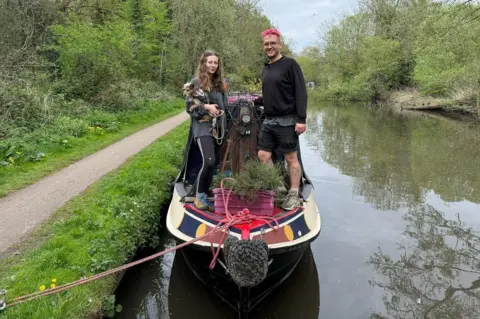
Gazda, 33, and Jones, 29, a painter for television and film, say they decided to buy their houseboat after becoming disillusioned with renting.
"I think loads of people our age have flatmates and stuff, and it's all 'who didn't do the dishes, who didn't buy the toilet paper'," says Gazda.
"Here we do have our neighbours and friends, but we all go to our own places afterwards."
Jones adds: "I think the most people we lived with was about 21 before we moved here, in a massive place with a lot of housemates.
"It feels similar in that we've got a lot of people that we're friendly with close by, but at the end of the day, we come back to our own space."
The most guests they have had on their boat at one time was eight, for their dog Hilda's first birthday.
Many people living on houseboats try to be as environmentally conscious as they can be.
The electricity on their boat is powered by solar panels, an increasingly frequent sight on the canals and rivers around London.
The couple use gas for cooking, and their water comes from the canal.
"It's filtered water, I'm not joking," Gazda says.
"We pump it through six filters, a UV light, then there are two more filters under the sink and this is reverse osmosis for drinking using a different tap."
The water tastes clear and clean, and softer than London tap water.
The lavatory is a compost toilet. Liquids go in one hole while waste drops into a larger hole and into a container with sawdust. Toilet paper and sanitary waste go into a small bin.
Gazda is part of a zero waste, human compost collection service for boaters called Circular Revolution, where waste is gathered for use across brownfield sites.
"We collect human waste from boaters then we turn it into brown gold - which is basically just compost," he explains.

Houseboat owners without a permanent mooring must move every two weeks to avoid having their licence revoked.
There are some exceptions: if a boat owner is sick or if their boat has broken down they may be able to plead exceptional circumstances, temporarily.
So as they do every fortnight, Gazda, Jones and Hilda are about to head off to new moorings.
They're being joined by their friends Ben Evans, 31, a researcher in AI, and Jenny Starzetz, 31, a PhD student and executive manager, who live on a similar houseboat a few metres further down the towpath, while others who have a boat nearby will also be coming along later.
It's a way for them all to keep together as a little community.
As well as a mini wi-fi tower, double bedroom, kitchen and bathroom, Evans and Starzetz's houseboat has its own office, so they can work from home.
The group have chosen a spot they think they will all fit in near Cassiobury Park.
Moorings are chosen on a first come, first served basis and finding one can take a while, explains Ben.
"It's a time commitment... you sort of lose half your weekend, which is lovely in the summer, and you really hope it's not raining in the winter."
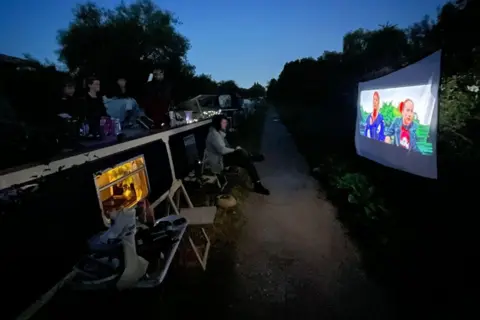 Jan Gazda
Further down the canal lives Gerry, who doesn't want to give me his surname.
For veteran boaters like Gerry you don't ask people's surnames on the canal apparently, because "it's not the done thing".
He's been living on his houseboat since 1989 and still uses tealights and candles to light his home.
He tells me he has very little that runs on electricity - he uses a wind-up radio and doesn't watch TV.
With all the wi-fi aerials and solar panels on boats all around him, he can see that times are changing and there are more people living on the canals and rivers.
"You look at the boats now and a good 70% of them are owned by young people that can't afford to rent, let alone buy a place," he observes.
"So if they want to work in London, then the only option is to buy a boat."
Listen to the best of BBC Radio London on Sounds and follow BBC London on Facebook, X and Instagram. Send your story ideas to hello.bbclondon@bbc.co.uk
