Bid to knock down already demolished kiln refused

 DJ Aerial Photography
A retrospective bid to demolish a "historic" brick kiln has been refused, despite it already having been flattened.
The Kepier Brick Kiln, near Durham, was knocked down in July to the shock of local politicians and historians, with the mystery of who was behind the destruction yet to be resolved.
Ruth Watson, the applicant, said the kiln had been in a "significant state of disrepair" for decades, such as extensive collapse, missing brickwork, deep voids in the walls and a roof that was close to failure.
Durham County Council has ruled the demolition of the 19th century building has harmed the character and appearance of the conservation area.
A planning statement said demolition was necessary on safety grounds, particularly given repeated trespassing, according to the Local Democracy Reporting Service.
Mary Kelly Foy, Labour MP for the City of Durham, previously described the demolition as a "huge blow" for the area's industrial heritage.
She said the historical building should have been treated with "significantly more care", given its status as a non-designated heritage asset within the Durham City Conservation Area.
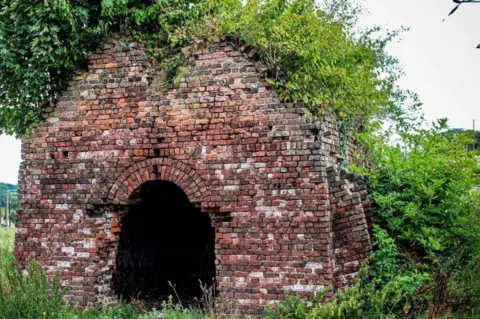 DJ Aerial Photography
The kiln was part of the wider Kepier Brick and Tile works, which was established around 1822 and was in use up until the 1880s.
The site was dismantled in the 1890s, leaving the kiln as the only surviving standing structure.
The planning statement included plans to create new 300mm-high footings and an interpretation board so the site could be "understood without recreating a dangerous structure".
The City of Durham Trust welcomed the proposed information board, but it warned it was not enough to offset the loss of the building.
A total of 30 objections were submitted against the retrospective application.
The council's planning department said the kiln was a "historic Victorian landmark that was a physical reminder of the area's industrial heritage, and a rare surviving structure integral to understanding local historic character".
"The justification provided is not supported by robust evidence, evidence that alternatives have been considered and discounted as not viable, and the submitted heritage recording is inadequate," it added.
