What was the 1970s oil crisis, and are we heading for something worse?

 James Pozarik/Liaison via Getty Images
The month-long closure of a crucial waterway for the global energy supply has sparked warnings the world is heading for problems worse than those caused by the 1970s oil crisis.
Lars Jensen, a shipping expert and former director at Maersk, told the BBC the impact of the US-Israeli war on Iran could be "substantially larger" than the economic chaos seen in the 1970s.
His comments follow a warning from the director of the International Energy Agency, Fatih Birol, earlier this month that the world is "facing the greatest global energy security threat in history".
"It is much bigger than what we had in the 1970s, the oil price shocks. It is also bigger than the natural gas price shock we have experienced after the Russia's invasion of Ukraine," he told the BBC.
But while the closure of the Strait of Hormuz is disruptive to global supplies, others argue the world today is more resilient.
What happened in the 1970s oil crisis?
The 1970s oil crisis was "fundamentally different" from today's, as the first oil shock back then was "the result of a deliberate policy decision", economist Dr Carol Nakhle, who is also the chief executive of Crystol Energy, told the BBC.
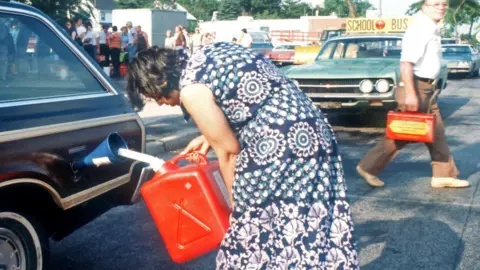
In October 1973, Arab oil producers placed an embargo on a group of countries led by the US over their support for Israel during the Yom Kippur war. That policy came alongside a co-ordinated cut to oil production.
"The result was a near quadrupling of oil prices within a few months," Nakhle said.
This led to fuel rationing in major oil-consuming countries, and Nakhle said it triggered a "global economic and financial crisis" with lasting implications.
Dr Tiarnán Heaney, a researcher at Queen's University Belfast, said high oil prices fuelled inflation across the board, "meaning businesses cut back further and unemployment soared".
"This had massive knock-on effects that damaged the social fabric of many countries with widespread strikes, unrest, and increases in poverty as many households struggled to make ends meet," he said.
Both the US and UK had recessions that lasted from 1973 to 1975, with the crisis contributing to the downfall of Ted Heath's Conservative government in 1974.
A second oil shock came in 1979, with the Iranian Revolution.
What is happening in the current oil crisis?
Since the US and Israel launched their war with Iran a month ago, the narrow Strait of Hormuz has effectively been shut to shipping traffic.
That has disrupted the flow of oil, gas and other essentials from the Gulf states, which normally export about a fifth of the world's oil.
US President Donald Trump has tried various tactics to get Gulf oil flowing again, including calling on allied nations to send warships as escorts, and threatening to hit Iran harder if it does not let ships pass safely through the strait.
But Jensen, who now runs the consultancy Vespucci Maritime, told the BBC's Today programme much of the oil that had left the Gulf more than a month ago was still arriving at refineries around the world, and that flow would soon stop.
"So the oil shortages we've been seeing, they're only going to get worse, even if magically the Strait of Hormuz would re-open tomorrow," he said.
"We will face massive energy costs, not just while this crisis goes on but also for six to 12 months after it's over."
Could the current crisis get worse than the 1970s shock?
Nakhle, who is also the secretary general of the Arab Energy Club, said the oil market is more diverse than in the 1970s, while the overall amount being used relative to the size of the global economy has also dropped significantly.
She believes that while current prices are high, today's crisis is not as severe.
"While the volumetric disruptions we are seeing are significant - arguably among the largest in recent history - the market is far more resilient than in the 1970s," she said.
"It is more diversified, less oil-intensive, and better equipped with buffers and emergency response mechanisms."
Heaney said there were some differences today that work in the world's favour, including better understanding of our economies and more countries holding oil reserves.
"The best-case scenario is to end this conflict as quickly as possible and restore some semblance of stability."
Alicia Garcia Herrero, chief economist for Asia Pacific at Natixis CIB, said while 1970s oil shocks sent prices sky high, they only cut global supply by 5-7%. In contrast, the current crisis affects 20% of the world's supplies, "dwarfing the 1970s shock", she said.
"Today's Iran war crisis can end up being a bigger shock if the situation does not improve soon," she said, adding it was also a crisis of gas supply and other refined products.
"The fallout of this is that we could experience sharper price spikes, broader inflation pain, and deeper recession risks, especially in import-heavy Asia," she continued.
"Reserves and efficiency offer some buffer which the episodes in the 1970s lacked, but the raw scale of lost supply makes this nastier, with no fast fix in sight."
