Nowak killer's first recorded confession revealed

 Hampshire Police
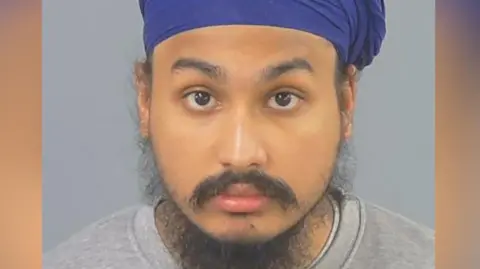
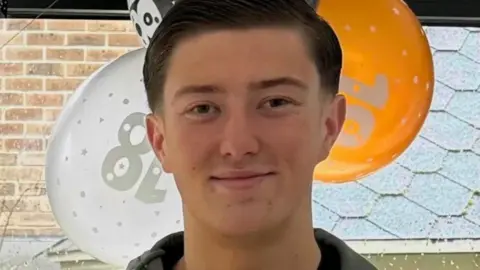
Within 36 hours of murdering Henry Nowak, Vickrum Digwa was recorded in the back of a police van admitting to his brother, Gurpreet, that he had stabbed the teenager multiple times.
The pair had been speaking in Punjabi as they were driven between a police station and a court for a custody extension hearing on 5 December 2025.
Digwa had previously lied to his family and police at the scene of the murder in Southampton, insisting he had been "racially attacked" and had only "pushed" and "punched" the student in self-defence.
Now, a transcript of the brothers' exchanges reveals details of Digwa's confession and shows they prayed to God to "save" them and their parents after all four were arrested.
The transcript is a Punjabi-to-English translation of the brothers' conversation and was referred to during Digwa's murder trial.
The extracts included in this report are drawn from that document, which the BBC requested and obtained from the Crown Prosecution Service.
 AFP via Getty Images
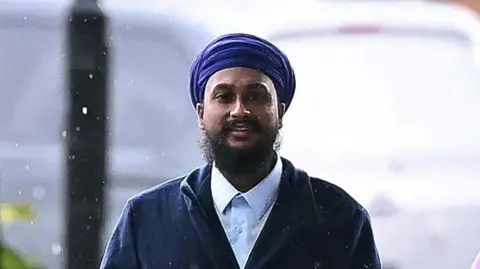
When Gurpreet Digwa asked his brother, Vickrum, "What did you do? Did you even do anything?", the transcript shows he pointed to his shoulder and said: "One here, towards the face and one on the chest."
Gurpreet, 27, told him: "You should not have done it." Digwa, 23, replied that it was his fault, or mistake.
At various points, Gurpreet told his brother he should have "just pushed" [Henry Nowak] or "hit him or beaten him up" instead.
"Why did you use the kirpan?" he asked.
Digwa replied: "I am a fool."
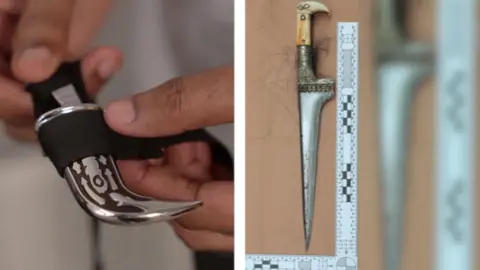
The use of the word "kirpan" to describe the 8in (21cm) murder weapon is disputed by many Sikhs, who say a kirpan is a small, usually curved ceremonial blade worn as an article of faith, symbolising a duty to uphold justice and protect others.
 BBC and Crown Prosecution Service
While practising Sikhs are legally permitted to carry a blade for religious reasons, any blade used in violence is treated as an offensive weapon.
Digwa had been wearing a small kirpan concealed around his neck, but used a second, much larger dagger to stab Henry Nowak.
He carried it in a cross-body sheath worn over his clothing, in keeping with a tradition associated with the Nihang warrior order, to which he belongs.
Sikh leaders have strongly condemned Digwa's actions and say his "false characterisation" of the murder weapon has contributed to a backlash against the community.
What the brothers said about murder weapon
While in the back of the police van, Gurpreet Digwa advised his brother on the word he should use to describe his knife.
Gurpreet: "Which Shastar did you use? (term – actual term used to refer to the religious or ceremonial weapon). Which weapon?"
Digwa: "Shura - knife."
Gurpreet: "You should have said Dui (your other one)."
They returned to the topic a number of times.
Gurpreet: "Say – Dorri (one that worn around the neck, the religious ceremonial small weapon)."
Digwa: "Will check with the solicitor."
Gurpreet: "What was written?"
Digwa: "Kirpan."
Gurpreet: "You should say that have used Kirpan."
Digwa: "I have said Kirpan too."
Gurpreet: "Doori [sic] is the Kirpan – means the kirpan. Speak with the solicitor first and then get doori written down or recorded.
"Maharaj protect/save all of us from here. Where have we ended up... Pray from the heart if you have not done anything wrong."
 Police handout
The suggestion that Digwa should claim he acted in "self-defence" surfaced several times and was repeatedly encouraged by Gurpreet, despite his brother admitting three times during the journey that he had stabbed Henry.
Gurpreet also suggested that Digwa should have run away.
When Digwa raised concerns about the possibility of CCTV near the scene, Gurpreet urged him to focus on prayer instead.
Digwa agreed that he would pray and recite bani, referring to the sacred hymns and teachings of the Sikh Gurus.
"Where have I ended up, Maharaj?" exclaimed Gurpreet, before appealing to Waheguru, the Sikh name for God, and beginning to pray.
He continued for approximately two-and-a-half minutes, ending with the words: "We have not done anything wrong God, please have mercy on us and protect us. Save all of us from here and get us home safely."
He then appealed for himself, his brother, and their parents to be blessed.
'It was my fault'
At the time of the conversation, the men's mother, Kiran Kaur, and father, Moga Singh, were also in police custody.
Gurpreet and his father were arrested minutes after Digwa, followed by Kiran Kaur about 90 minutes later.
The brothers discussed how their parents might be coping and how they would be affected if Digwa is convicted.
Digwa said: "Mum was making a lot of noise. It was my fault."
Kiran Kaur was convicted of assisting an offender after removing the murder weapon from the scene at Digwa's request. She is due to be sentenced later this month.
"You and the father, nothing will happen," Digwa said.
Neither Gurpreet nor his father faced charges in relation to the murder.
However, both Gurpreet and Vickrum Digwa and their father, Moga Singh, were charged with multiple weapons offences, dated the same day Henry Nowak was declared dead by medics.
All three have pleaded not guilty to possessing weapons, including machetes, knuckledusters, flick-knives and 37 swords, in a private place, at the family home in St Denys Road, Southampton.
Gurpreet Digwa has also pleaded not guilty to an additional four charges of possessing weapons in a public place, in a car in Belmont Road.
The three men are due to stand trial at Southampton Magistrates' Court in September 2027.
When the brothers' talked about their solicitors, Gurpreet warned Digwa to "listen to them" and not to "show off or try to act all hard".
"No I will not," agreed Digwa.
The transcript ends with the brothers trying to ensure their accounts of events matched, while admonishing each other over things they believed the other "should not have said" to police.
Previously released video of Henry Nowak in handcuffs caused national outrage and sparked violent disorder in Southampton, after Digwa was sentenced to life in prison for a minimum of 21 years.
At the hearing, Judge William Mousley KC told Digwa: "You abused the privilege extended to Sikhs to have a knife in a public place for religious reasons, dishonoured your religion and have now put others at risk of repercussions."
He added that his minimum jail term might have been shorter had he not repeatedly lied to police and instead told them "what you said to your brother in the police van" on 5 December.
Digwa is seeking to appeal against his conviction and sentence, while the Solicitor General, Ellie Reeves, has referred his sentence to the Court of Appeal to be reviewed under the Unduly Lenient Sentence scheme.
The BBC has not had access to the original police audio recording and has therefore been unable to independently verify the accuracy of the English translation.
Many of the brothers' words were marked as "indistinct" in the transcript, and the extracts included in this article are reproduced as they appear in that document.
